New signs alerting beach goers to the possible presence of wildlife are going up across the West Coast region.
Led by the West Coast Penguin Trust, this initiative has the support of every District Council and local Department of Conservation teams. The wording and design of the new signs were developed collaboratively, and Westland Milk Products generously stepped in to pay for them.
The new signs ask people to keep themselves and their dogs at least 20m away from wildlife, whether it be penguins, seals, sealions or other sea or shore birds such as banded dotterels and black-billed gulls. Many of these are threatened or at risk and their survival relies on minimising disturbance.
Sadly, DOC and penguin trust data collected over the past 14 years shows that dogs continue to be responsible for around 19% of the deaths of blue penguins reported across the region. These new signs are a friendly reminder to keep dogs under close control when walking at the beach during daylight hours, and on a lead from dusk to dawn and through vegetated dunes and coastal scrub.
Trust Manager, Inger Perkins, explained:
“When penguins have been killed by dogs, generally those dogs have been loose and often free to roam from home or out of sight and control of the owner. And it’s not just penguins that are at risk. Seals have been known to have been savaged by dogs and later had to be euthanized. But even the wasted energy required to escape disturbance by people or dogs could be the difference between survival and death for one of these creatures.”
Blue penguins are at the start of this year’s breeding season. They generally lay eggs around July – August and are raising chicks between September and December.
In a study of dog control in relation to wildlife on Dunedin’s beaches, it was found that it was critical to have consistency in the messaging, and not have a variety of signs from Trusts, Councils and DOC that could present conflicting information. If signage was confusing or conflicting, it was largely being ignored, so the group working on this new project from the West Coast Penguin Trust, Buller, Grey and Westland Councils and with various DOC biodiversity staff from Westport, Greymouth and Hokitika offices have been at pains to work together and come up with a consistent and shared message.


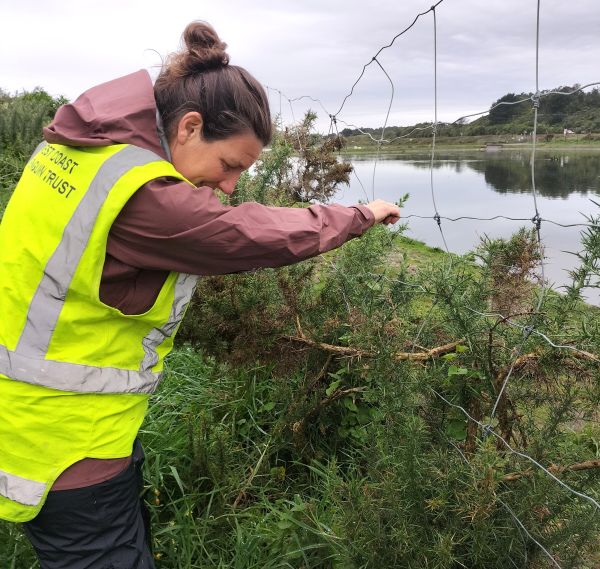
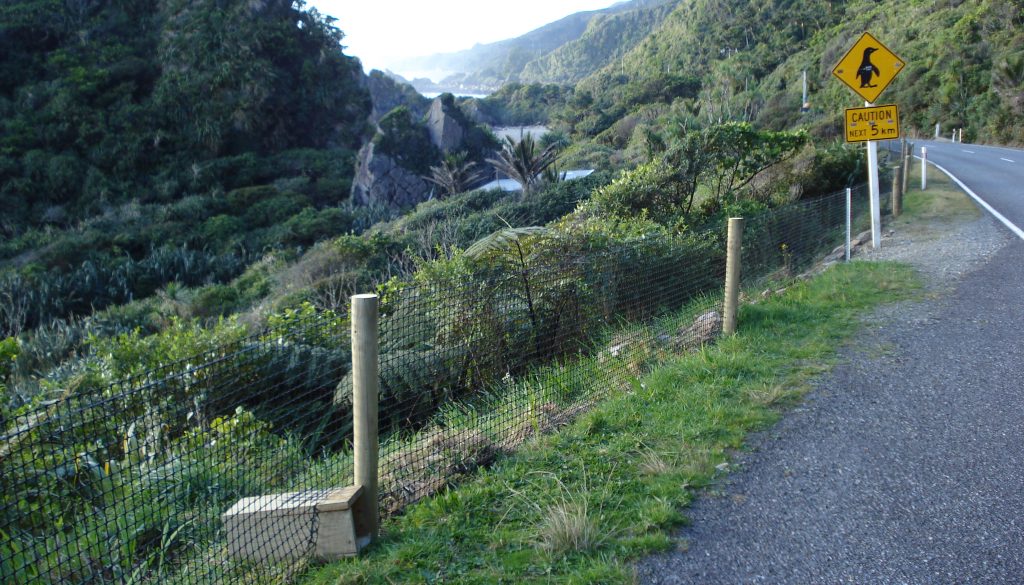 While materials were chosen that would stand up to the harsh coastal conditions, those same coastal conditions are conducive to plant growth! Occasional checks of the fences have been carried out by volunteers and rangers so that any maintenance needs can be identified and remedied. The never-ending need for maintenance is managing the vegetation that can grow through the fence, for example gorse, blackberry and hydrangea, pushing it to breaking point in places, or flop over causing damage from the weight of rank grass, rushes and weeds such as montbretia.
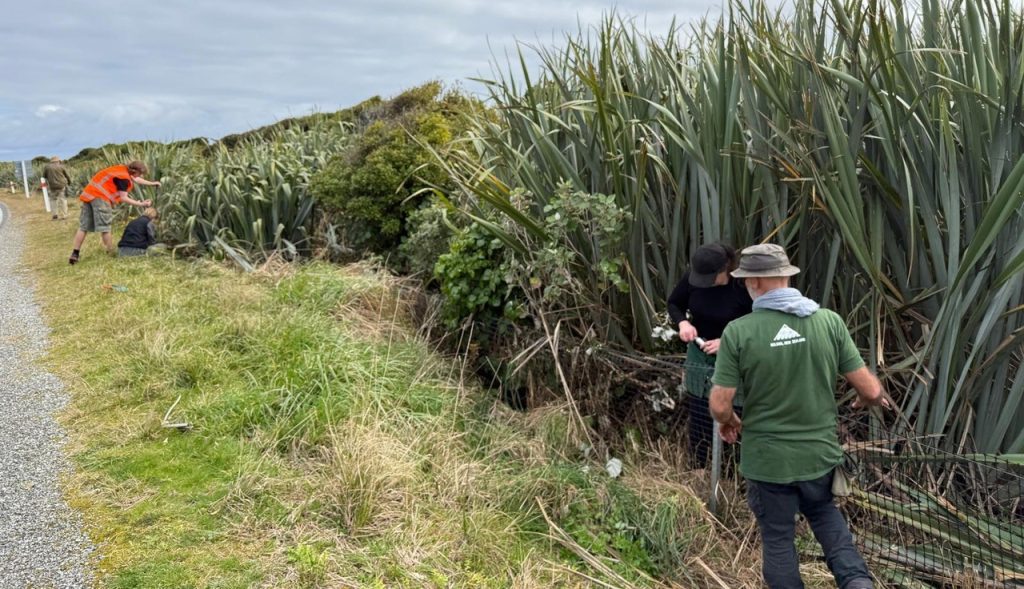
Volunteers recently spent a few hours tidying up the main fence along Woodpecker Bay north of Punakaiki so a big shout out to them - thank you Fiona, Jony, Reef, Katrina, Mandy, Marty, Teresa and Deb! Flax had been pressing down on the fence, but now the fence has been freed up by these wonderful volunteers - and they picked up a fair bit of rubbish too.
While materials were chosen that would stand up to the harsh coastal conditions, those same coastal conditions are conducive to plant growth! Occasional checks of the fences have been carried out by volunteers and rangers so that any maintenance needs can be identified and remedied. The never-ending need for maintenance is managing the vegetation that can grow through the fence, for example gorse, blackberry and hydrangea, pushing it to breaking point in places, or flop over causing damage from the weight of rank grass, rushes and weeds such as montbretia.
Volunteers recently spent a few hours tidying up the main fence along Woodpecker Bay north of Punakaiki so a big shout out to them - thank you Fiona, Jony, Reef, Katrina, Mandy, Marty, Teresa and Deb! Flax had been pressing down on the fence, but now the fence has been freed up by these wonderful volunteers - and they picked up a fair bit of rubbish too.
 Volunteer Natassja Savidge has offered to check and help maintain the Hokitika penguin protection fence and joined Ranger Lucy Waller and Manager Inger Perkins in May to inspect the length of the fence. Some minor issues were found but the main finding was the extent of the vegetation growth that was damaging the fence in places. Big thanks to Natassja!