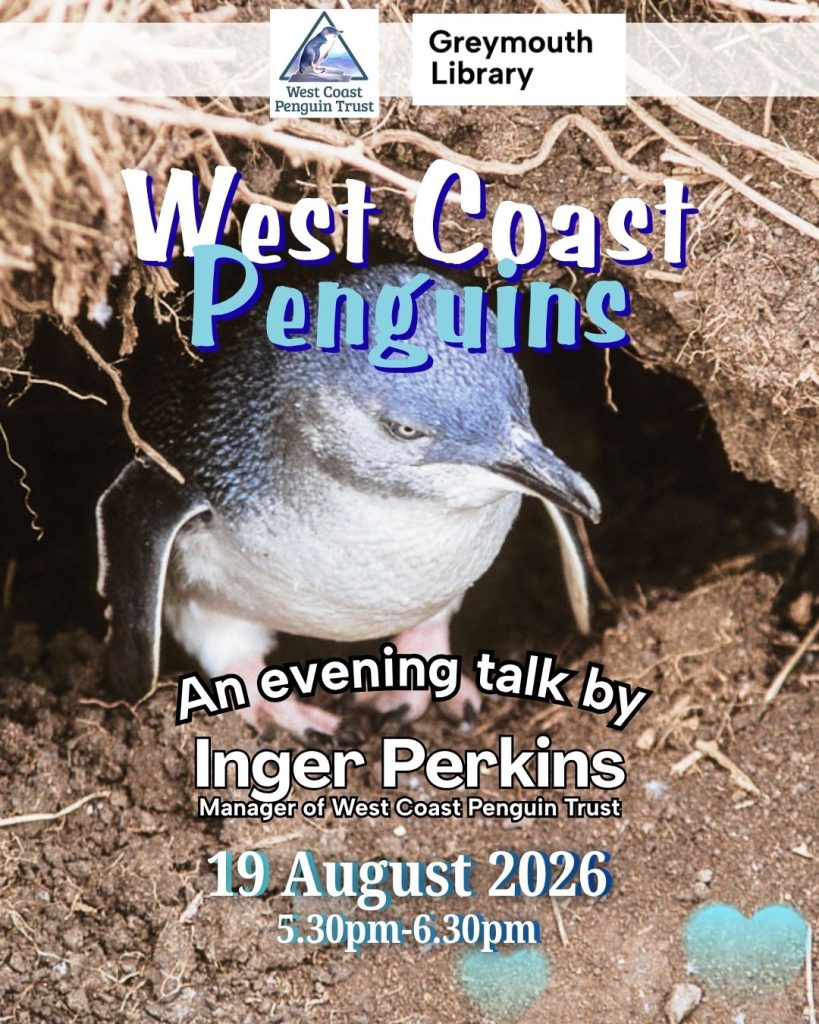
The Trust’s foraging study – tracking little penguins / kororā at sea – shifted from Charleston to Camerons for the 2023 season and the colony there was found more suitable for the regular breeding success monitoring and further developing our research programme.
Breeding success monitoring
Field work for the 2024 season started on 22 July at the Camerons colony, where most of the nest sites are in nest boxes and easier to monitor. Ranger Lucy Waller has found 61 potential nest sites in the general area, 21 of them being active this season. Interestingly, Lucy found that eggs were laid in 17 of these nests within the same three day period at the end of August. One pair laid two weeks earlier and first the chicks appeared to struggle and then sadly one adult was found dead in the nest. One of the chicks from that nest fledged at 11.5 weeks old and the other, apparently having been roughed up by the other, was slower and had to recover from lost chick down on his head, but we are pleased to report that the second chick fledged successfully at around 13 weeks old. Eggs were laid in the other three nests a few weeks later in mid-October.

The first chicks fledged in the second week of November. In another interesting observation, Lucy found that, in every nest, there was a dominant, larger chick throughout the growing process, which was then more likely to fledge first. She also noted a general trend of a more dominant partner and a more shy partner among the adult pairs.
Lucy noted: “A paper was written about ‘fat aggressive males being good breeders’ and from the angriest, most aggressive penguin we came across this season (the one that took the top of Thomas’ finger and my knuckle on one occasion), male and 1.5 kg, they were very successful breeders, with very fat, healthy, rapidly growing chicks.”
The paper entitled Correlations between body size, defensive behaviour and reproductive success in male Little Blue Penguins Eudyptula minor: implications for female choice was published in 2003 in the ornithological journal Ibis. It’s a fascinating study from The University of Waikato and available here. Authors Masamine Miyazaki & Joseph R. Waas wrote: “Our results show that, in Little Blue Penguins, large males bred earlier than smaller ones and that chicks of larger males grew more rapidly than those of smaller males. A female’s body size, however, did not affect her reproductive success. Large males also used higher-pitched aggressive calls and were more likely to vocalize in response to an intruder’s call, but only during the post-guard stage. This vocal information could be used by opponents as well as females to gauge male attributes.”
Back to our study colony and, in one nest, it appears that the penguins abandoned their eggs but they have had a second attempt at breeding.
We will have a full report and analysis of the season soon.
Microchipping for demography study
Microchipping of penguins at the Camerons colony also began this season and with help from fabulous volunteers Sharon, Maria and Grace, Lucy has microchipped 20 adults and 20 chicks. Microchips, also known as transponders or PIT tags, allow the trust to identify individual penguins. Lucy is trained to insert the microchip under the penguin’s skin while the penguin is carefully held by her field assistant. A wand reader can be used to obtain a unique code from the microchip each time the penguin is seen. Minimal handling is always best and the penguins are back in their nest in moments.

As data is collected from breeding and with an understanding of individual demographics thanks to the microchips, within the next 2-3 years we will be able to gain clarity with annual updates as to whether the population is growing or decreasing. We will also learn more about those larger and more assertive penguins.
Foraging study
The improved understanding of kororā described above will be supported by the foraging study, which this year has tracked kororā during the egg and then chick guard stages. The loggers record where penguins have been as well as frequency and depth of dives. The trust is very fortunate to have guidance from our scientist Dr Thomas Mattern and through him, Masters student Patrick Daugherty. In 2025, Patrick will be reviewing the foraging data with respect to marine conditions for our study and another community project based in New Plymouth. This is an area of work the trust has been hoping to undertake for a few years, linking an understanding of El Niño / La Niña conditions, sea surface temperatures and nutrients / chlorophyll to breeding success.
Read more about the foraging study here
Find out about a Te Nukuao Wellington Zoo volunteer working on this study here