Sooty Shearwaters / Titī
Although the population of sooty shearwaters is in the millions, they are in decline, surviving on islands, particularly around the southern South Island. A handful of ‘sooties’ nest on the mainland at Cape Foulwind and the Trust has been encouraging more to nest here and trying to protect those that do with trapping.
Over the past few years, numbers nesting at this site have increased, but the colony remains small and as yet no chicks have fledged. With more frequent monitoring and using trail cameras in the 2022 season, we learned that weka may be responsible for taking chicks immediately after hatching.
 These large black birds are consummate seabirds, flying up to 2000 km from home on foraging trips and have been recorded diving more than 60 m. They return to their nests around dusk, so simply standing on the Wall Island lookout of the Cape Foulwind Walkway should reward you with the sight of these birds during their breeding season, from November to around May.
They are usually silent at sea; most calls are given by birds at night on the breeding colonies, though occasional calls are given by birds flying over breeding colonies at night. The main call is a loud, rhythmically repeated slightly hysterical coo-roo-ah generally made by duetting birds from within burrows or on the surface.
Here’s a video of a noisy pair of ‘sooties’ at Cape Foulwind.
Little Penguins / Kororā
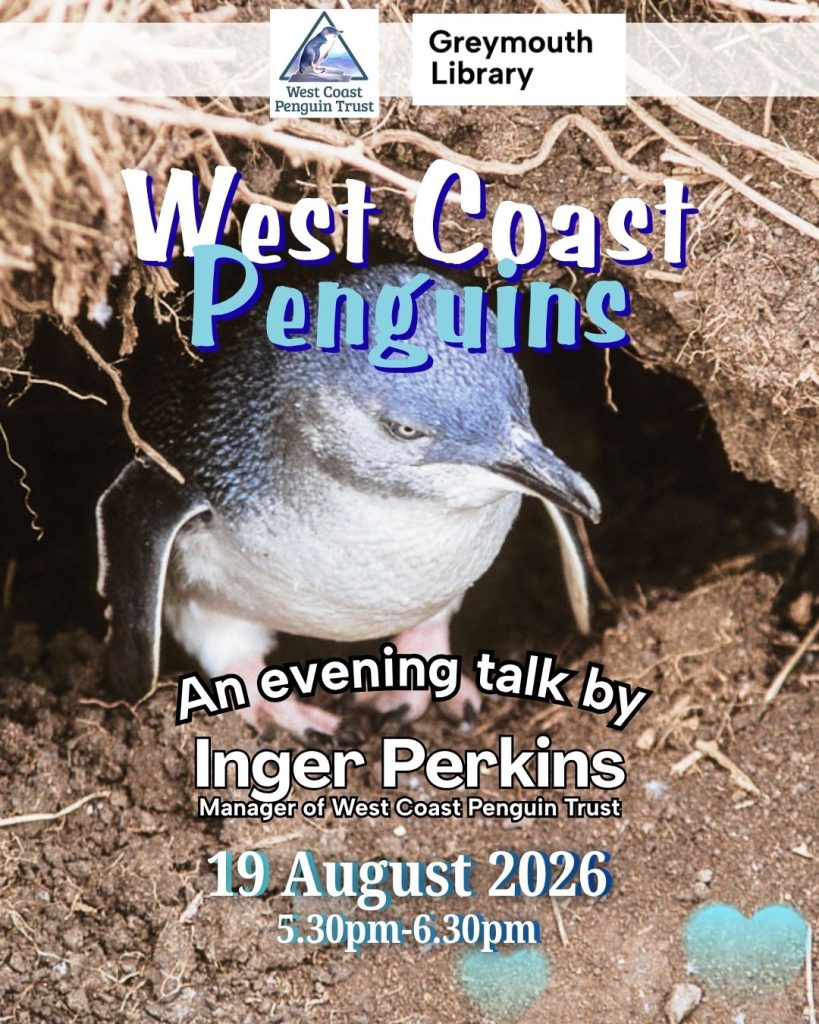
There are only a few blue penguins nesting at Cape Foulwind, despite the sound system mentioned above also being used to play calls to encourage them into this site. These sounds are played between June and August, as the breeding season gets underway.
In time, the Trust hopes to establish a small viewing opportunity, perhaps with a discrete nest cam.
Fairy Prions / Titī wainui
 Fairy prions are beautiful small petrels, also known as dove prions as they are pale grey blue in colour. Only 25cm long, they are very vulnerable to prolonged stormy weather, often succumbing and being washed up on west coast beaches in vast numbers.
The Trust discovered that Wall Island, the rocky island some 250m off shore from the Cape Foulwind seal colony, has more seabirds than any other island between Cook Strait and Stewart Island. Every scrap of soil on this rocky outcrop has been used for a seabird burrow, predominantly fairy prions.
The island is currently predator free, and the Trust maintains the trap line on the nearby coast to ensure it remains that way. We also check the island every couple of years or so to ensure that prions are surviving. Any presence of predators would mean that the prion population would crash.