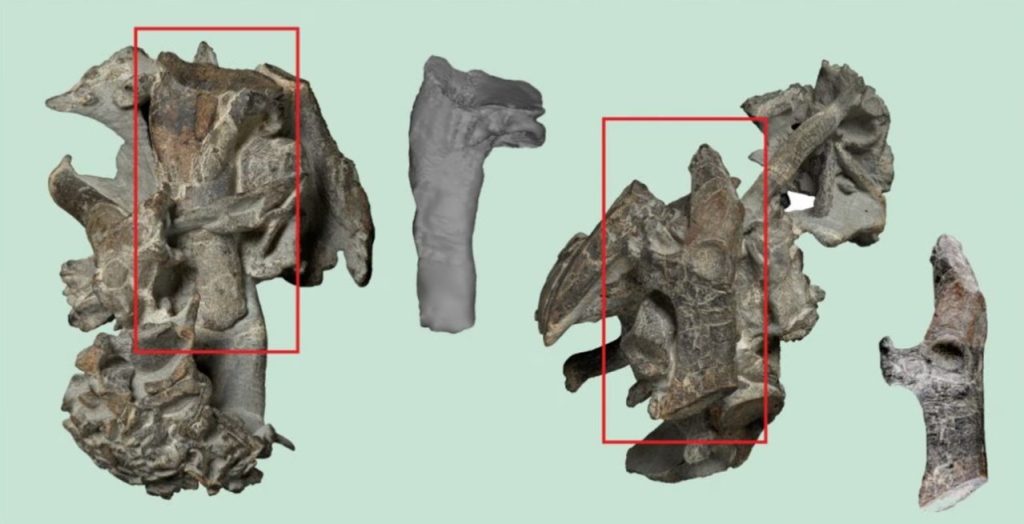
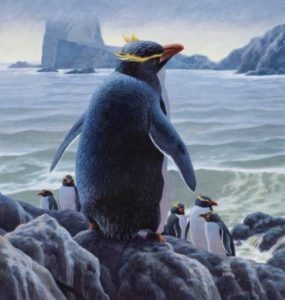
Every year New Zealand Post releases a coin commemorating one of Aotearoa’s extinct animals. This vivid coin recalls the recently discovered Chatham Island crested penguin, a unique species that existed on this remote archipelago until only a few hundred years ago.
Trust Scientist, Kerry-Jayne Wilson, reported that this penguin was named in honour of John Warham, once the world authority on crested penguins and her mentor when she was a student, and added that both the Chatham species were only discovered recently when ancient DNA could be extracted from sub-fossil bones.
Ms Wilson is currently working on a new seabird book and provided these fascinating extracts:
While many terrestrial and freshwater birds became extinct the only known extinctions of marine birds are Scarlett’s shearwater from the mainland, Inber’s Petrel, Warham’s Penguin and Richdale’s Penguin from the Chatham Islands (Worthy et al 2017, Cole et al 2019) and the Waitaha Penguin from the south east of the South Island (Boessenkool et al 2009). Other seabirds have survived the arrival of people and predators thanks to populations on islands that remained predator free despite the local losses of vast colonies of many species from the mainland and some islands. Hundreds of millions, perhaps billions of petrels nested on the North and South Island mainlands prior to the coming of people and predators; the pugnacious Westland Petrels, the alpine breeding Hutton’s Shearwaters and the tiny remnant colonies of Sooty Shearwaters, Grey-faced petrels and Fairy Prions are all that remain.
Prior to the arrival of people three other species or sub-species were endemic to New Zealand. The Waitaha Penguin occurred along the eastern coast of the South Island until hunted to extinction during the last 750 years. It was replaced by the closely related Yellow-eyed Penguin which colonised Southland and Otago from its Auckland and Campbell Islands homeland. Richdale’s Penguin, a sub-species of the Yellow-eyed, and Warham’s Penguin, a crested penguin, were both apparently restricted to the Chatham Islands (Cole et al 2019). They too became extinct, presumably through hunting after Polynesian settlement of those islands.
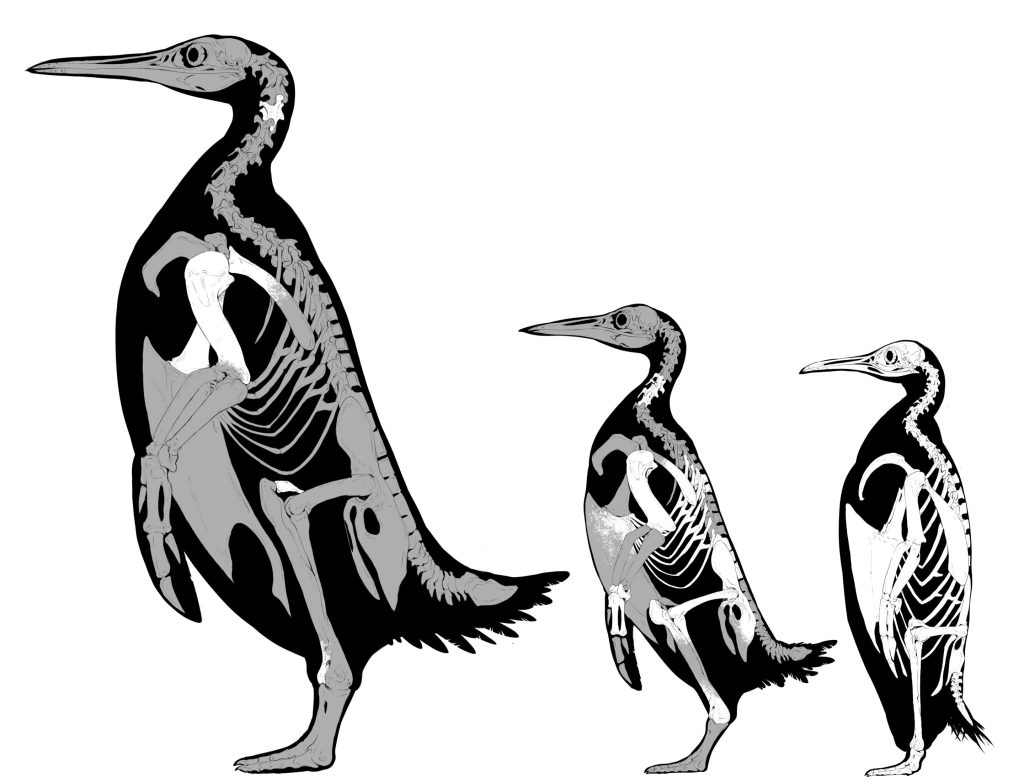
Click on the reconstruction below for a link to the NZbirdsonline entry for the Chatham Island Crested Penguin:
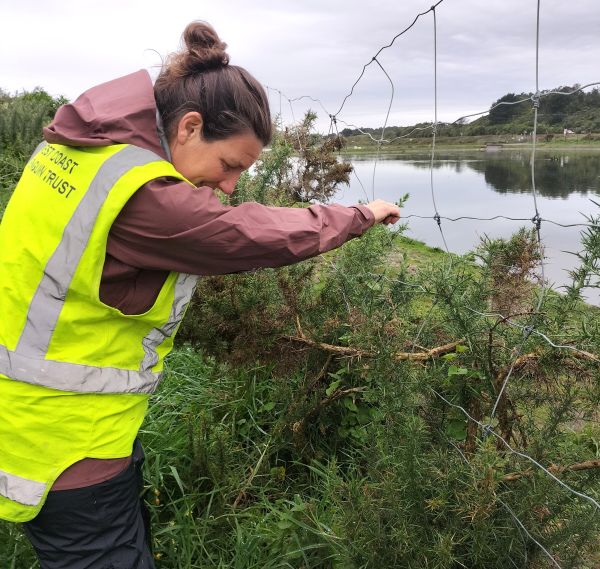
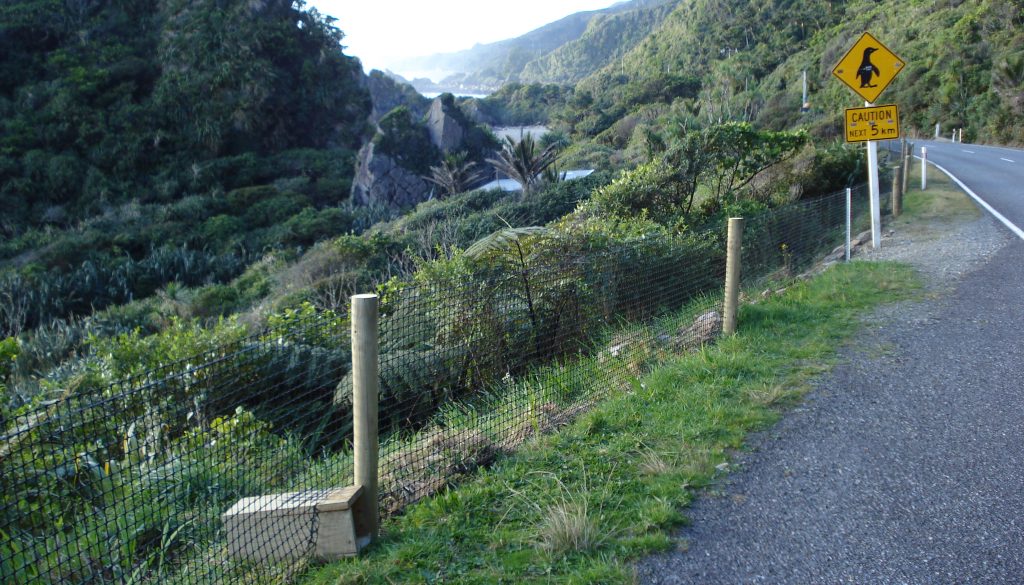 While materials were chosen that would stand up to the harsh coastal conditions, those same coastal conditions are conducive to plant growth! Occasional checks of the fences have been carried out by volunteers and rangers so that any maintenance needs can be identified and remedied. The never-ending need for maintenance is managing the vegetation that can grow through the fence, for example gorse, blackberry and hydrangea, pushing it to breaking point in places, or flop over causing damage from the weight of rank grass, rushes and weeds such as montbretia.
Volunteers recently spent a few hours tidying up the main fence along Woodpecker Bay north of Punakaiki so a big shout out to them - thank you Fiona, Jony, Reef, Katrina, Mandy, Marty, Teresa and Deb! Flax had been pressing down on the fence, but now the fence has been freed up by these wonderful volunteers - and they picked up a fair bit of rubbish too.
While materials were chosen that would stand up to the harsh coastal conditions, those same coastal conditions are conducive to plant growth! Occasional checks of the fences have been carried out by volunteers and rangers so that any maintenance needs can be identified and remedied. The never-ending need for maintenance is managing the vegetation that can grow through the fence, for example gorse, blackberry and hydrangea, pushing it to breaking point in places, or flop over causing damage from the weight of rank grass, rushes and weeds such as montbretia.
Volunteers recently spent a few hours tidying up the main fence along Woodpecker Bay north of Punakaiki so a big shout out to them - thank you Fiona, Jony, Reef, Katrina, Mandy, Marty, Teresa and Deb! Flax had been pressing down on the fence, but now the fence has been freed up by these wonderful volunteers - and they picked up a fair bit of rubbish too.
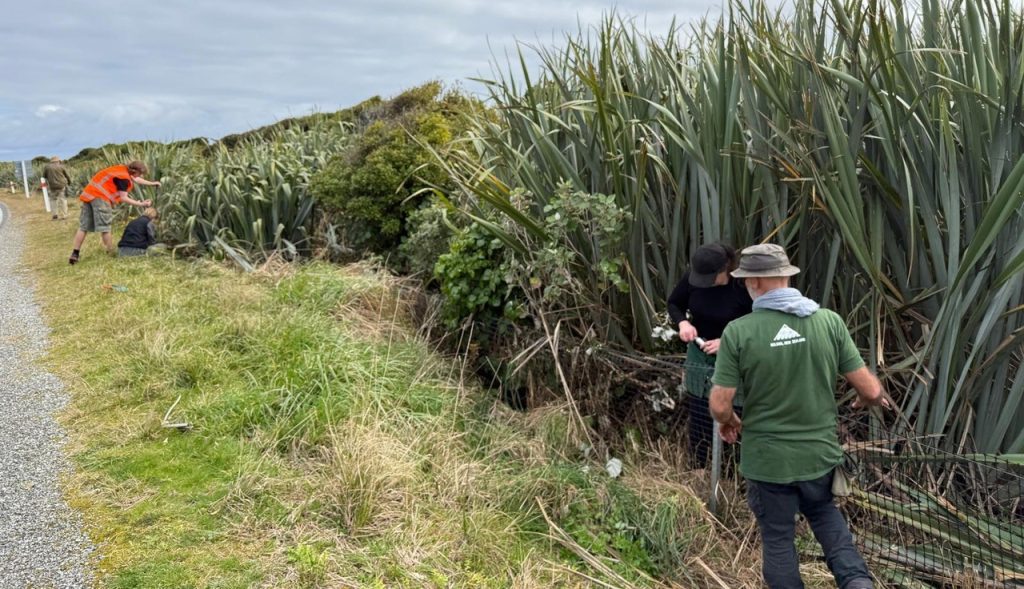 Volunteer Natassja Savidge has offered to check and help maintain the Hokitika penguin protection fence and joined Ranger Lucy Waller and Manager Inger Perkins in May to inspect the length of the fence. Some minor issues were found but the main finding was the extent of the vegetation growth that was damaging the fence in places. Big thanks to Natassja!