Trust Ranger, Matt Charteris, reports that 2020 was a good breeding year for blue penguins on the Buller Coast. Breeding data supports short foraging trips observed through gps tracking, suggesting that food was not a limiting factor for the 2020 season. Food appeared to be a problem in the 2019 season and lower breeding success was observed.
At localities where disturbance is expected to be present there was a corresponding lower breeding success than areas where disturbance is minimal.
The 2021 season is about to begin. Monitoring will continue, including further gps tracking, to continue our long term data set and our understanding of Buller blue penguins.
Charleston 2020 season results:
The Rahui and Knoll sites receive a monitoring visit every fortnight (mid July – mid January).
| Site | Monitored Breeding burrows | Eggs laid | Chicks hatched | Chicks fledged | Chicks per breeding attempt | Breeding success | Failed breeding attempts |
| Rahui | 27 | 54 | 52 | 46 | 1.70 | 85.2 | 1 |
| Knoll | 27 | 54 | 48 | 36 | 1.33 | 66.7 | 3 |
Other Buller sites 2020 season results:
The other monitored Buller sites receive 2 visits during the breeding season (egg period and late chick period). Not all breeding burrows are necessarily known at these sites and therefore not all breeding burrows are monitored.
| Site | Monitored breeding burrows | Eggs laid | Chicks seen | Breeding success | Failed breeding attempts |
| Foulwind | 4 | 8 | 5 | 62.5 | 0 |
| Whitehorse | 10 | 20 | 16 | 80.0 | 1 |
| Bullock Creek | 3 | 6 | 6 | 100 | 0 |
| Punakaiki River | 2 | 4 | 4 | 100 | 0 |


And if you’re wondering what that red thing is as our featured image, it is the screen our rangers use when they use a burrowscope for monitoring penguin nests. A 2m cable with a camera at one end and a viewer – the red box, at the other. It’s not always easy to interpret what they see.
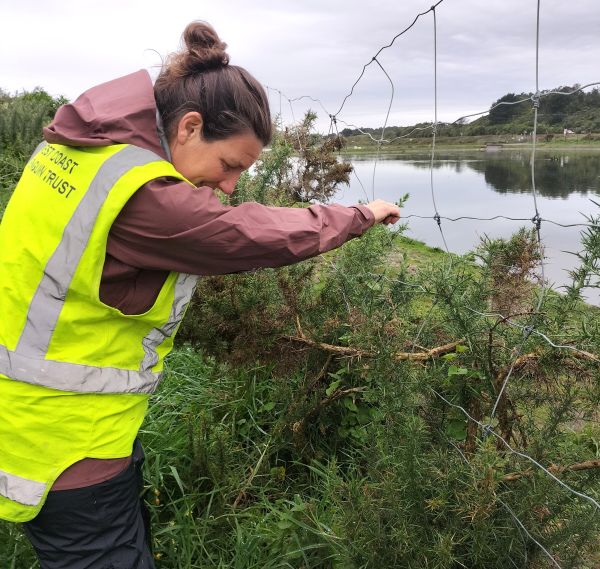
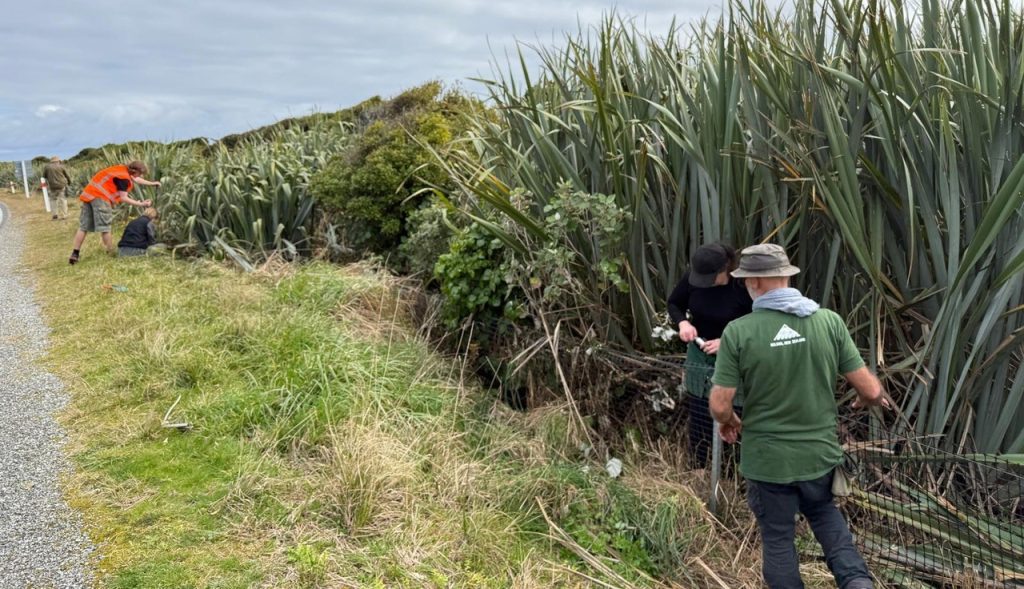
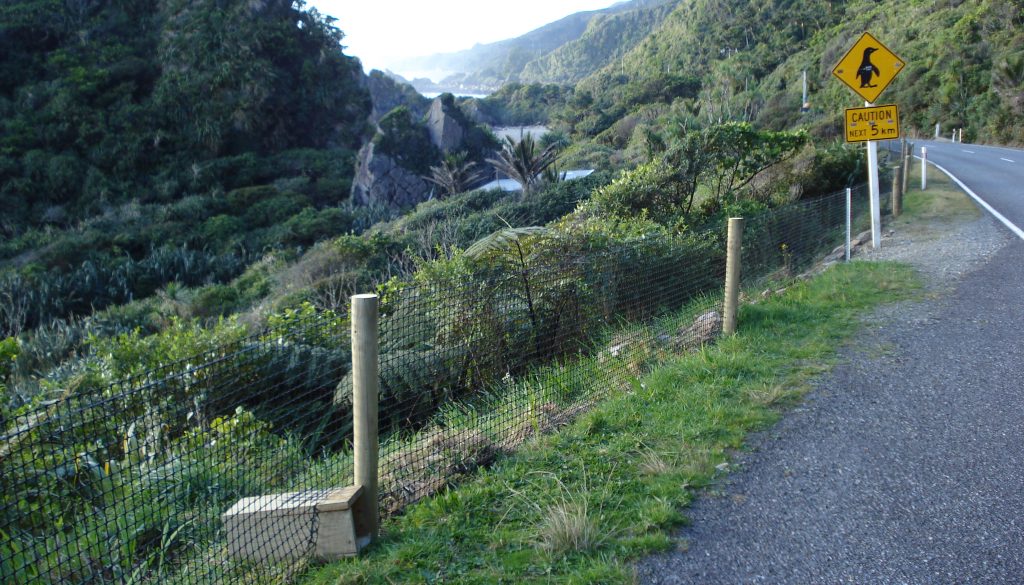 While materials were chosen that would stand up to the harsh coastal conditions, those same coastal conditions are conducive to plant growth! Occasional checks of the fences have been carried out by volunteers and rangers so that any maintenance needs can be identified and remedied. The never-ending need for maintenance is managing the vegetation that can grow through the fence, for example gorse, blackberry and hydrangea, pushing it to breaking point in places, or flop over causing damage from the weight of rank grass, rushes and weeds such as montbretia.
Volunteers recently spent a few hours tidying up the main fence along Woodpecker Bay north of Punakaiki so a big shout out to them - thank you Fiona, Jony, Reef, Katrina, Mandy, Marty, Teresa and Deb! Flax had been pressing down on the fence, but now the fence has been freed up by these wonderful volunteers - and they picked up a fair bit of rubbish too.
While materials were chosen that would stand up to the harsh coastal conditions, those same coastal conditions are conducive to plant growth! Occasional checks of the fences have been carried out by volunteers and rangers so that any maintenance needs can be identified and remedied. The never-ending need for maintenance is managing the vegetation that can grow through the fence, for example gorse, blackberry and hydrangea, pushing it to breaking point in places, or flop over causing damage from the weight of rank grass, rushes and weeds such as montbretia.
Volunteers recently spent a few hours tidying up the main fence along Woodpecker Bay north of Punakaiki so a big shout out to them - thank you Fiona, Jony, Reef, Katrina, Mandy, Marty, Teresa and Deb! Flax had been pressing down on the fence, but now the fence has been freed up by these wonderful volunteers - and they picked up a fair bit of rubbish too.
 Volunteer Natassja Savidge has offered to check and help maintain the Hokitika penguin protection fence and joined Ranger Lucy Waller and Manager Inger Perkins in May to inspect the length of the fence. Some minor issues were found but the main finding was the extent of the vegetation growth that was damaging the fence in places. Big thanks to Natassja!