The following post contains images that may be disturbing.
Sadly, the reduced traffic on our roads did not save this blue penguin from a fatal impact with a vehicle.
The penguin was found beside the Coast Road and delivered to West Coast Vets in Greymouth. Through the Trust’s education programme, vet Marjan Sprock led dissection classes for senior biology students at John Paul II High School last year and kindly offered to do a post mortem on this penguin. For those of us not used to seeing the inside of once living being, the images are gruesome but Marjan’s notes and the images tell a powerful story.
Although there was barely a mark on the penguin, the massive internal injuries are the result of an impact with a vehicle. This is a reminder to everyone who cares about our penguins and wildlife to drive a bit slower after dark on coast roads. Penguins could be crossing at any time under cover of darkness. If you drive a little slower, you might have a fraction more time and be able to safely avoid hitting a penguin. Please pass on this important message.
Here is Marjan’s report.
- On the outside there were no lesions or wounds, so a dog attack is very unlikely.
- There was no fat under the skin, but the muscles on the breast bone were still well developed. [i.e. it was not starving]
- Under the skin there were already signs of a bleeding present.
- When opened further, the abdomen and its organs on the penguin’s left side were ruptured.
- Its left side of the pelvis and lower spine were severely broken, with the head of the femur out of the pelvis socket.
- The right hand side of the abdomen contained lots of blood.
- It was a male penguin.
- Due to the pressure build-up in the abdomen of the supposedly “hit by a car” accident, 1 cm of the inside of the cloaca was pushed outside the rectum. [A cloaca is the intestinal, genital, and urinary tract combined together in one unit in animal anatomy.]
While writing this news item, we heard that another blue penguin has been killed, this time on the coastal cycle trail in the Greymouth area, and this time most likely by a dog. So two lessons from these sad events – please:
- Drive a little more slowly at night on coast roads
- Keep dogs on leads in coastal vegetation areas including paths and trails.
- Share these messages.
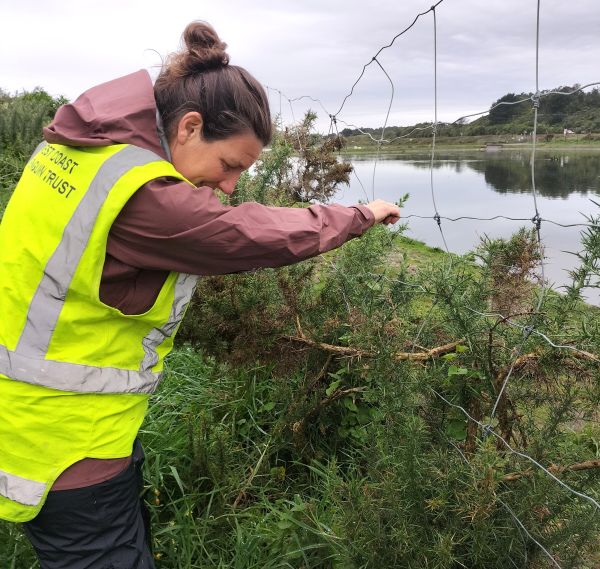
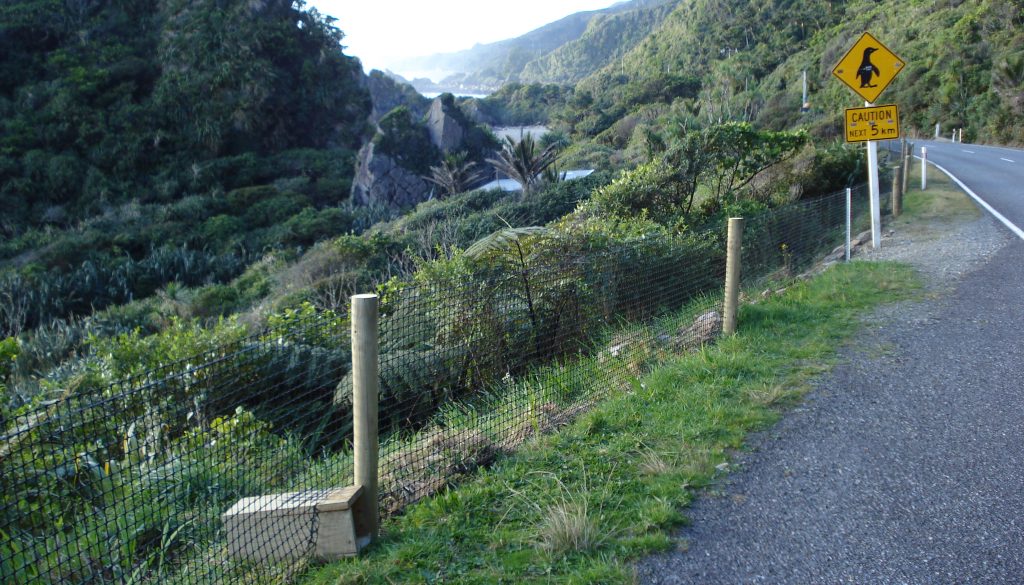 While materials were chosen that would stand up to the harsh coastal conditions, those same coastal conditions are conducive to plant growth! Occasional checks of the fences have been carried out by volunteers and rangers so that any maintenance needs can be identified and remedied. The never-ending need for maintenance is managing the vegetation that can grow through the fence, for example gorse, blackberry and hydrangea, pushing it to breaking point in places, or flop over causing damage from the weight of rank grass, rushes and weeds such as montbretia.
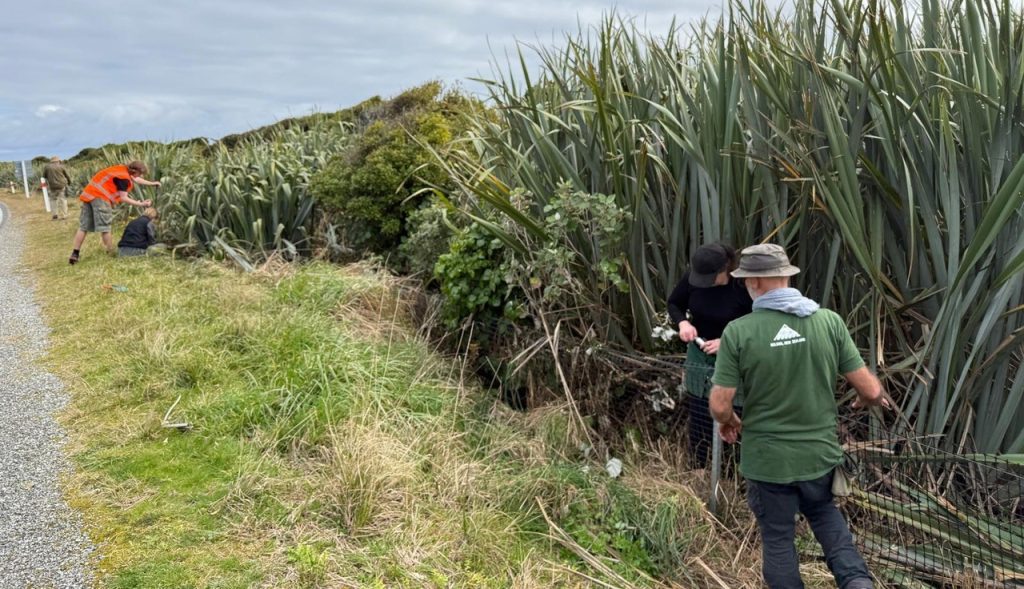
Volunteers recently spent a few hours tidying up the main fence along Woodpecker Bay north of Punakaiki so a big shout out to them - thank you Fiona, Jony, Reef, Katrina, Mandy, Marty, Teresa and Deb! Flax had been pressing down on the fence, but now the fence has been freed up by these wonderful volunteers - and they picked up a fair bit of rubbish too.
While materials were chosen that would stand up to the harsh coastal conditions, those same coastal conditions are conducive to plant growth! Occasional checks of the fences have been carried out by volunteers and rangers so that any maintenance needs can be identified and remedied. The never-ending need for maintenance is managing the vegetation that can grow through the fence, for example gorse, blackberry and hydrangea, pushing it to breaking point in places, or flop over causing damage from the weight of rank grass, rushes and weeds such as montbretia.
Volunteers recently spent a few hours tidying up the main fence along Woodpecker Bay north of Punakaiki so a big shout out to them - thank you Fiona, Jony, Reef, Katrina, Mandy, Marty, Teresa and Deb! Flax had been pressing down on the fence, but now the fence has been freed up by these wonderful volunteers - and they picked up a fair bit of rubbish too.
 Volunteer Natassja Savidge has offered to check and help maintain the Hokitika penguin protection fence and joined Ranger Lucy Waller and Manager Inger Perkins in May to inspect the length of the fence. Some minor issues were found but the main finding was the extent of the vegetation growth that was damaging the fence in places. Big thanks to Natassja!