Don’t get caught up in Christmas sales, you can help penguins instead!
Friday 29th November is Black Friday but you can donate here.

Don’t get caught up in Christmas sales, you can help penguins instead!
Friday 29th November is Black Friday but you can donate here.
New penguin encounter centre opened 17th October 2025
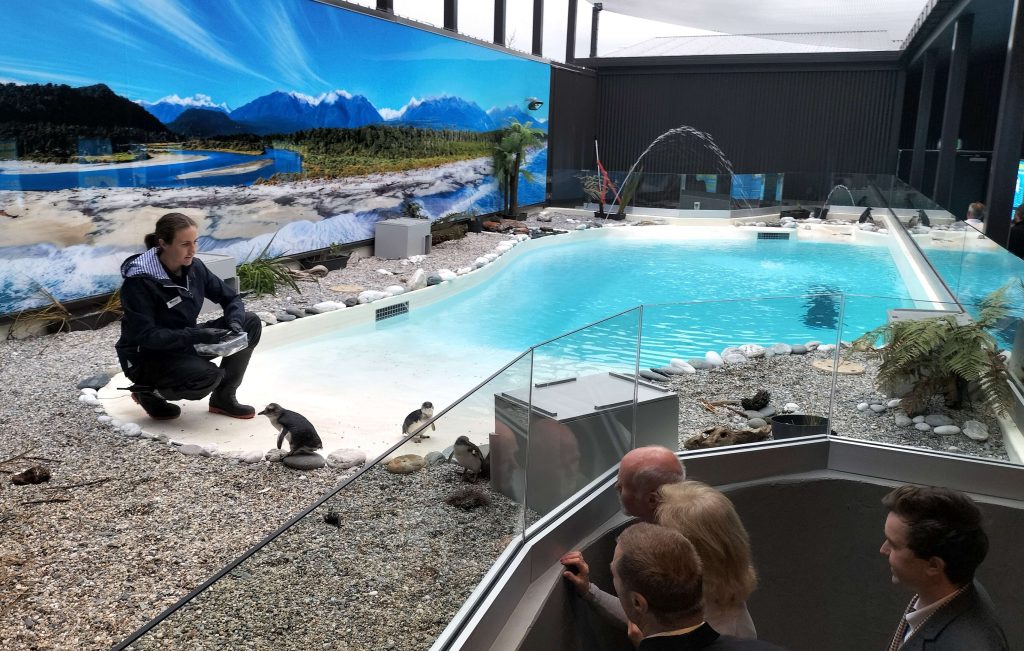
5 November 2025 An exciting new opportunity to meet little penguins / kororā - Ambassador Kororā Encounter - opened at the West Coast Wildlife Centre in Franz Josef last month. The West Coast Penguin Trust has been privileged to be connected to the ideas and plans for a penguin encounter opportunity here for a few years and were honoured to be at the official opening. We're delighted that our work is featured on a couple of panels at the new addition to the Wildlife Centre, a fixed panel and another that scrolls through some photos. Visitors are invited to make a donation for community conservation of penguins, kiwi and tuatara - the three species on display at the centre, promoting conservation of their relatives in the wild. Every year, donations will be shared between our trust and others working with kiwi and tuatara. The 'ambassador' penguins are birds that would not have survived in the wild, generally due to injury. Here, they can live out their lives in comfort and be ambassadors for their species. The event was opened by Paul Madgwick and other members of Te Rūnanga o Makaawhio with a Pōwhiri, followed by a speech by centre owner, Richard Benton, who, together with his wife Sherilee, have developed this wonderful new centre, benefitting penguins and the region. DOC Director Owen Kilgour added more conservation focus and noted the value of the work Richard and the West Coast Wildlife Centre have done for rowi and Haast tokoeka kiwi for many years and the strong partnership with DOC, welcoming the additions of penguins. Development West Coast CE, Heath Milne, welcomed the significant investment in tourism on the West Coast while giving conservation a priority, focus and stronger profile. And West Coast - Tasman MP, Maureen Pugh, had the honour of welcoming the new attraction and then cutting the ribbon with Richard. She also emphasised the importance of conservation - of our native species and their habitat, which was great to hear. Here's a news story about the ambassador penguins: https://www.facebook.com/reel/654336360889403 And photos below are from the opening event, including speeches, ribbon cutting, our panels, the donation panel, the opening event plaque, the penguins of course, and even ice penguin sculptures to add to the occasion. In place of red carpet, there was blue carpet, and the staff wore blue bow ties. The blue of little blue penguin was celebrated everywhere! Put a visit to the ambassador penguins and their wonderful new home on the to do list, for you, and your family and friends! https://wildkiwi.co.nz/the-attraction/penguinChecks and repairs of the fences have been carried out by volunteers and rangers
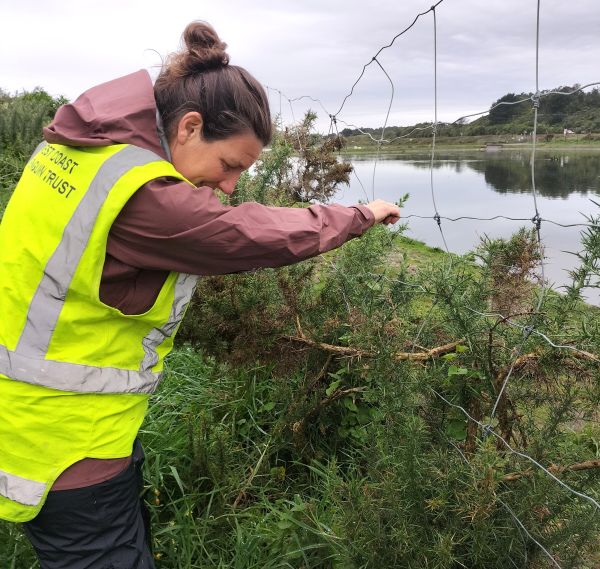
September 2025 The first trial penguin protection fence was installed just south of Punakaiki in 2013 and the main one for the Coast Road was constructed north of Punakaiki in 2014. A smaller one was added near Seal Island in 2015, the newest penguin protection fence was installed on the northern outskirts of Hokitika in 2021 and two new sections were added north of Punakaiki in 2023 and 2024.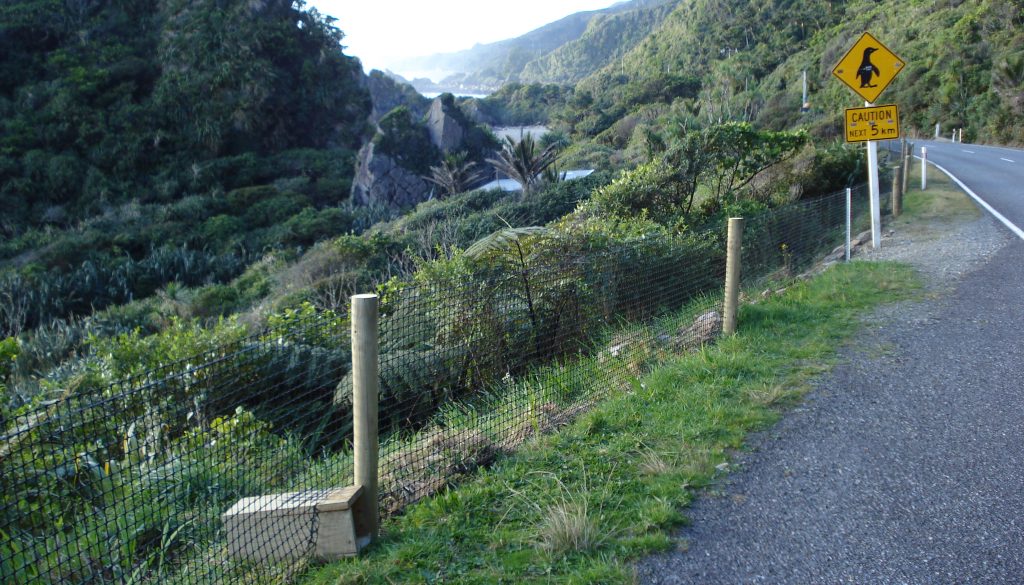 While materials were chosen that would stand up to the harsh coastal conditions, those same coastal conditions are conducive to plant growth! Occasional checks of the fences have been carried out by volunteers and rangers so that any maintenance needs can be identified and remedied. The never-ending need for maintenance is managing the vegetation that can grow through the fence, for example gorse, blackberry and hydrangea, pushing it to breaking point in places, or flop over causing damage from the weight of rank grass, rushes and weeds such as montbretia.
Volunteers recently spent a few hours tidying up the main fence along Woodpecker Bay north of Punakaiki so a big shout out to them - thank you Fiona, Jony, Reef, Katrina, Mandy, Marty, Teresa and Deb! Flax had been pressing down on the fence, but now the fence has been freed up by these wonderful volunteers - and they picked up a fair bit of rubbish too.
While materials were chosen that would stand up to the harsh coastal conditions, those same coastal conditions are conducive to plant growth! Occasional checks of the fences have been carried out by volunteers and rangers so that any maintenance needs can be identified and remedied. The never-ending need for maintenance is managing the vegetation that can grow through the fence, for example gorse, blackberry and hydrangea, pushing it to breaking point in places, or flop over causing damage from the weight of rank grass, rushes and weeds such as montbretia.
Volunteers recently spent a few hours tidying up the main fence along Woodpecker Bay north of Punakaiki so a big shout out to them - thank you Fiona, Jony, Reef, Katrina, Mandy, Marty, Teresa and Deb! Flax had been pressing down on the fence, but now the fence has been freed up by these wonderful volunteers - and they picked up a fair bit of rubbish too.
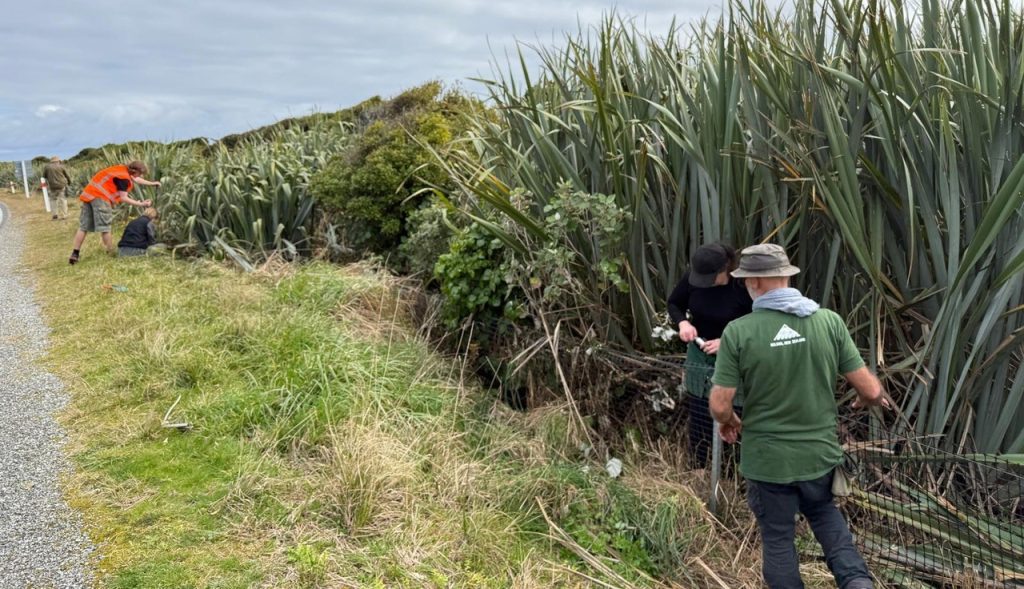 Volunteer Natassja Savidge has offered to check and help maintain the Hokitika penguin protection fence and joined Ranger Lucy Waller and Manager Inger Perkins in May to inspect the length of the fence. Some minor issues were found but the main finding was the extent of the vegetation growth that was damaging the fence in places. Big thanks to Natassja!
West Coast New Zealand penguin fossil discoveries tell us about penguin evolution
Penguin fossils have been popping up in the news in recent years so it was interesting to discover that they are also being found on the West Coast recently.
First, a bit of background. New Zealand boasts the world's richest record of penguin fossils. They reveal that ancient penguins were diverse in size, reaching sizes much larger than today's penguins. Those early giants show that large body size was present at the dawn of penguin evolution, with some fossils dating back 60-62 million years. The fossils have also provided insights into the rapid evolution of early penguins' limb or wing shape. A couple of years ago, we reported on a new penguin fossil where the species had been named after our late Chair and Scientist, Kerry-Jane Wilson MNZM (read it here).

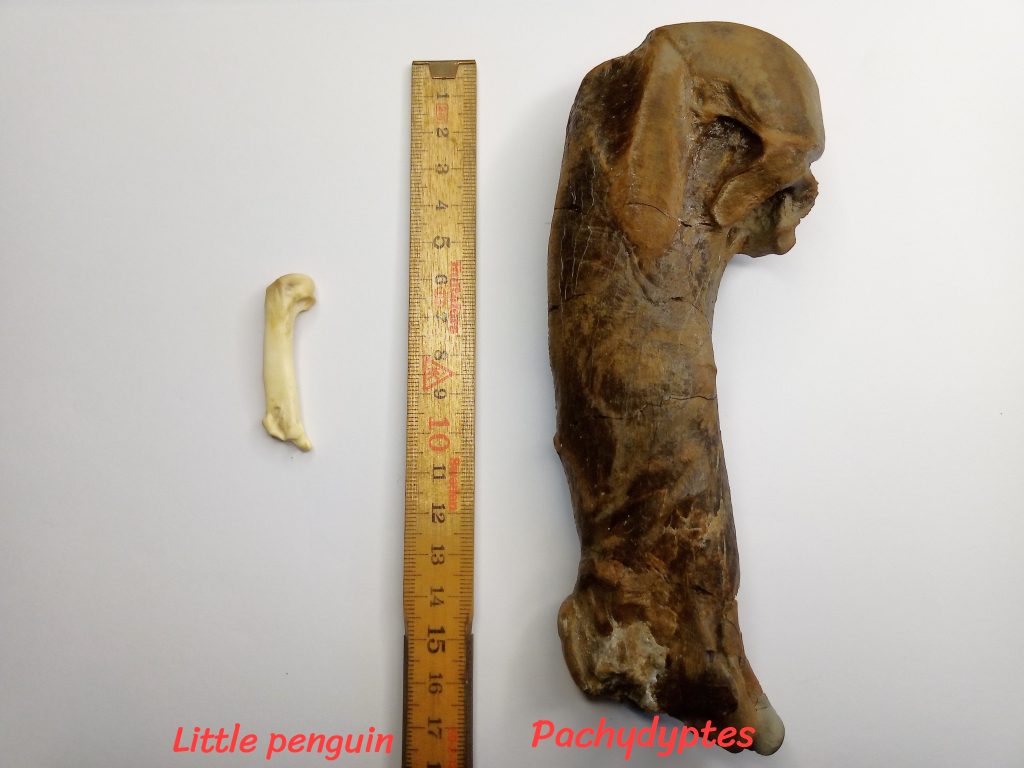
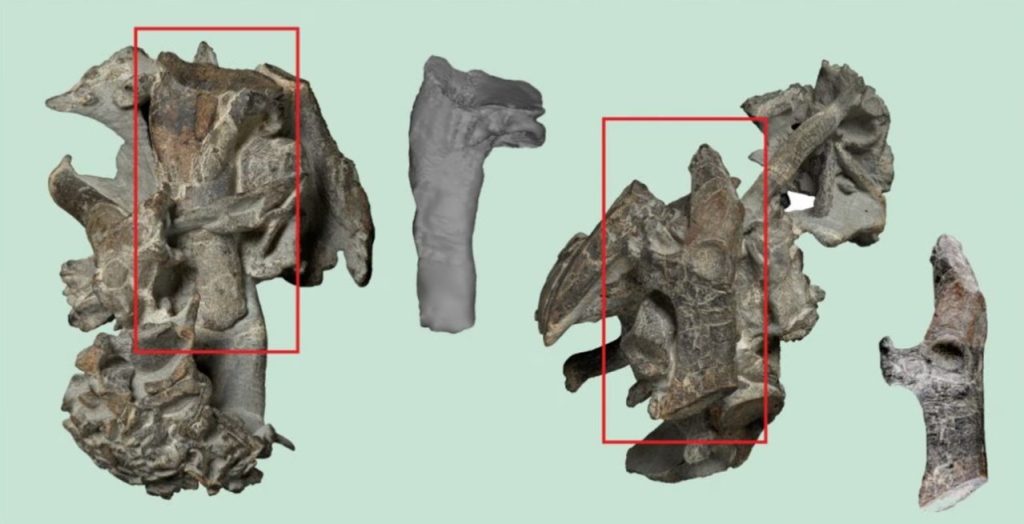
A couple of months ago, trust manager, Inger Perkins, and trust tawaki ranger, Catherine Stewart, were giving talks at the Westland District Library in Hokitika and were approached by a chap with a small suitcase. It turned out that, inside the case, Harry Jensen had the carefully prepared and packed fossil bones of a penguin's wing or flipper. The flipper fossil was much larger than that of a little penguin or kororā. In the case there are also two smaller as yet unidentified wing bones from two species of miocene-aged penguin found near Cape Foulwind, 11-9 million years old (Ma). He kindly accepted our invitation to speak for a few minutes at the end of the scheduled presentations explaining the hundreds of hours that goes into paring back the rock in which the fossils were found, often in large cobbles or small boulders.
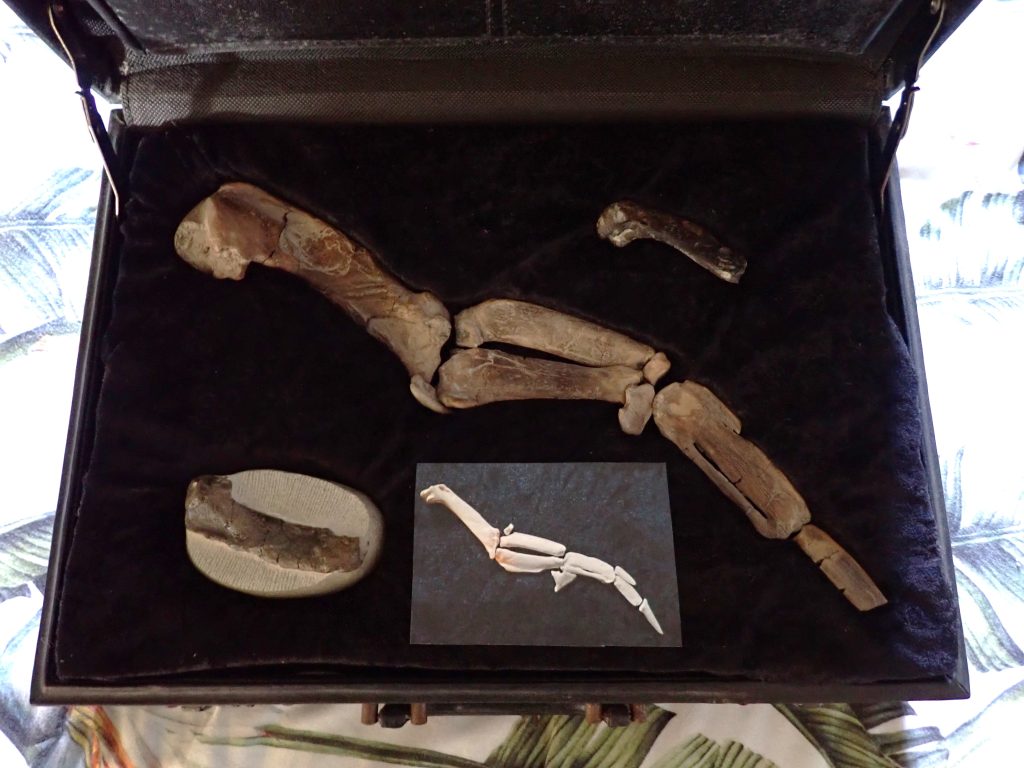
This fascinating and time-consuming hobby is contributing to the world's knowledge of earlier penguins and their distribution and evolution.
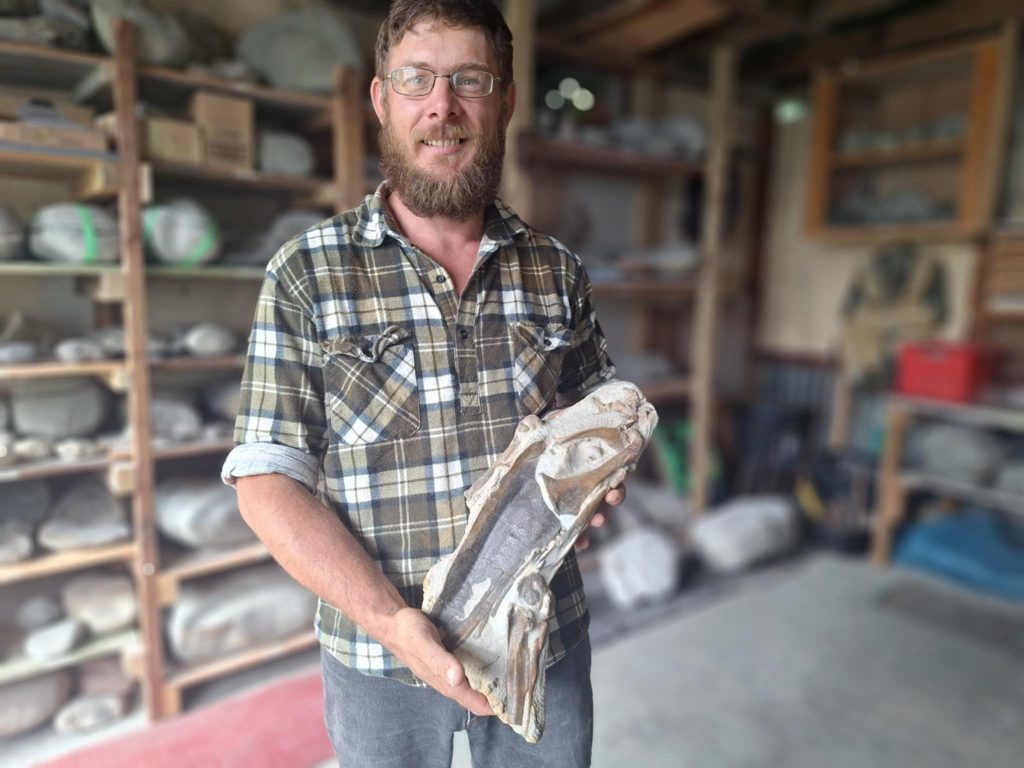
Harry explained about another fossil he has found near Rapahoe:
* Holotype: a single type specimen upon which the description and name of a new species is based."The flipper fossil is from a penguin related to the Pachydyptes ponderosus, and is around 32-34 million years old, from the late Eocene. Pachydyptes is estimated to have been around 1.4 metres tall and weighing in at just under a hundred kilograms, the former heavyweight of the penguin world. Recent examination shows this is likely to be a new to science species, as there are certain differences between this specimen and the original Pachydyptes holotype*."
Authoritiy on penguins at Otago University and now Otago Museum, Marcus Richards, (former Department of Geology Paleontology Curator and now Collections Technician at the museum) has been collaborating with Harry, as has Alan Tennyson, Curator of Vertebrates at the Museum of New Zealand Te Papa Tongarewa. Alan Tennyson is a world expert on New Zealand's fossil penguins.
It seems that penguin fossils are not new on the West Coast. The first were found in 1869 in Woodpecker Bay, north of Punakaiki. There is a short note about this find on Te Ara here, including sketches of the fossilised penguin bones along with an outline of the equivalent bone of a Fiordland crested penguin or tawaki. The comparison shows how much bigger the ancient penguin was, perhaps twice as tall as the tawaki, which are 60cm tall.
Between Harry and his collaborators, at least six different types of fossil penguins have been identified from the West Coast.
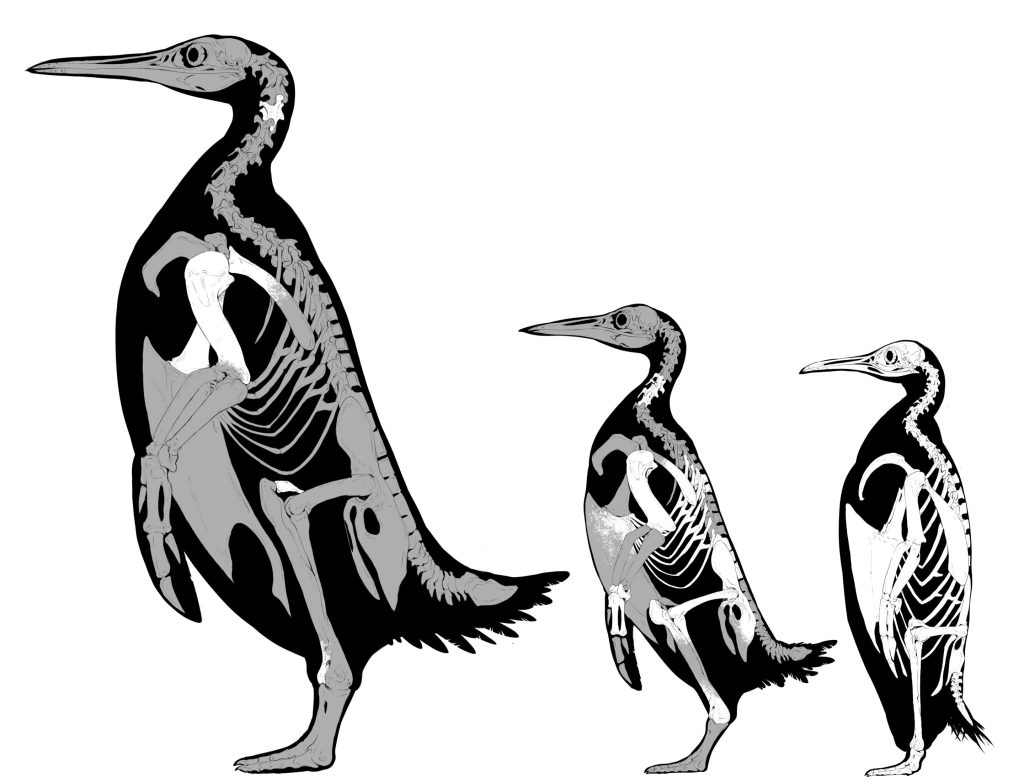
The Kumimanu fossil penguin, found in North Otago, proves that some of the earliest penguins were much larger than even the emperor penguin today. The University of Otago has been leading this work and you can find some information about their work here. It seems that Kumimanu fordycei was the largest fossil penguin every discovered, estimated to weigh in at a huge 154kg! Another newly described species is Petradyptes stonehousei, which would haveweighed 50kg. When compared to our current West Coast penguins, they are colossal. Tawaki are around 4kg and kororā just 1kg.








“Building an intergenerational business for New Zealand”
We are committed to becoming a world leader in critical minerals that advance the shift toward a sustainable future. As we work towards achieving this, we will build a resilient business that benefits our company, the West Coast, and New Zealand for generations to come.