During the update of our education resource, this question, often put to us by children, came up to be answered.
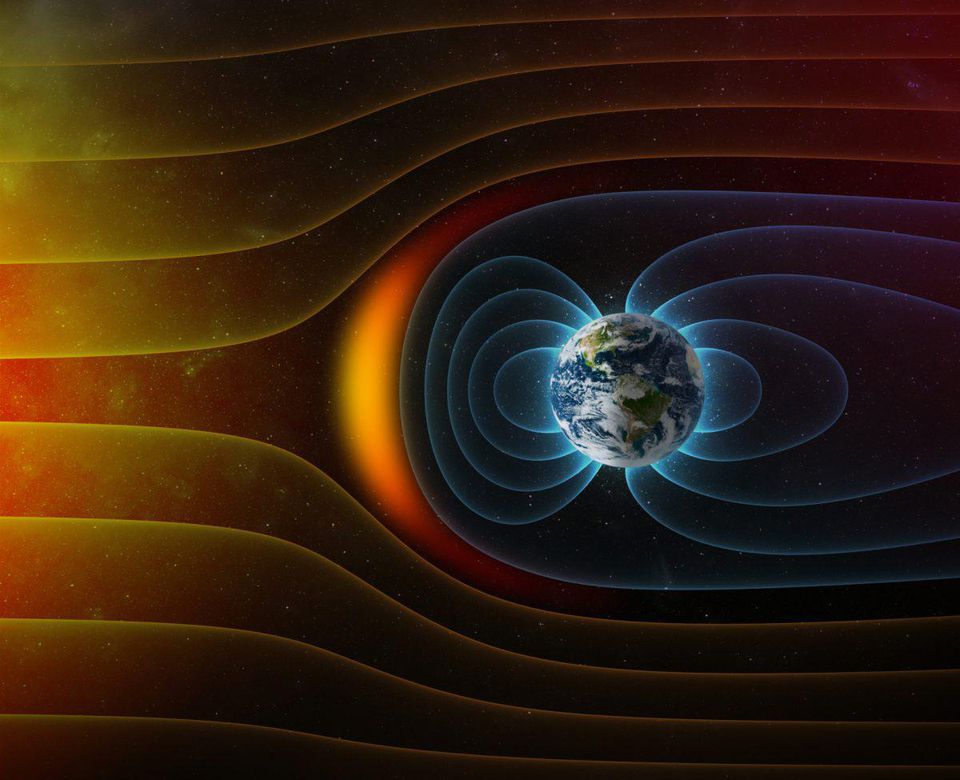
Education Ranger, Lucy Waller read that a special protein found in the eyes of birds, ‘Cry4’ might detect blue light so they can see the magnetic field of the earth, but it is not known if this might also be found in penguins.
We asked penguin scientist Dr Thomas Mattern about penguins’ navigation capabilities.
While the latest info that has come out regarding Cry4 and navigation capabilities in birds is indeed interesting, so far nobody was able to actually connect all the dots there and find definite proof that the protein allows birds to “see” the electromagnetic field. In essence, we only know that the light receptor protein is there, but not how (or even if) it transfers any sensory data to the brain. So I wouldn’t get too hung up on this.
More importantly, however, using the Earth’s magnetic field for orientation generally only works on a large scale, i.e. during long-distance migrations. On a smaller, regional scale the spatial variation of the magnetic field are subtle to non-existent and likely won’t provide any reliable cues for accurate navigation.
Instead, penguins seem to rely on visual cues for orientation. In Little [blue] penguins, foggy nights caused massive drops in bird numbers returning to the colony, presumably because the birds could not make out landmarks on the shoreline that guide them back to their breeding sites (https://doi.org/10.1007/s10336-007-0125-5). We have had the same experience with hoiho [yellow-eyed penguins] that would not return because of low hanging clouds covering the tops of the Otago Peninsula. Taking about hoiho, our work has provided further evidence that visual cues are important for their navigation with penguins changing their travel course when they hit underwater landmarks, such as a reef in an otherwise largely featureless seafloor environment (https://www.int-res.com/articles/meps2007/343/m343p295.pdf).
Beyond visual cues, it appears as if penguins are able to detect anomalies in the sea surface elevation. Underwater features such as underwater ridges or continental shelves cause the ocean surface to bulge. The penguins seem to be able to detect this bulging effect and travel along the edge of the bulge. We have seen that in tawaki returning to the NZ mainland by following the Macquarie Ridge an underwater mountain chain west of the Auckland Islands (https://doi.org/10.1371/journal.pone.0198688).
All that is not to say that magneto-reception may not play an important role. However, we just don’t know enough about this process to use it as the default explanation for how birds use the Earth’s magnetic field for orientation.
West Coast Penguin Trust scientist, Kerry-Kayne Wilson added:
With other birds it has been shown they can make use of magnetic fields, stars and the sun and, for petrels, smell – they may be able to smell their colony from several kilometres and even identify their own nest. However, those that are known to be able to use the stars can find their way on very cloudy days. My take is that birds are using multiple cues. Remember they see the world differently to us, most birds see into the UV so they may be using cues invisible to us.
You can read more about the Cry4 protein here.
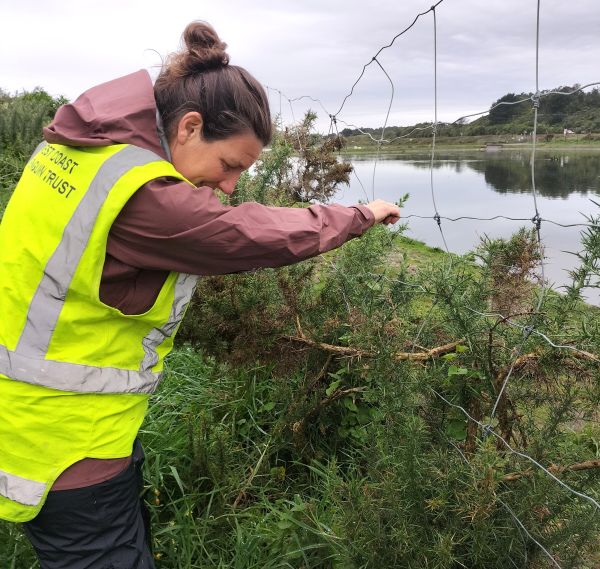
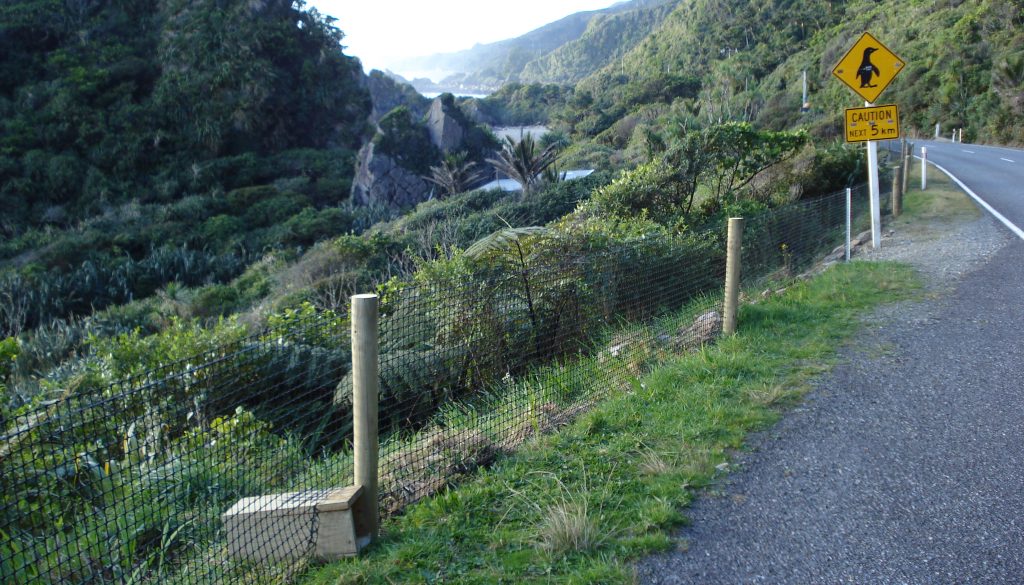 While materials were chosen that would stand up to the harsh coastal conditions, those same coastal conditions are conducive to plant growth! Occasional checks of the fences have been carried out by volunteers and rangers so that any maintenance needs can be identified and remedied. The never-ending need for maintenance is managing the vegetation that can grow through the fence, for example gorse, blackberry and hydrangea, pushing it to breaking point in places, or flop over causing damage from the weight of rank grass, rushes and weeds such as montbretia.
Volunteers recently spent a few hours tidying up the main fence along Woodpecker Bay north of Punakaiki so a big shout out to them - thank you Fiona, Jony, Reef, Katrina, Mandy, Marty, Teresa and Deb! Flax had been pressing down on the fence, but now the fence has been freed up by these wonderful volunteers - and they picked up a fair bit of rubbish too.
While materials were chosen that would stand up to the harsh coastal conditions, those same coastal conditions are conducive to plant growth! Occasional checks of the fences have been carried out by volunteers and rangers so that any maintenance needs can be identified and remedied. The never-ending need for maintenance is managing the vegetation that can grow through the fence, for example gorse, blackberry and hydrangea, pushing it to breaking point in places, or flop over causing damage from the weight of rank grass, rushes and weeds such as montbretia.
Volunteers recently spent a few hours tidying up the main fence along Woodpecker Bay north of Punakaiki so a big shout out to them - thank you Fiona, Jony, Reef, Katrina, Mandy, Marty, Teresa and Deb! Flax had been pressing down on the fence, but now the fence has been freed up by these wonderful volunteers - and they picked up a fair bit of rubbish too.
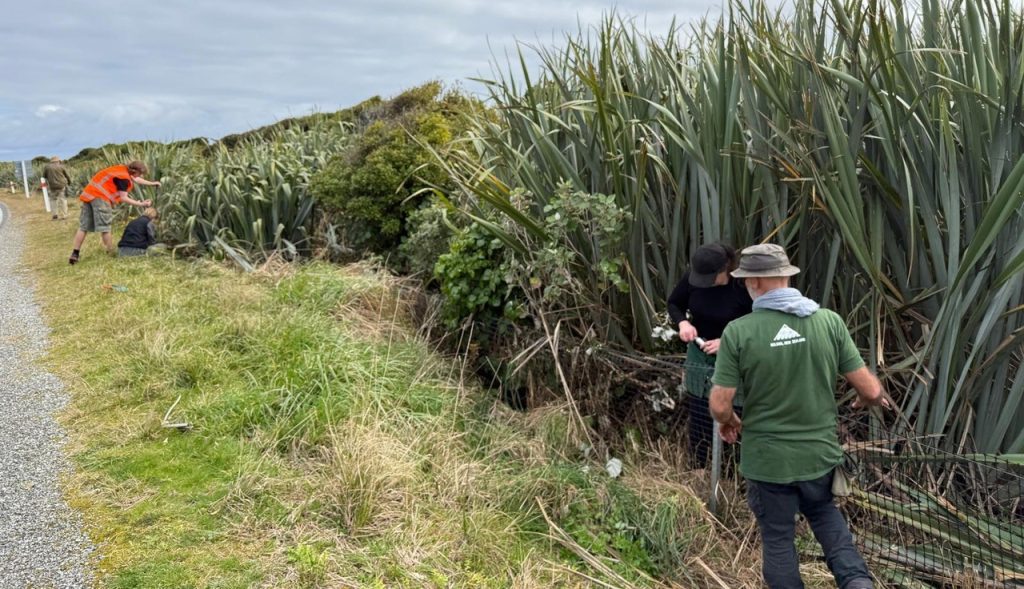 Volunteer Natassja Savidge has offered to check and help maintain the Hokitika penguin protection fence and joined Ranger Lucy Waller and Manager Inger Perkins in May to inspect the length of the fence. Some minor issues were found but the main finding was the extent of the vegetation growth that was damaging the fence in places. Big thanks to Natassja!