Recently, we were invited to comment when DOC shared the sad story about the deaths of two tawaki, attributed to loose dogs at Jackson Bay/Jackson Head in South Westland. It was an opportunity to focus on the key messages for dogs in relation to penguins on the West Coast, particularly when speaking to National Radio.
First and foremost is to ensure that dogs are safe and secure at home. Loose dogs are not only at risk of being hit on the roads and causing traffic accidents, they can also scare, threaten or even attack adults, children and other animals. But in coastal areas, they may be roaming through dunes and on beaches where penguins may be nesting, resting, moulting or simply hanging out, perhaps ill. In forest areas, it may be kiwis that are vulnerable. In some places, wildlife is so precious and vulnerable that dogs are absolutely prohibited.
1. Ensure dogs cannot roam from home.
The beach is a wonderful place for dogs to run and have fun, but penguins could be found at any time at any beach and in any coastal vegetation. The same applies for forests and kiwis.
2. Ideally dogs will be on leads throughout coastal areas and always on a lead (a) going through coastal vegetation to reach the beach and (b) after dark.
Blue penguins or kororā will generally come ashore after dark and leave before dawn – if they are seen at the beach during daylight hours, there is likely to be something wrong and they will be at great risk from dogs. Fiordland crested penguins or tawaki often come ashore in the afternoon and are more likely to be seen at the beach in their nesting areas, mainly in South Westland (and Fiordland and Stewart Island). Again, these handsome penguins could be found anywhere along the West Coast and if they are largely still, they too may need some help. These and in fact all coastal wildlife, including seals, sealions, dotterels and other shorebirds are at risk from dogs.
3. If not on a lead, and only during daylight hours and in the tidal part of the beach, dogs must be under effective control – i.e. respond as required.
Effective control means that the dog will respond as required, whether stopping immediately or coming when called, so not too far away, within voice or whistle control and well trained. There was a tragic story of a dog attacking a young seal – despite the owner calling and calling and then trying to pull the dog off, the dog would not let go and the seal had to be put down. Again, the same applies in forests.
Dog owner or not, everyone can play a role in informing dog owners about wildlife at the beach. Wildlife, whether seals or dotterels, are well camouflaged at the beach and it is easy to approach too closely or even step on nests. If you see any wildlife as you walk on the beach and then meet a dog and owner, just let them know, both to protect the wildlife and potentially to protect the dog.
4. Warn dog owners if you see vulnerable wildlife at the beach.
If you see sick or injured wildlife, and that includes penguins just hanging out, which they are only likely to do if they are unable to get to safety, please call the 0800 DOC HOTline (0800 362 468). DOC will be able to pass on the details to the nearest ranger and sometimes the penguin trust. Some penguins can be rescued and assessed for possible rehabilitation and release.
5. Call the 0800 DOCHOT line if you see sick or injured wildlife.
Finally, there are some sites that are just too precious for dogs to be in at all, on or off a lead. Wildlife Refuges are specially protected for very rare wildlife and/or breeding colonies, for example that at Jackson Head where tawaki breed.
6. Never allow your dog to enter a Wildlife Refuge or other dog excluded area.
If you see a loose dog in an area where dogs are prohibited, call the 0800 DOCHOT emergency line as soon as possible.
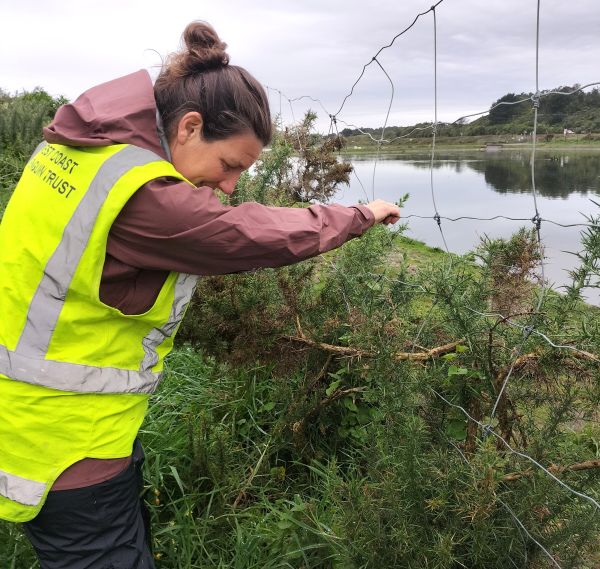
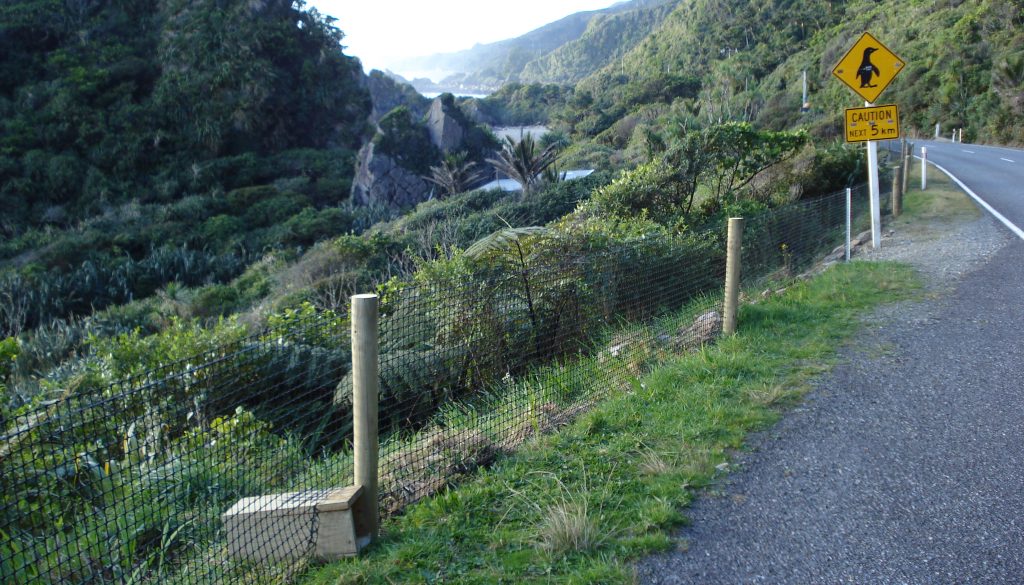 While materials were chosen that would stand up to the harsh coastal conditions, those same coastal conditions are conducive to plant growth! Occasional checks of the fences have been carried out by volunteers and rangers so that any maintenance needs can be identified and remedied. The never-ending need for maintenance is managing the vegetation that can grow through the fence, for example gorse, blackberry and hydrangea, pushing it to breaking point in places, or flop over causing damage from the weight of rank grass, rushes and weeds such as montbretia.
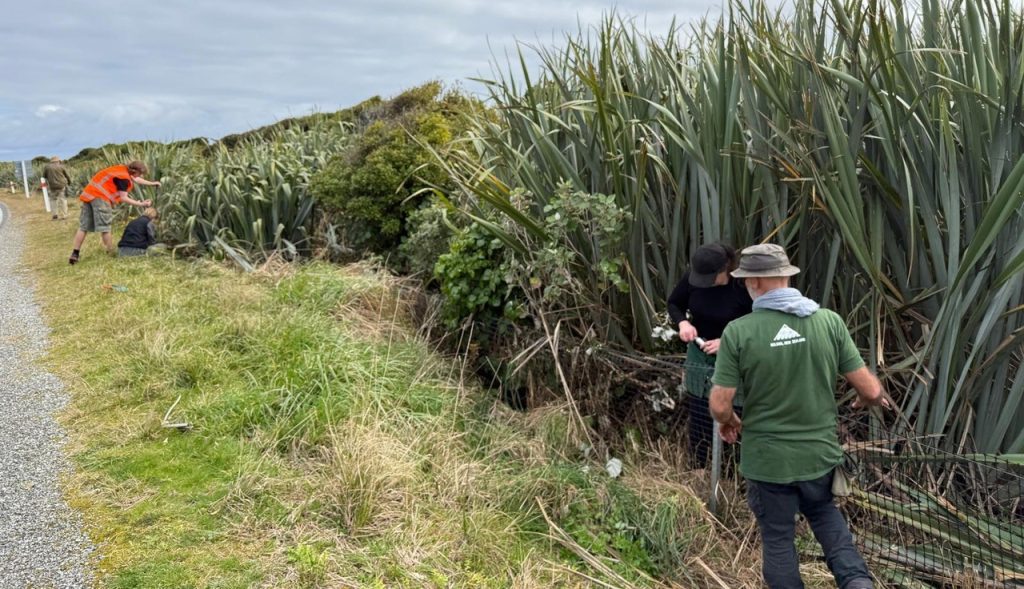
Volunteers recently spent a few hours tidying up the main fence along Woodpecker Bay north of Punakaiki so a big shout out to them - thank you Fiona, Jony, Reef, Katrina, Mandy, Marty, Teresa and Deb! Flax had been pressing down on the fence, but now the fence has been freed up by these wonderful volunteers - and they picked up a fair bit of rubbish too.
While materials were chosen that would stand up to the harsh coastal conditions, those same coastal conditions are conducive to plant growth! Occasional checks of the fences have been carried out by volunteers and rangers so that any maintenance needs can be identified and remedied. The never-ending need for maintenance is managing the vegetation that can grow through the fence, for example gorse, blackberry and hydrangea, pushing it to breaking point in places, or flop over causing damage from the weight of rank grass, rushes and weeds such as montbretia.
Volunteers recently spent a few hours tidying up the main fence along Woodpecker Bay north of Punakaiki so a big shout out to them - thank you Fiona, Jony, Reef, Katrina, Mandy, Marty, Teresa and Deb! Flax had been pressing down on the fence, but now the fence has been freed up by these wonderful volunteers - and they picked up a fair bit of rubbish too.
 Volunteer Natassja Savidge has offered to check and help maintain the Hokitika penguin protection fence and joined Ranger Lucy Waller and Manager Inger Perkins in May to inspect the length of the fence. Some minor issues were found but the main finding was the extent of the vegetation growth that was damaging the fence in places. Big thanks to Natassja!