Penguin fossils have been popping up in the news in recent years so it was interesting to discover that they are also being found on the West Coast recently.
First, a bit of background. New Zealand boasts the world’s richest record of penguin fossils. They reveal that ancient penguins were diverse in size, reaching sizes much larger than today’s penguins. Those early giants show that large body size was present at the dawn of penguin evolution, with some fossils dating back 60-62 million years. The fossils have also provided insights into the rapid evolution of early penguins’ limb or wing shape. A couple of years ago, we reported on a new penguin fossil where the species had been named after our late Chair and Scientist, Kerry-Jane Wilson MNZM (read it here).

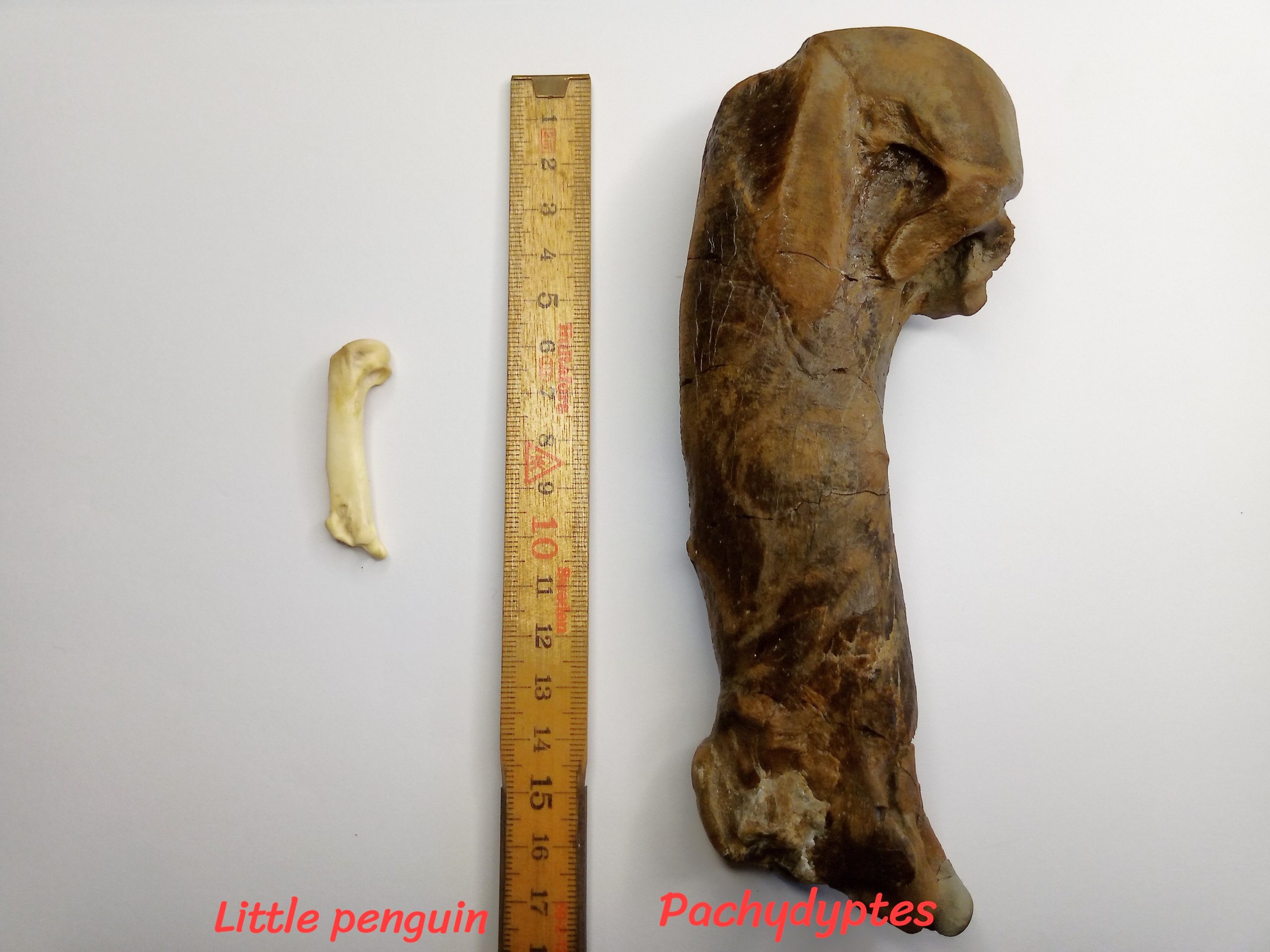
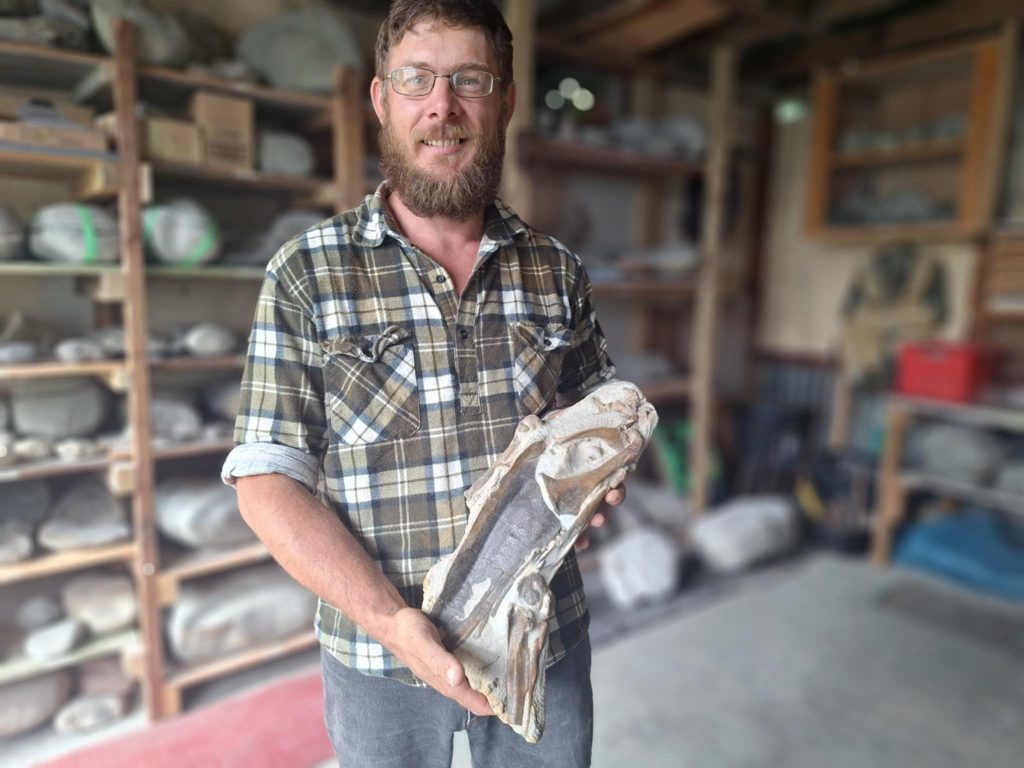
A couple of months ago, trust manager, Inger Perkins, and trust tawaki ranger, Catherine Stewart, were giving talks at the Westland District Library in Hokitika and were approached by a chap with a small suitcase. It turned out that, inside the case, Harry Jensen had the carefully prepared and packed fossil bones of a penguin’s wing or flipper. The flipper fossil was much larger than that of a little penguin or kororā. In the case there are also two smaller as yet unidentified wing bones from two species of miocene-aged penguin found near Cape Foulwind, 11-9 million years old (Ma). He kindly accepted our invitation to speak for a few minutes at the end of the scheduled presentations explaining the hundreds of hours that goes into paring back the rock in which the fossils were found, often in large cobbles or small boulders.
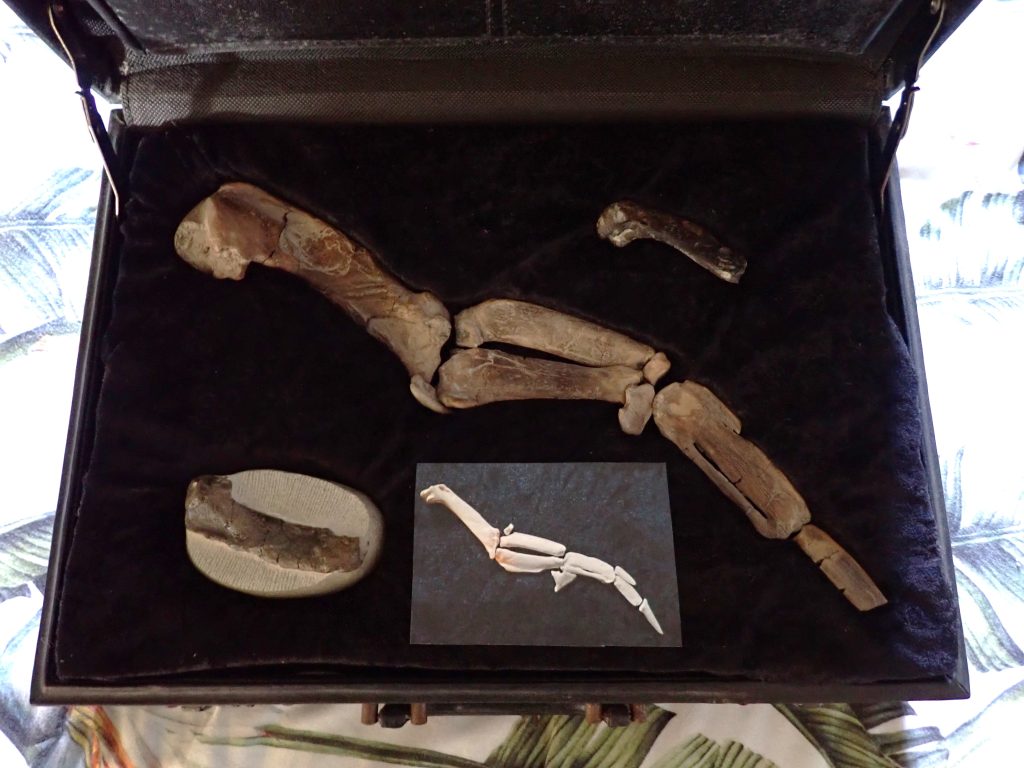
This fascinating and time-consuming hobby is contributing to the world’s knowledge of earlier penguins and their distribution and evolution.
Harry explained about another fossil he has found near Rapahoe:
“The flipper fossil is from a penguin related to the Pachydyptes ponderosus, and is around 32-34 million years old, from the late Eocene. Pachydyptes is estimated to have been around 1.4 metres tall and weighing in at just under a hundred kilograms, the former heavyweight of the penguin world. Recent examination shows this is likely to be a new to science species, as there are certain differences between this specimen and the original Pachydyptes holotype*.”
* Holotype: a single type specimen upon which the description and name of a new species is based.
Authoritiy on penguins at Otago University and now Otago Museum, Marcus Richards, (former Department of Geology Paleontology Curator and now Collections Technician at the museum) has been collaborating with Harry, as has Alan Tennyson, Curator of Vertebrates at the Museum of New Zealand Te Papa Tongarewa. Alan Tennyson is a world expert on New Zealand’s fossil penguins.
It seems that penguin fossils are not new on the West Coast. The first were found in 1869 in Woodpecker Bay, north of Punakaiki. There is a short note about this find on Te Ara here, including sketches of the fossilised penguin bones along with an outline of the equivalent bone of a Fiordland crested penguin or tawaki. The comparison shows how much bigger the ancient penguin was, perhaps twice as tall as the tawaki, which are 60cm tall.
Between Harry and his collaborators, at least six different types of fossil penguins have been identified from the West Coast.
The Kumimanu fossil penguin, found in North Otago, proves that some of the earliest penguins were much larger than even the emperor penguin today. The University of Otago has been leading this work and you can find some information about their work here. It seems that Kumimanu fordycei was the largest fossil penguin every discovered, estimated to weigh in at a huge 154kg! Another newly described species is Petradyptes stonehousei, which would haveweighed 50kg. When compared to our current West Coast penguins, they are colossal. Tawaki are around 4kg and kororā just 1kg.
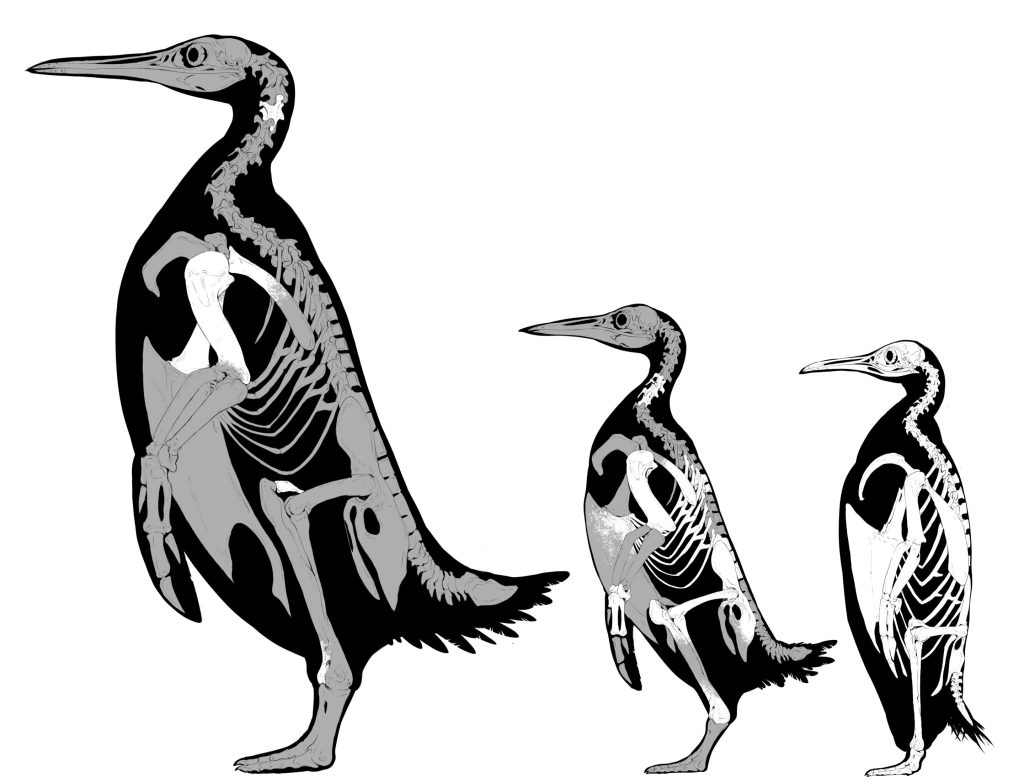
Giant penguin fossil bones were also found south of Christchurch in the early 2000s. It took many years to carefully remove and then study pieces of the skeleton. The penguin species weighed around 100kg and was about 1.77m tall. This one was also described as Kumimanu, after the Maori words “kumi”, meaning a large mythological monster, and “manu” for bird, and this time Kumimanu biceae. More on that story here from the Guardian.
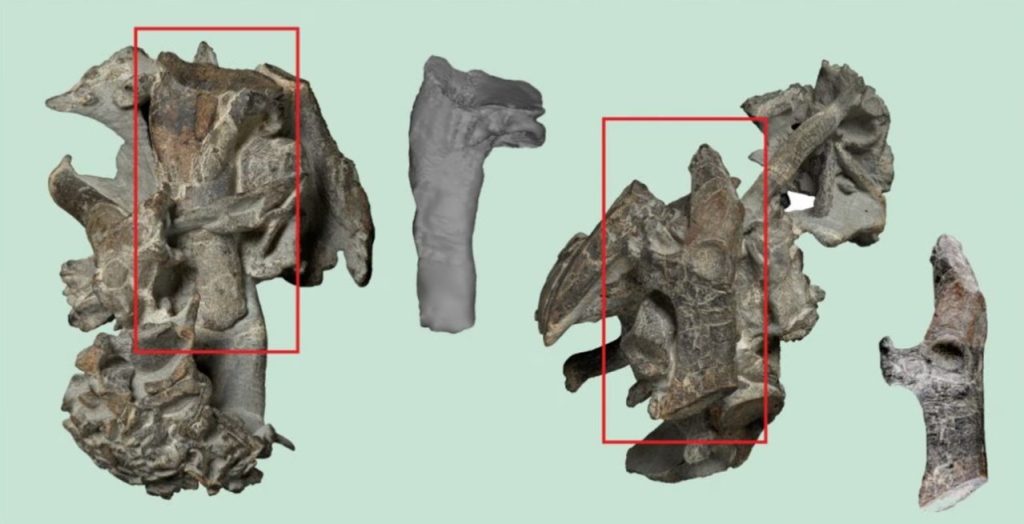
Photograph: Gerald Mayr/Senckenberg Research Institute (Guardian.com Dec 2017)
Our thanks go to Harry for getting us excited about the history of penguins in the region and to him and his collaborators for the untold hours that go into finding, preparing and analysing these precious fossils.
There is a lot more work to come and results will be published in due course.
Postscript
The study of fossil penguins is continuing apace, and news of the find and study of a giant fossil penguin skull from the Taranaki coast was shared this month. The skull is 35% larger than that of the Emperor penguins, which weigh upwards of 35 kg.
RNZ National reported the study, orginally published in the Journal of Paleontology (18 Sept 2025) – find the news here with a link to the journal article: What caused the extinction of great penguins that roamed New Zealand? | RNZ News
The scientists, including Alan Tennyson mentioned above, found that this giant penguin was alive 3-3.3 million years ago in the mid-Piacenzian Warm Period (mPWP) when global temperatures were around 3°C above those of the preindustrial era. They suggest that the extinction of giant penguins back then may have been linked to the arrival of large raptors including Haast’s eagle.

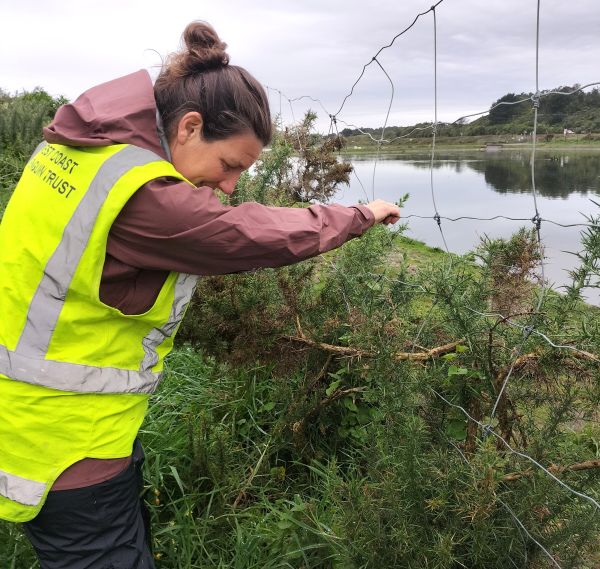
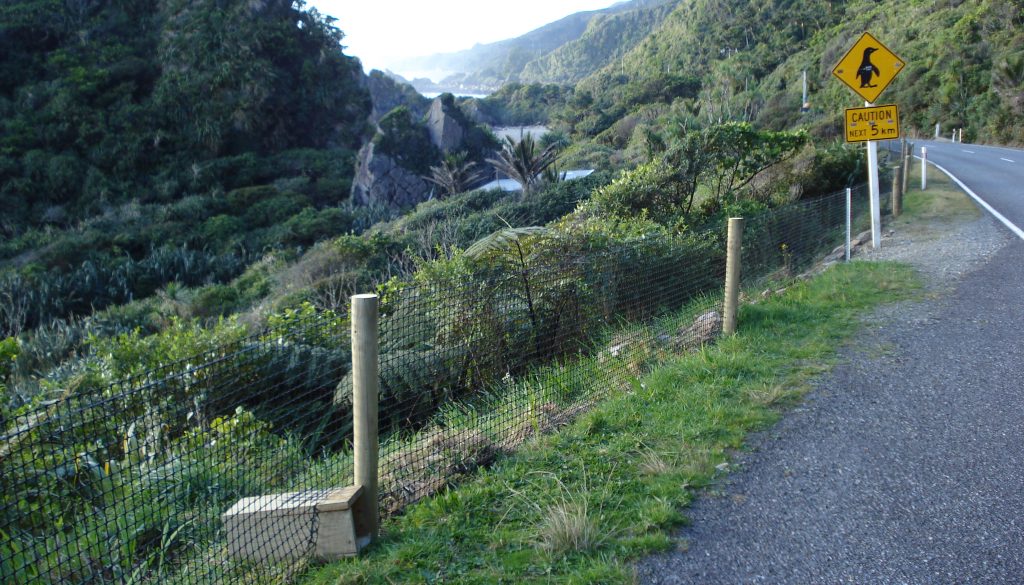 While materials were chosen that would stand up to the harsh coastal conditions, those same coastal conditions are conducive to plant growth! Occasional checks of the fences have been carried out by volunteers and rangers so that any maintenance needs can be identified and remedied. The never-ending need for maintenance is managing the vegetation that can grow through the fence, for example gorse, blackberry and hydrangea, pushing it to breaking point in places, or flop over causing damage from the weight of rank grass, rushes and weeds such as montbretia.
Volunteers recently spent a few hours tidying up the main fence along Woodpecker Bay north of Punakaiki so a big shout out to them - thank you Fiona, Jony, Reef, Katrina, Mandy, Marty, Teresa and Deb! Flax had been pressing down on the fence, but now the fence has been freed up by these wonderful volunteers - and they picked up a fair bit of rubbish too.
While materials were chosen that would stand up to the harsh coastal conditions, those same coastal conditions are conducive to plant growth! Occasional checks of the fences have been carried out by volunteers and rangers so that any maintenance needs can be identified and remedied. The never-ending need for maintenance is managing the vegetation that can grow through the fence, for example gorse, blackberry and hydrangea, pushing it to breaking point in places, or flop over causing damage from the weight of rank grass, rushes and weeds such as montbretia.
Volunteers recently spent a few hours tidying up the main fence along Woodpecker Bay north of Punakaiki so a big shout out to them - thank you Fiona, Jony, Reef, Katrina, Mandy, Marty, Teresa and Deb! Flax had been pressing down on the fence, but now the fence has been freed up by these wonderful volunteers - and they picked up a fair bit of rubbish too.
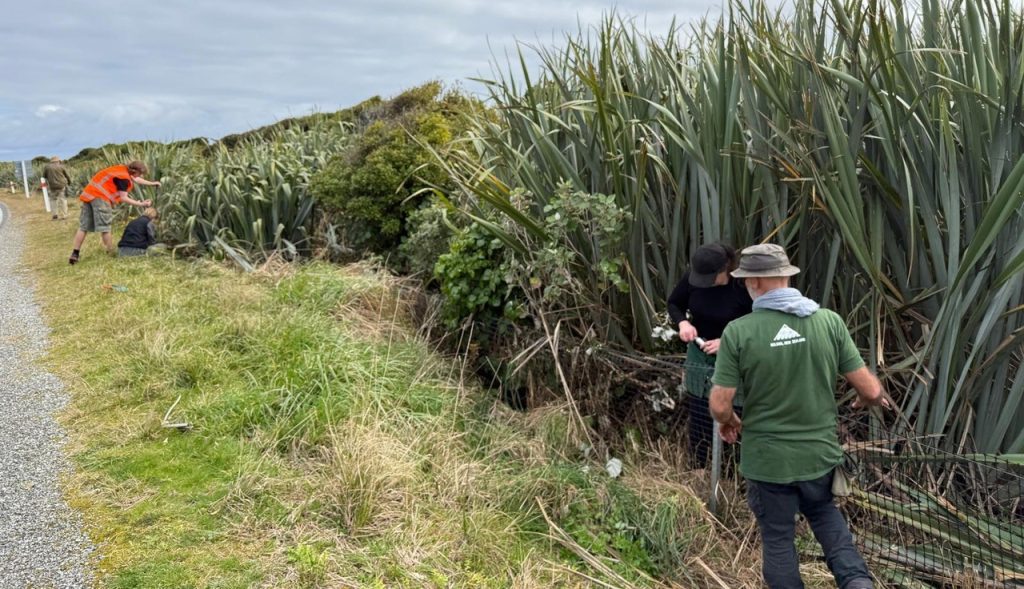 Volunteer Natassja Savidge has offered to check and help maintain the Hokitika penguin protection fence and joined Ranger Lucy Waller and Manager Inger Perkins in May to inspect the length of the fence. Some minor issues were found but the main finding was the extent of the vegetation growth that was damaging the fence in places. Big thanks to Natassja!