From Waka Kotahi – NZTA
To try and help protect the endangered seabird, the Westland petrel/tāiko, Waka Kotahi NZ Transport Agency will again turn off highway lighting at night on a short section of State Highway 6 through Punakaiki this summer.
“In consultation with Buller District Council, all streetlights from Waikori Road in the south to Bullock Creek Road on the north side of Punakaiki will be turned off on Monday, 8 November 2021 and turned back on Monday, 10 January, 2022,” says Colin Hey, Senior Network Manager for Waka Kotahi.
Pedestrians, who are the main beneficiaries of the lights, are advised to take extra care at night during this time with cautionary signage being installed on either side of the 3.4 km section of highway affected.
“Buller District Council supports Waka Kotahi in this initiative to help protect fledgling Westland petrels from disorientation from streetlights and will darken its local road streetlights in the Punakaiki township during the same dates,” says Eric de Boer, Manager Infrastructure Delivery for Buller District Council.
The Westland petrel/tāiko fledglings or chicks nest in burrows and can become disoriented from bright lights under their flight paths causing them to crash land nearby, a phenomena known as fallout. As well as street-lights, any bright lights can attract these birds to land, and cause fallout.

“The breeding colony is just south of Punakaiki, with petrel fledglings beginning to fly from early November,” says Mr Hey.
Last year was the first season Waka Kotahi turned off the LED street-lights in Punakaiki. Initial results indicated that fewer birds were found disoriented or killed by vehicles in Punakaiki. More will be known next year after the second season with Punakaiki’s lights off.
Safer footpath
The footpath through Punakaiki has had a full upgrade this year as part of the new cycling/walking shared path, says Mr Hey, which will help night-time walkers in the settlement.
Background to this switch-off
In 2019, Waka Kotahi replaced six streetlights in the Punakaiki village which had badly corroded steel poles and were at risk of blowing down. LED fittings were used on the replacement poles, as is standard practice for all streetlight replacements based on energy efficiency and ability to direct the light.
“Following the installation, concerns were raised by the Westland Petrel Conservation Trust,” says Mr Hey. “They pointed out that artificial lighting, and particularly LED lighting, may accentuate the difficulties for the petrels and the fledglings, and may cause more ‘fallout’ or disorientation than the original high-pressure sodium lights.
“We investigated possible solutions to protect the young birds including changing the bulbs and fitting hoods to the new LED lights. To date no suitable, proven solution with existing street-lights has been found.”
A fraction of the original numbers surviving
The Department of Conservation/ Te Papa Atawhai says that today’s breeding population of about 6,200 pairs is a remnant of what would have originally been many hundreds of thousands.
With only one breeding colony in the world, the survival of every fledgling to breeding age is needed for the survival of this species, says DOC.
The main threats the Westland petrel/ tāiko continues to face are incidental bycatch in commercial fishing, introduced mammal predators, illegal releases of feral pigs into the breeding colonies and climate change, which alters prey availability and increases the frequency of severe weather events, which has caused the loss of breeding burrows to landslides in recent years.
Apart from the benefits provided to the petrels by the light switch-off, local residents and visitors to the area will also have the opportunity to see the night sky more clearly during this period.
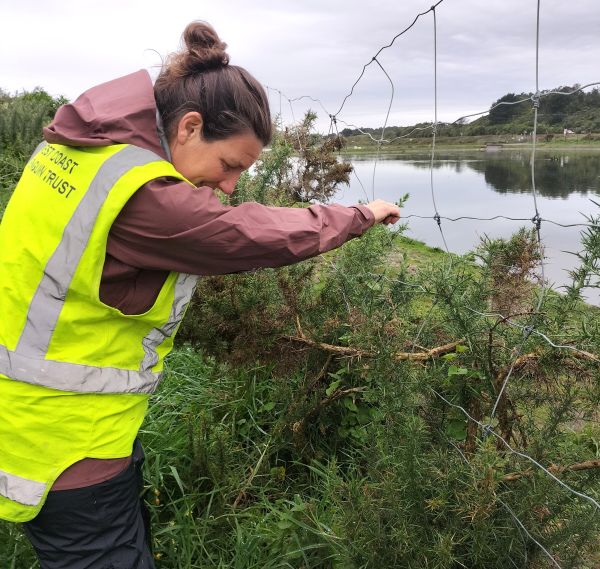
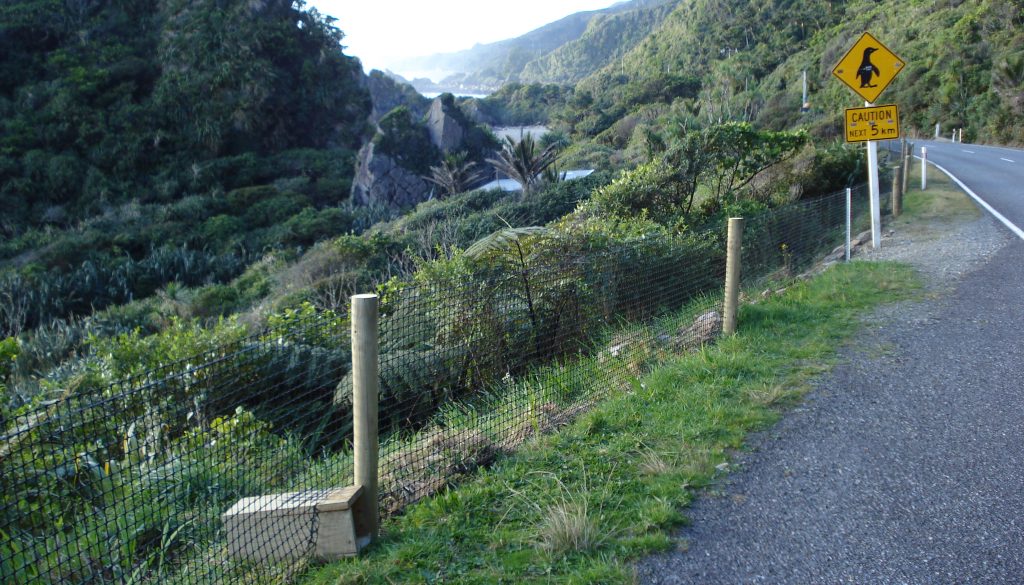 While materials were chosen that would stand up to the harsh coastal conditions, those same coastal conditions are conducive to plant growth! Occasional checks of the fences have been carried out by volunteers and rangers so that any maintenance needs can be identified and remedied. The never-ending need for maintenance is managing the vegetation that can grow through the fence, for example gorse, blackberry and hydrangea, pushing it to breaking point in places, or flop over causing damage from the weight of rank grass, rushes and weeds such as montbretia.
Volunteers recently spent a few hours tidying up the main fence along Woodpecker Bay north of Punakaiki so a big shout out to them - thank you Fiona, Jony, Reef, Katrina, Mandy, Marty, Teresa and Deb! Flax had been pressing down on the fence, but now the fence has been freed up by these wonderful volunteers - and they picked up a fair bit of rubbish too.
While materials were chosen that would stand up to the harsh coastal conditions, those same coastal conditions are conducive to plant growth! Occasional checks of the fences have been carried out by volunteers and rangers so that any maintenance needs can be identified and remedied. The never-ending need for maintenance is managing the vegetation that can grow through the fence, for example gorse, blackberry and hydrangea, pushing it to breaking point in places, or flop over causing damage from the weight of rank grass, rushes and weeds such as montbretia.
Volunteers recently spent a few hours tidying up the main fence along Woodpecker Bay north of Punakaiki so a big shout out to them - thank you Fiona, Jony, Reef, Katrina, Mandy, Marty, Teresa and Deb! Flax had been pressing down on the fence, but now the fence has been freed up by these wonderful volunteers - and they picked up a fair bit of rubbish too.
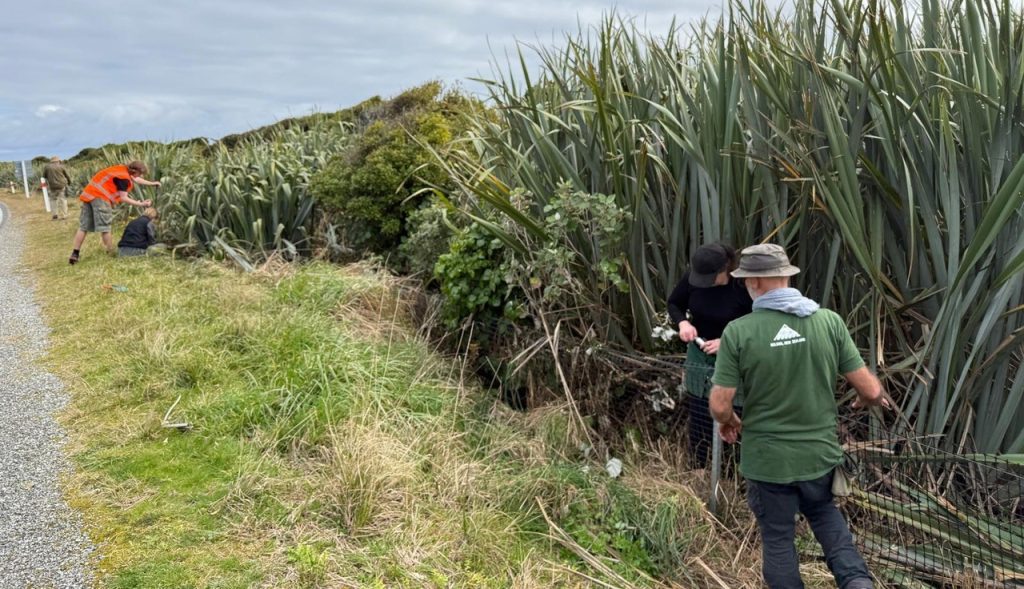 Volunteer Natassja Savidge has offered to check and help maintain the Hokitika penguin protection fence and joined Ranger Lucy Waller and Manager Inger Perkins in May to inspect the length of the fence. Some minor issues were found but the main finding was the extent of the vegetation growth that was damaging the fence in places. Big thanks to Natassja!