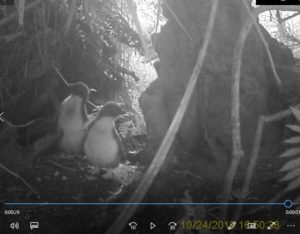
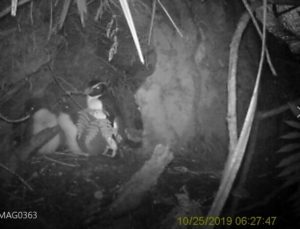
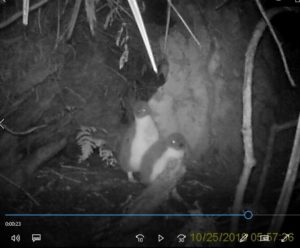
Our experience from our monitoring of West Coast tawaki nest sites in recent years is that, if tawaki chicks survive, only one chick is usually raised to fledging, but in these photos, from cameras at Gorge River, one tawaki pair has raised two chicks!
Fiordland crested penguins or tawaki follow the crested penguin approach to breeding, that is laying one egg first and a larger one a couple of days later – which then hatches first (B chick). The larger chick then gets fed first and the second, back up chick if you like, only gets fed if the first one is full, being pushed out of the way by the first one. This almost always means that the chick from the first egg (A chick) dies within a few days of hatching.
But not for this nest and in fact not in other areas where food is more abundant. The Tawaki Project has found that some of the pairs monitored at Harrison Cove in Milford Sound were raising two chicks with plentiful food right on their doorstep and had foraging ranges of only 3km.
In 2015, during the second year of camera monitoring by the West Coast Penguin Trust in South Westland, it seems that most if not all nests failed at Jackson Head due to chick starvation. The Tawaki Project were tracking some tawaki from Jackson Head and found that they were going significantly further to forage to feed chicks than in other years, for example they averaged a 12km range in 2014 but a 100km range in 2015 during very strong El Niño conditions. (Read their 2016 season report here including reports for Jackson Head 2015 and Milford Sound 2016.)
The Trust is fortunate to have Catherine Stewart at Gorge River to maintain cameras in the tawaki colony and has continued this valuable work each season since it began in 2014. This year, for the first time in the six years of our camera monitoring, she has seen two chicks grow up in one nest. She reported:
“Nest GR15 raised two chicks, at least to the end of October. Lots of video of B chick being preferentially fed and A chick much smaller during the guard phase, but later they were pretty equal.”
Catherine has now reviewed all the recordings from 10 cameras and Robin Long, Tawaki Ranger, is compiling a report for the season, collating the Gorge River Data along with breeding success monitoring at two other South Westland sites. The report will be available soon.
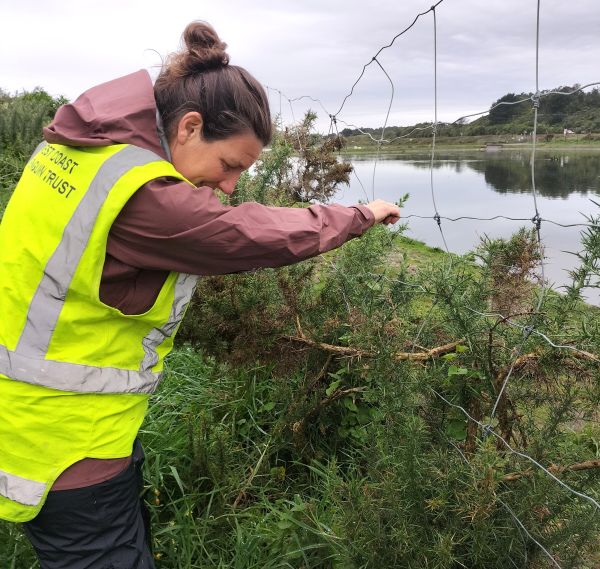
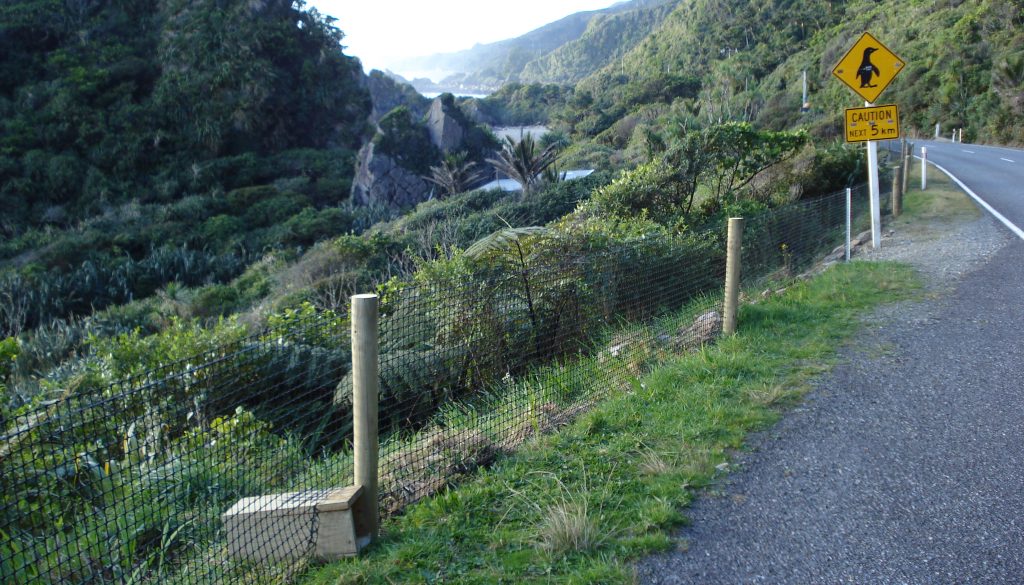 While materials were chosen that would stand up to the harsh coastal conditions, those same coastal conditions are conducive to plant growth! Occasional checks of the fences have been carried out by volunteers and rangers so that any maintenance needs can be identified and remedied. The never-ending need for maintenance is managing the vegetation that can grow through the fence, for example gorse, blackberry and hydrangea, pushing it to breaking point in places, or flop over causing damage from the weight of rank grass, rushes and weeds such as montbretia.
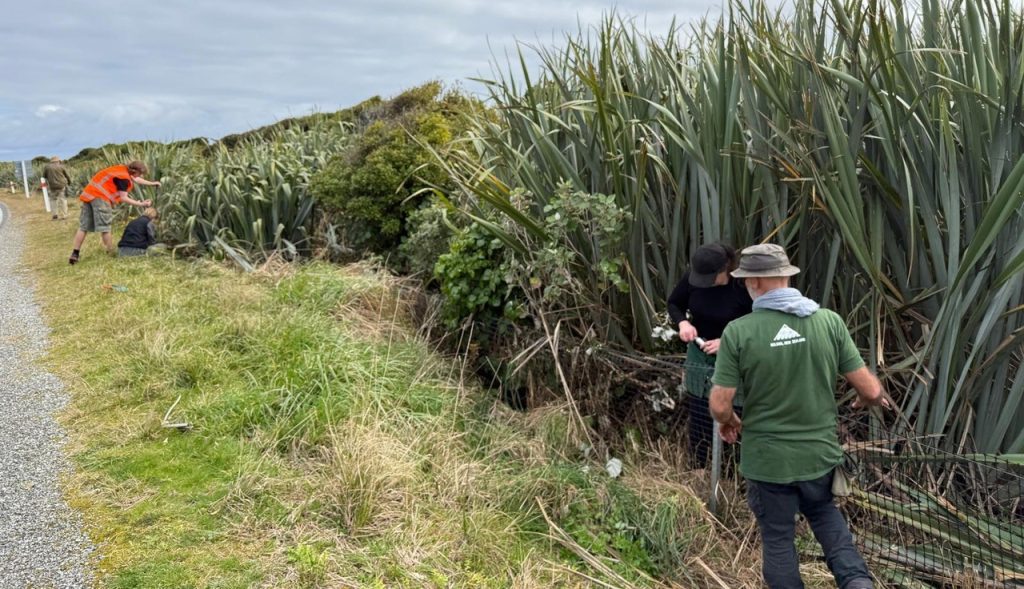
Volunteers recently spent a few hours tidying up the main fence along Woodpecker Bay north of Punakaiki so a big shout out to them - thank you Fiona, Jony, Reef, Katrina, Mandy, Marty, Teresa and Deb! Flax had been pressing down on the fence, but now the fence has been freed up by these wonderful volunteers - and they picked up a fair bit of rubbish too.
While materials were chosen that would stand up to the harsh coastal conditions, those same coastal conditions are conducive to plant growth! Occasional checks of the fences have been carried out by volunteers and rangers so that any maintenance needs can be identified and remedied. The never-ending need for maintenance is managing the vegetation that can grow through the fence, for example gorse, blackberry and hydrangea, pushing it to breaking point in places, or flop over causing damage from the weight of rank grass, rushes and weeds such as montbretia.
Volunteers recently spent a few hours tidying up the main fence along Woodpecker Bay north of Punakaiki so a big shout out to them - thank you Fiona, Jony, Reef, Katrina, Mandy, Marty, Teresa and Deb! Flax had been pressing down on the fence, but now the fence has been freed up by these wonderful volunteers - and they picked up a fair bit of rubbish too.
 Volunteer Natassja Savidge has offered to check and help maintain the Hokitika penguin protection fence and joined Ranger Lucy Waller and Manager Inger Perkins in May to inspect the length of the fence. Some minor issues were found but the main finding was the extent of the vegetation growth that was damaging the fence in places. Big thanks to Natassja!