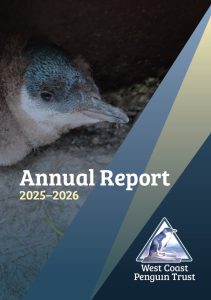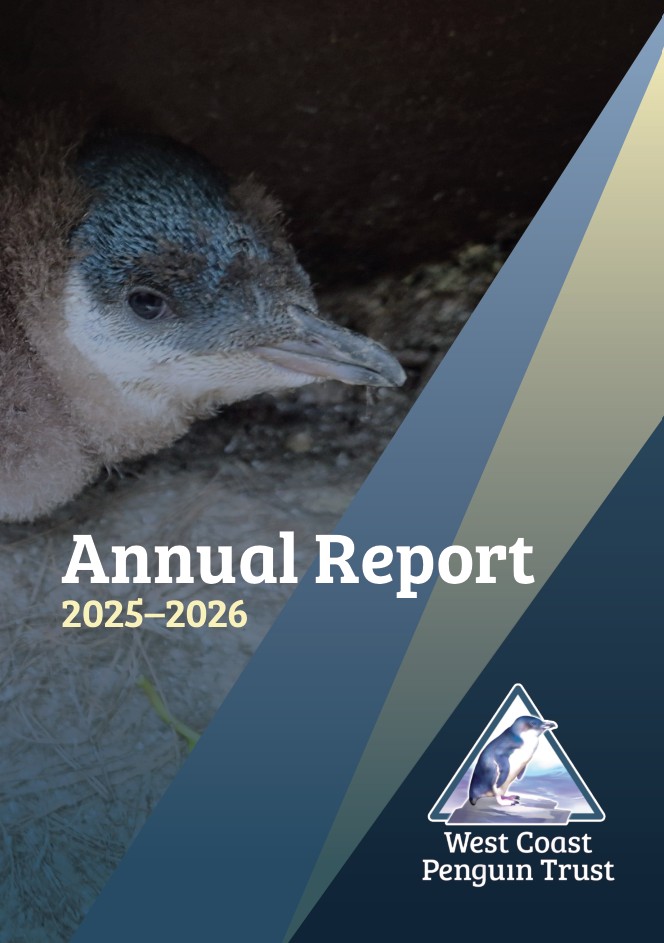
The Trust’s Annual Report for 2025-26 celebrates 20 years of conservation action and growing research programmes.
Challenges were noted for little penguins / kororā with a poorer than average breeding season, likely linked to a marine heatwave and reduced prey availability associated with a third consecutive La Niña event. Our research is evolving to better understand the myriad threats to penguins, and climate and marine heatwaves are a critical part of the picture. We expect analysis of our data in relation to conditions such as La Niña and El Niña events will bring more clarity and we hope this will take place in the coming months.
Fieldwork at our main study site included gathering breeding success data, demographic data using microchips and microchip readers, as well as the foraging study, tracking little penguins at sea. Tracking showed penguins taking longer and going much further than usual to find food during egg incubation, putting pressure on the other penguin on the nest.
Breeding success for Fiordland crested penguins / tawaki was around the average recorded in recent years, with most monitored nests raising one healthy chick (from two eggs).
Other threatened seabirds in the West Coast region include the precious Westland petrel / tāiko, which breeds in only one place in the world, on the steep, forested slopes between Punakaiki and Barrytown. Our role is focussed on advocacy for this species. We also run traps to protect sooty shearwaters at Cape Foulwind as well as for those and other seabirds on nearby Wall Island, and on the mainland beside Seal Island, protecting spotted shags, terns and red-billed gulls. Trapping will be supporting other native birds in these areas, including little penguins.
Penguin protection fences have had a boost in recent months, with a team of community volunteers looking after our main fence north of Punakaiki and other volunteers helping with the Hokitika fence, keeping little penguins on the seaside of State Highway 6.
Education has always been a key component of the Trust’s work and that continues, working with teachers, students, guides and scouts across the region, reaching hundreds of children and their educators every year.
Awareness is another constant role, as the Trust shares information through traditional and social media, and through public talks. Advocacy, speaking up for penguins, seabirds and their habitat, is another essential role for the Trust, ensuring that these birds and their needs are not forgotten in the face of resource consent applications in coastal areas and changing plans and legislation.
Our Annual Report is always an opportunity to share our thanks with so many that we rely on, from our wonderful team, our outstanding scientist, our sponsors, donors and those who provide us with grants, and all those who support us in a variety of ways – thank you, none of our work would be possible without you.
You can read our 2025-26 Annual Report from the link below, and we thank our design volunteer, Erin Dailey, for her work to make this year’s report far more appealing and enjoyable to read!
If you would like a better quality, higher resolution copy of the report, or for a copy specifically designed for printing, please drop us an email.