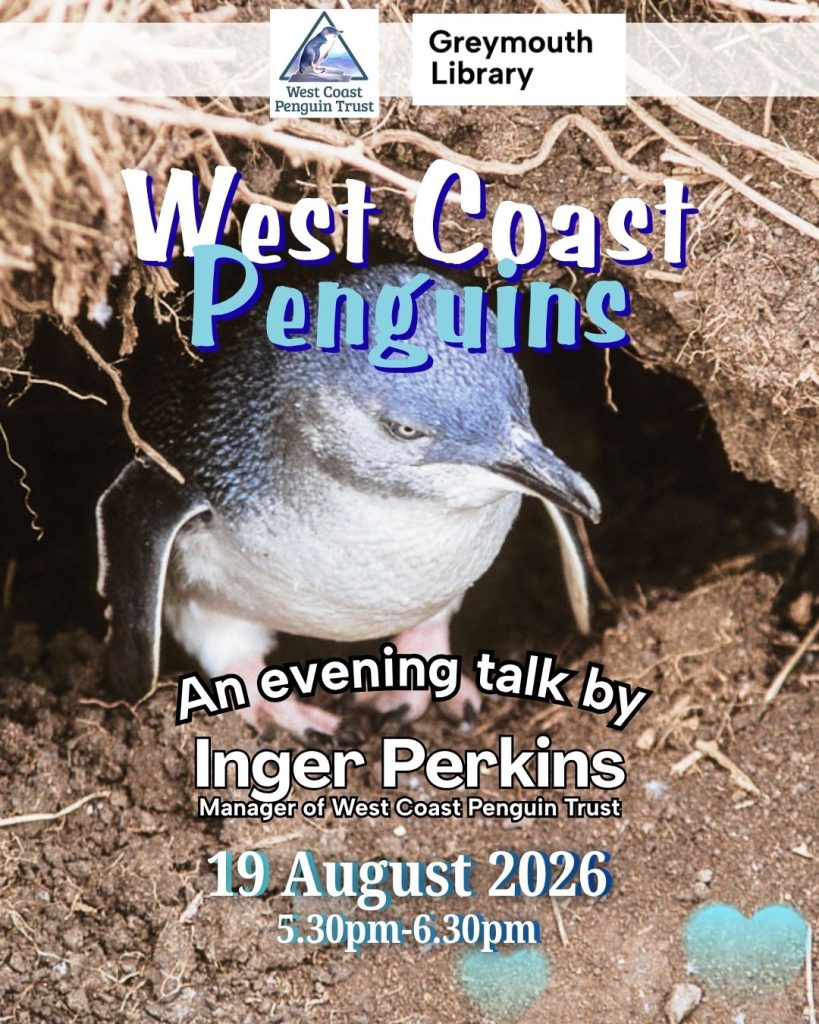
Little Penguins (kororā) on the West Coast faced a challenging breeding season in 2025.
Breeding success declined at key study sites, with more failed nests than the previous season, and many parents fledging one chick instead of two.
News like this proves how crucial long-term monitoring is to determine colony health and identify patterns across seasons. The dataset our ranger and volunteers are building, with the help of our scientists, helps us to connect dots and respond to changing threats that penguins and other endangered seabirds are facing year on year.
Greymouth Study Site: Monitoring Breeding Success
2025 marked the second season of monitoring at our primary study site near Greymouth. We monitored penguin nest boxes twice a month across the colony, to learn about breeding success.
The season was off to a good start, with 23 active nests compared to the 22 active nests in 2024.

However, our foraging study at this site began to show unusual trends during the egg incubation period. Tracking data showed monitored birds remained at sea far longer than usual, and travelled unusually far distances (up to 120km, compared to the usual 25-30km) to forage during egg incubation. While hunting for food, penguins left the remaining parent at the nest for much longer than the expected 5-7 days.
With extreme journeys pointing to limited food availability close to shore, stress on our study colony began to show.
Click here to read our foraging study report.
By the end of the season, there were more nest failures at our key study site (five in total) compared to 2024, and more nests that fledged a single chick rather than two.
Overall, we recorded 23 fledged kororā chicks in 2025 – far fewer than the 32 chicks that fledged the previous year. This brought the overall breeding success rate down from 76% in 2024 to 52% in 2025. This sits much lower than the average of 69% breeding success across our study colonies in previous years.
We also noticed:
- Egg-laying times were significantly spread out in the 2025 season, with some eggs laid weeks apart. In 2024, almost all eggs across the colony were laid within 4 days of each other.
- All failed nests were in the northern part of the colony.

Predation
This season, we recorded no obvious signs of predation from mustelids (stoats, ferrets, weasels), rodents, dogs, cats, or weka.
Stoats could be present at our primary study site. While we don’t believe they pose a current significant threat to kororā on the West Coast, they certainly could do so when in large numbers or, as we saw this year, when hungry chicks are waiting outside nest boxes.
The continued efforts of volunteers to trap rats and stoats in this area, established by the Guardians of Paroa Taramakau Coastal Area Trust years ago, are hugely appreciated. This season, they caught one stoat in the colony, just 3 metres away from active penguin burrows.
Land-based predators remain a substantial threat to kororā across Aotearoa. Pōhatu Penguins on Banks Peninsula in Akaroa reported a single stoat killing 15 chicks over two months.
Besides evidence of weka investigating nests and scavenging scraps from meal leftovers, no predator interactions were caught on camera at our study colony over the course of a few weeks.
Second Study Site
Our second study site has an invaluable and long-standing dataset. Breeding success of kororā has been monitored there and results generously shared by landowner, Matt Charteris and his family, since 2008.
- Between 2008 and 2019, the breeding success rate (2 chicks fledged = 100%) varied between just over 70% to just below 40%.
- In 2020 and then 2021, breeding success crept up to 89% and then 94%, but crashed to 45% with the La Niña event of 2022.
- 2023 saw a return to better breeding success at 80%, then falling to lower success rates for the 2024 and 2025 seasons.

There is a pattern of highs and lows at our two study sites, though not always a consistent increase or decrease year on year. This confirms that, despite regional conditions such as marine heatwaves, there are also local conditions at play. One colony cannot represent the Little Penguin (kororā) population across the West Coast, so the Trust continues to monitor multiple colonies as resources allow.

A bit more detail from the Greymouth study site:
- Six nests failed in 2025 compared to two failed nests in 2024 (entirely failed nests – both eggs/chicks failed)
- All failed nests were in the northern section of the colony
- Egg laying times were much more spread out in the 2025 season, being weeks apart, in comparison to 2024, where most kororā laid their eggs within 4 days
- While there was a drop in breeding success from 2024 to 2025 at both Rahui and Camerons, it was more marked at Camerons
- The pattern of breeding success, i.e. increasing or decreasing from one year to the next, is similar for Rahui and Camerons and previously the Charleston ‘Knoll’ study site, but not mirrored, confirming advice from our scientist, Dr Thomas Mattern, that data cannot be extrapolated from one colony to other sites across the region
- Two nests were found each with two dead chicks at the start of the hatching period, which, alongside the long distance and duration of foraging trips indicated a worrying season ahead.

Other kororā colonies
There are a few colonies, mainly in the Buller District, which we monitor when we can. Some we are monitoring twice during the breeding season, to give us in indication of presence and breeding activity. While results are less accurate than the detailed monitoring at the two study sites, they provide useful information. Where we saw both study sites see a drop in breeding success, our findings indicated that breeding success increased at our former study site, the ‘Knoll’, and at Joyce Bay, both close to Charleston. Ranger Lucy reported joy at Joyce Bay, finding 15 active nests compared to only seven in 2024.
Some sites have not been visited for a while and we will be reviewing our approach to this monitoring programme to maximise efficiency while obtaining valuable data where we can.
Our plan for 2026
Breeding success monitoring is a fundamental component of our work. Together with demographics obtained through microchipping and following individual penguins each year, as well as the foraging study, we are gradually learning a lot more about kororā. There is always work to be done and along with sourcing grants occasionally, we rely on our supporters, especially through donations, to keep on keeping on. Thank you.
In addition to checking penguin nests regularly throughout the season, we will:
- Replace any nest boxes or lids that are in disrepair, without disrupting the colony
- Ensure access to the main study colony is minimised and hidden to avoid drawing public attention, after we saw that nest boxes had been disturbed last year
- Update and optimise our online database, improving our penguin archive system for data security and long-term monitoring
- Continue to upskill our valued volunteers
- Continue to microchip new adult penguins and chicks
- Work with our scientists to analyse our data and link it to marine, weather and climate conditions
- Confirm and implement a monitoring programme for non-study colony sites
- Share our findings through our education, awareness and advocay programmes.