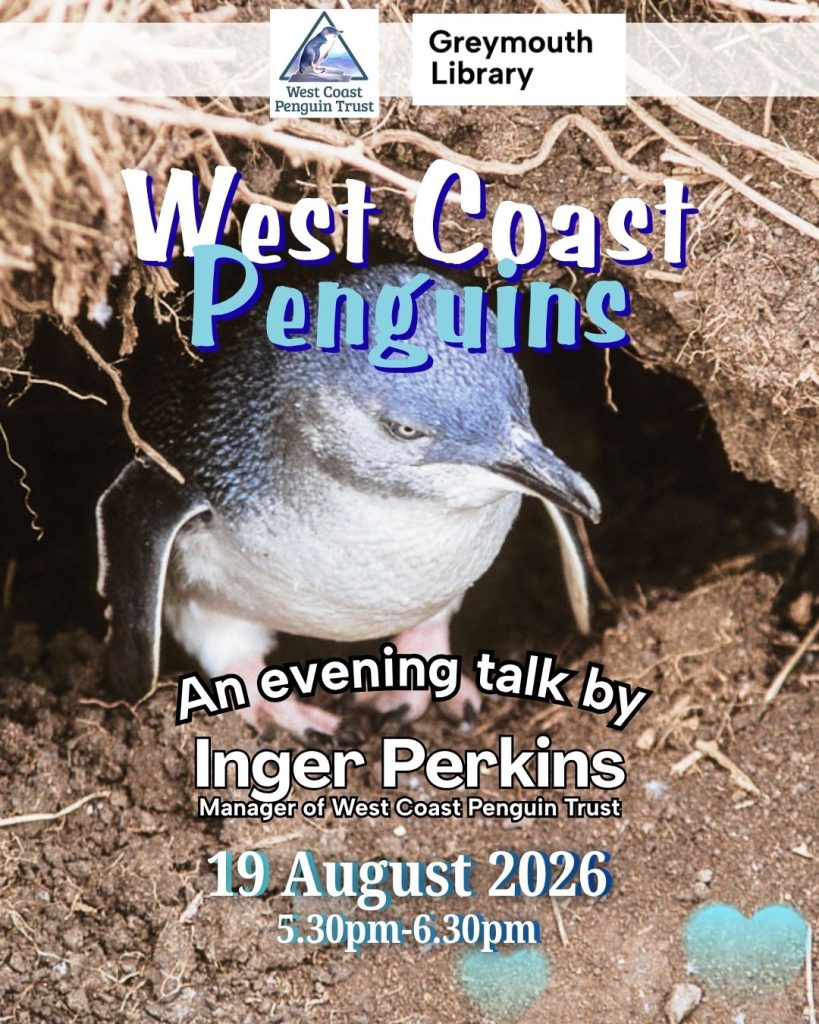
The 2025 penguin season revealed apparent foraging stress on Little Penguins (kororā) nesting here on the West Coast.
From August to September 2025, five tracking datasets were collected from kororā during the egg incubation stage at the West Coast Penguin Trust’s study colony near Greymouth. Tiny GPS and dive loggers recorded where the penguins travelled, how long they stayed at sea, and their dives, giving us their diving efficiency as they foraged beneath the surface.
The results indicated a reduction in prey availability, and highlighted both the resilience and vulnerability of kororā in the face of environmental pressures.

Longer trips, extraordinary distances
During this season’s egg incubation period, we were shocked to find that tracked kororā remained at sea for as long as three weeks, instead of the expected 5-7 days, and travelled extraordinary distances offshore.
One bird reached a maximum home range of more than 120km, far exceeding anything previously recorded in our work. In a typical season, usual home ranges are around 25-30km, as recorded from earlier studies at at the Greymouth study site and at Charleston.


Extreme journeys such as these are a strong indication of food scarcity close to shore and perhaps beyond. Below-average diving efficiency further suggested that kororā are having to expend more energy than usual to travel to possible feeding areas rather than dive for food.
Our findings raised two key questions: what is affecting prey availability on the West Coast, and what does it mean for kororā breeding success?
Changing ocean conditions affecting prey availability
Marine heatwaves and shifting La Niña conditions affected New Zealand waters throughout 2025, with sea surface temperatures remaining above average along parts of the West Coast during the critical incubation period for kororā eggs.

Warmer waters can alter where prey species gather, potentially pushing food further offshore or to greater depths. This can put food beyond the easy reach of kororā, the world’s smallest penguin, who are naturally limited in both diving depth and range compared to larger seabirds.
We suspect that changing ocean conditions may have played a major role in shaping this season’s outcomes.
Click here to read our article about ENSO, the El Niño Southern Oscillation, and how extreme events of El Niño or La Niña are likely to impact penguin breeding success.
What did this mean for the rest of the 2025 breeding season?
Longer foraging trips during the egg incubation stage place extra pressure on both parents: the one hunting at sea, and the one left behind to keep the eggs warm. When prey is harder to find, consequences can ripple through the entire breeding season.

At the study site, breeding success dropped significantly to 52% in 2025, compared to 76% breeding success in the previous year. In other words, a disappointing average of only one chick per nest was raised successfully at the study colony in the 2025 season.
Our data has shown a likely connection between poor foraging conditions during the incubation period and a decline in breeding success later in the season. More nests failed, more chicks died early or were underweight, and as we’ve shown, kororā breeding attempts resulted in an average of only a single chick being fledged instead of two. Kororā faced a difficult year across the board.
Click here for a deeper dive into kororā breeding success in 2025.
Striking evidence of individual resilience
Despite significant environmental pressure, many kororā returned from exhausting journeys to successfully hatch eggs and raise chicks.
We saw them maintain breeding attempts despite difficult feeding conditions that may have stretched across the entire season.

While feeding young chicks, the chick guard stage, penguin parents did not travel as far to find food as they did during the incubation stage. It is imperative that they return quickly to feed hungry chicks. However, some parents headed south in this stage rather than straight out to sea to forage – another pattern we haven’t seen before and perhaps related to an instinct that river mouths have higher nutrients and thus potential for prey fish. One individual travelled over 35km south from Karoro Beach to the Hokitika River mouth.
The resilience of our kororā populations on the West Coast is remarkable. But the results from this season also reflect their vulnerability.

Why long-term monitoring is critical to our research
This season’s findings highlight why ongoing foraging research is becoming increasingly important. Without our tracking data, the offshore conditions faced by kororā this season may have remained largely hidden.
Our study is helping to build a long-term data set that can demonstrate how changing marine conditions might influence breeding success, chick survival, colony growth or decline, and the future of kororā here on the West Coast.
As this data set grows, it will provide us with invaluable long-term insight into the environmental conditions and evolving selection pressures that kororā are facing in our changing oceans.
A more detailed look
There are some key points of interest from the data we have obtained. As you may remember, we trialled a new study site in 2023 and obtained data during the chick guard stage of breeding. We moved our study focus there in 2024 and that year and in 2025, our Ranger, Lucy Waller, with her crew of volunteers, tracked kororā during both incubation and chick guard stages.
The figures during incubation last year/last season were striking, with the maximum home range of over 120km, the penguin taking around 21 days to return. Our earlier research from a Charleston colony indicated a more usual 25-30km home range. As a result, it was a difficult season for this project, with many unsuccessful repeat checks to retrieve loggers on penguins staying out far longer than we had believed possible.
Average dive depths that period were a low 3.6m but were very long, averaging 227m. Each dive includes time at the surface between dives, that is dive and surface time before the next dive. It seems that the penguins tracked during egg incubation in 2025 were travelling great distances to find food. The maximum dive depth recorded for a kororā is an incredible 66.7m but the majority of their dives are understood to be under 30m.
Tracking from our Charleston site did not have the benefit of the dive depth function, so we only have a limited data set by which to assess this. We aim to continue to track kororā during egg incubation and chick guard stages and these future years of research will clarify average and extreme measurements.

Diving efficiency (dive time over dive period including time at surface) is higher during the 2025 incubation stage than in 2024, but lower than average from the data collected at this site. Lower efficiency indicates poor foraging generally with deeper dives. However, in our data, we saw difficult foraging conditions during incubation more clearly indicated by the extreme distances of the foraging trips.
Ideally foraging efficiency, a figure generated by the logger program, would give us a single figure to compare within or between seasons. Unfortunately, it relies on the movement of the penguin, for example when quickly reaching for prey. Interestingly, the loggers have become so sensitive that they now pick up the normal movement of the penguins’ every wing stroke so this figure can not be relied upon.