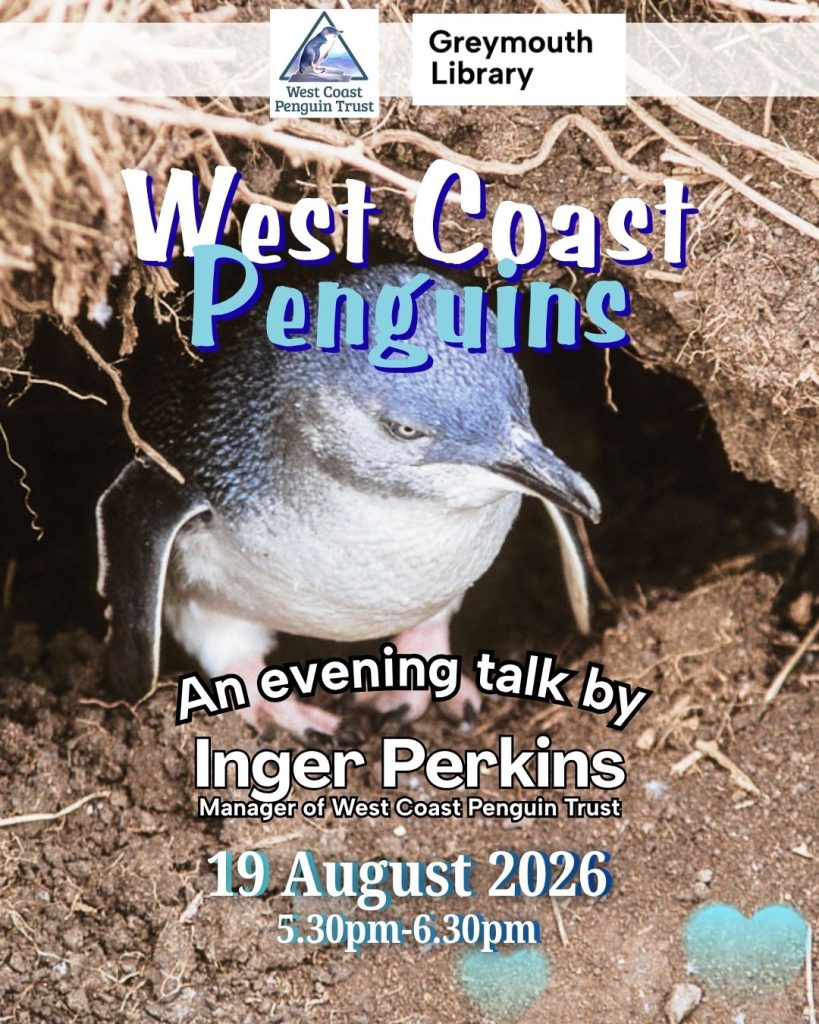
Results from the 2025 penguin breeding season are in. Here on the West Coast, as they do around the world, penguins face ever-changing challenges.
Despite notable losses at key breeding sites, our Little Penguins (kororā) and Fiordland Crested Penguins (tawaki) continue to respond with remarkable resilience.
Your support helps us to understand and respond to the rapidly changing conditions that our penguins face every day and we are enormously grateful.
Here’s some of what we achieved and learned from the 2025 season.
- 31 kororā microchipped this season (now 77 in total)
- Kororā travelled up to three times further offshore than usual, staying away much longer than expected to find food during egg incubation
- Lower breeding success at key sites reflects likely environmental stress
- Joyce Bay colony strongly rebounded in breeding activity
- Tawaki had a stable season despite some unexplained chick deaths
- No stoats seen at the tawaki colony monitored with cameras, demonstrating the success of DOC’s predator control efforts in 2025 (as per our advocacy) and benefitting penguins breeding there.
Little Penguin (kororā): 2025 season updates
31 new penguins microchipped

31 kororā were microchipped this season, bringing the total to 77 across two seasons. We aim to microchip all penguins in the study colony that can be reached, both adults and new chicks each year, once they are big enough, giving us information about individual birds – their arrival, their survival and their return.
Next year, after three years of data collection, this dataset of the demography of these penguins, along with breeding success data, will reach a point where it will start revealing survival rates and colony growth or decline. We will then be able to link that to foraging patterns and changing marine and weather conditions. Critical insights like these are key to guiding and informing future conservation decisions and efforts.
Foraging study reveals surprising findings
Using tiny GPS and dive loggers, we were shocked to find that kororā from our study site travelled up to three times further offshore to find food during the egg incubation stage. It seems they were out at sea much longer than in previous years too. With daily checks on the nests, one took nearly 3 weeks instead of the expected 5-7 days to return. For these breeding birds, that indicated a much tougher time finding food, and a tougher time for the increasingly hungry parent left to keep the eggs warm.


Extreme journeys early in the breeding season are a likely indication of reduced prey availability within the usual foraging range. This may have been due to higher sea surface temperatures associated with weak La Niña conditions. Thermal stratification locally (warm surface water) may lock nutrients and small schooling fish at depth and sediment in the top warmer layer, reducing visibility, essential for penguins to find prey fish. We will be investigating this in the coming months with the help of our scientists and will report back.
Find out more about our foraging study and last year’s results here
Breeding success down from the previous year

Overall, we recorded more nest failures, underweight chicks, and early chick losses than in most previous seasons. At our main study site at Camerons near Greymouth (replacing the ‘Knoll’ site near Charleston), several nests failed, and many produced only one chick from the two eggs laid. With no evidence of predation, and taking into account tracking data from our foraging study, the signs point to environmental stress, probably reduced prey availability early in the breeding season.
Find out about the 2025 kororā breeding season here
The very poor season in 2022 also appears to be related to environmental stress, most likely La Niña conditions that peaked in early spring, part of a rare three-year ‘triple-dip’ phenomenon extending to March 2023. Those conditions led to elevated risks from weather extremes and we saw unprecedented marine heatwaves accompanied by dropping indicators of primary production such as chlorophyll levels, an indicator for phytoplankton, the base of marine food webs. There was a weak La Niña in 2025. We assume these conditions push prey fish out of the usual foraging range of kororā and we will be doing more work to understand that.
Read our article about La Niña and El Niño here
Resilience and recovery

Despite tough conditions, kororā on the West Coast continue to show remarkable resilience. Many penguin parents successfully raised chicks despite significant early foraging challenges. Some colonies, notably at Joyce Bay, experienced a strong rebound in breeding activity compared to previous years. This is incredibly promising evidence of the adaptability of Little Penguins, and indicates that even when hope is fading, colony recovery is possible.
Fiordland Crested Penguins (tawaki): 2025 season updates
A steady breeding season

Encouragingly, camera-monitored tawaki nests at our key study site showed high breeding success rates (~90%), though lower success was found using broader monitoring measures (~65%). Varied results likely reflect monitoring limitations, and the camera-monitored figure will be more accurate.
Monitored chicks appeared well-fed and showed normal growth rates, suggesting that food availability, unlike for kororā, was not a major issue for tawaki this season.

Read our tawaki season news here
Mysterious chick deaths
A small number of healthy tawaki chicks were found dead without signs of predation. Possible causes include parental loss or unknown environmental factors. We aim to continue and improve our camera monitoring so that we can learn more about such scenarios.
Predator management success for tawaki

We have used cameras to monitor the risk of predation of tawaki eggs and chicks since 2014. This season, no stoats were seen at the tawaki colony monitored with cameras, which demonstrates the success of DOC’s landscape-scale predator control efforts there earlier in 2025.
From our previous monitoring, we have concluded that stoats are a major threat to tawaki when these mustelids are in plague proportions, so predator management will certainly benefit penguins breeding there.

What’s happening in 2026?
Over nearly 20 years, we have seen the challenges our penguins face grow, but we have continued to develop our ability to understand those challenges and respond.
Where we have already responded, with penguin protection fences, campaigns to protect penguins from loose dogs, and our much-valued education programme, we have seen reductions in the numbers of penguins killed on the road and by dogs as a result.
With your support, our ongoing penguin monitoring and research efforts will drive improved knowledge of kororā and tawaki, ensuring we continue to make a lasting impact on their future here on the West Coast and continue to work towards our Vision:
“Sea and shore birds, and their habitat across the West Coast Te Tai Poutini, are healthy and thriving.“

Here’s our focus for 2026:
- Continue microchipping new kororā chicks as well as adults that may be new to the study colony or that we haven’t been able to reach before. This will build a long-term dataset that tracks survival and population trends, and, with our foraging study, help us better understand how changing environmental conditions may be affecting West Coast penguins
- Continue our kororā foraging study during egg incubation and chick guard stages
- Upgrade kororā nest boxes at our study site
- Maintain penguin protection fencing that is serving so well to save kororā lives
- Improve tawaki monitoring with better cameras and batteries, and improve our understanding of the variable timing of egg-laying and thus chick rearing to improve our data collection and analysis
- We will be monitoring forecast El Niño conditions and hope that they will not impact penguin breeding success. The last major El Niño event led to almost total breeding failure for tawaki in 2015
- Maintain our education programme, supporting teachers and youth leaders to deliver educational resources through lessons, activities and beach visits
- Work with DOC and District Councils to update beach access signage that will encourage responsible dog ownership: keeping dogs safe reduces the risk of dog attacks on penguins and other wildlife
- Maintain our advocacy programmes to protect penguins, other endangered seabirds, and their nesting and foraging places here on the West Coast
- And we might find a way to celebrate 20 years since the West Coast Penguin Trust was born!