From Vancouver with love
September 24, 2020
KiaOra Vancouver is an ex pat group of kiwis keen to help fellow kiwis feel at home there, keep informed and have fun ... and fundraise for causes like penguin conservation!
From Vancouver with love

KiaOra Vancouver is an ex pat group of kiwis keen to help fellow kiwis feel at home there, keep informed and have fun ... and fundraise for causes like penguin conservation!
KiaOra Vancouver is an ex pat group of kiwis keen to help fellow kiwis feel at home there, keep informed and have fun ... and fundraise for causes like penguin conservation back home! They organise events and social gatherings including Waitangi Day, a Summer picnic, and a Christmas party as well as providing tips and hits for living in Vancouver along with work and travel related information with an overall aim of joining kiwis together. On Saturday February 8th, 2020 Kia Ora Vancouver Community Society hosted their tenth annual Waitangi Day Celebration and Fundraiser at The Blarney Stone bar in downtown Vancouver, Canada. As part of the festivities, their major sponsor Air New Zealand donated a round-trip airline ticket to New Zealand which always helps to draw large crowds. One of the KiaOra Vancouver Directors, Robyn Tucker-Peck explains: "This event continues to attract hundreds of New Zealand expats and honorary New Zealanders in Greater Vancouver to celebrate this significant day in New Zealand’s history and to raise funds for a worthy cause. "We now have a large following of over 4,000 members and our mission is to engage our members with information and services in Vancouver. Supported by Twitter, Instagram and our newsletter, the Waitangi Day event is a targeted audience for New Zealand organisations to introduce their products and to grow or spread their brand. "The success of our 2020 Waitangi Day event was largely due to the contributions of our sponsors, who went out of their way to support us with donations and products. Funds raised were used to help two charities in New Zealand: “Kiwis for Kiwi” who supports the conservation of the kiwi bird in New Zealand, and “The West Coast Penguin Trust” who support the blue penguin." This is the second year that KiaOra Vancouver have supported the West Coast Penguin Trust with fundraising at the Waitangi Day event and they raised a very generous $1500 for the Trust's work with blue penguins through $1 per Steinlager stubbie donations! Trust Manager, Inger Perkins, welcomed the donation: "This donation is very useful and very timely. The Trust has been fortunate to engage Alastair Judkins and his penguin detection conservation dog, Mena, for some essential penguin survey work as well as visits to some of the schools we are working with. This wonderful donation from KiaOra Vancouver is a huge help in bringing Alastair and Mena over for two weeks work with the Trust and we're enormously grateful to Robyn and her fellow volunteers all the way over in Vancouver." Robyn added: "Our Board Directors all share a common goal – Join Kiwis together. We come from all areas of industry, and Business, are all professionals, and volunteer our time. We do this out of love for our New Zealand heritage and the desire to bring like-minded kiwis and friends together for fun, business, socializing and networking." Thank you KiaOra Vancouver!!


Annual report shares highlights
August 26, 2020
Every year, the Trust compiles its achievements, hopes and thanks into an Annual Report from the Chair. This year, Trust Chair, Reuben Lane, looks back on his first year in the role.
Annual report shares highlights

Every year, the Trust compiles its achievements, hopes and thanks into an Annual Report from the Chair. This year, Trust Chair, Reuben Lane, looks back on his first year in the role.
Every year, the Trust compiles its achievements, hopes and thanks into an Annual Report from the Chair. This year, Trust Chair, Reuben Lane, looks back on his first year in the role. Highlights include a successful application to the Department of Conservation Community Fund, giving the Trust three years of security with around 56% of our costs being met and the confidence to employ a permanent part time year round Ranger, and we're delighted to have the very experienced Matt Charteris in that role. The New Zealand Penguin Initiative came into being on the back of work by Kerry-Jayne Wilson and Dr Thomas Mattern to review the research and conservation status of all New Zealand penguins. Our Trust will be working closely with the NZPI team to ensure our methodology and reporting are consistent with those of other penguin conservation groups around the country. That includes our newly established Fiordland crested penguin or tawaki breeding success monitoring programme. Our Education programme led by Lucy Waller has grown strongly over the 2019-20 year and Lucy is now working with 15 Coast schools and other penguin groups outside the region are keen to borrow our education resource. Special thanks go to Wellington Zoo Trust, the West Coast Community Trust, the ANZ Staff Foundation, the Sargood Bequest and the Buller Council Community Fund for their generous financial support of our work last year. Read all the highlights and more detail in our WCPT Annual Report 2019-20.
Birds NZ Research Fund supports Trust projects
August 25, 2020
The West Coast Penguin Trust has been successful in its applications for funding from the Birds NZ Research Fund this year.
Birds NZ Research Fund supports Trust projects

The West Coast Penguin Trust has been successful in its applications for funding from the Birds NZ Research Fund this year.
The West Coast Penguin Trust has been successful in its applications for funding from the Birds New Zealand Research Fund (BNZRF) this year. The fund mainly supports logistic costs and equipment and we sought support for our blue or little penguin foraging study based in Charleston, and our study of tawaki or Fiordland crested penguins in South Westland in order to better understand the threat posed by stoats and the best methods to manage that threat. Birds New Zealand / Te Kāhui Mātai Manu o Aotearoa are the Ornithological Society for New Zealand and their mission is to foster the study, knowledge, and enjoyment of birds. The generous support of their research fund for the tawaki project in particular is especially helpful. Following the 'mega mast' or heavy seeding event seen in Autumn 2019, it is anticipated that stoat numbers will have climbed steeply last summer and remain high through the winter, with the potential for a disastrous impact on tawaki eggs and chicks.

Annual penguin count dates set
August 17, 2020
The Great Annual West Coast Blue Penguin Count will take place this year between 17th and 22nd October, when tides are low in the early morning.
Annual penguin count dates set

The Great Annual West Coast Blue Penguin Count will take place this year between 17th and 22nd October, when tides are low in the early morning.
The Great Annual West Coast Blue Penguin Count will take place this year between 17th and 22nd October, when tides are low in the early morning. If you ever think you would like to make time to get out to the beach for an early morning walk, now's the time to do it with an extra purpose!
- a dose of daylight - helps to reset melatonin levels for a better night's sleep
- fresh air
- exercise
- connecting to nature
- mental well-being
- reminding you why you love the coast, and
- helping to determine where there may be penguins.


Coastal wildlife awareness signs going up at a beach near you
June 23, 2020
New signs alerting beach goers to the possible presence of wildlife are going up across the West Coast region.
Coastal wildlife awareness signs going up at a beach near you
New signs alerting beach goers to the possible presence of wildlife are going up across the West Coast region.
New signs alerting beach goers to the possible presence of wildlife are going up across the West Coast region. Led by the West Coast Penguin Trust, this initiative has the support of every District Council and local Department of Conservation teams. The wording and design of the new signs were developed collaboratively, and Westland Milk Products generously stepped in to pay for them. The new signs ask people to keep themselves and their dogs at least 20m away from wildlife, whether it be penguins, seals, sealions or other sea or shore birds such as banded dotterels and black-billed gulls. Many of these are threatened or at risk and their survival relies on minimising disturbance. Sadly, DOC and penguin trust data collected over the past 14 years shows that dogs continue to be responsible for around 19% of the deaths of blue penguins reported across the region. These new signs are a friendly reminder to keep dogs under close control when walking at the beach during daylight hours, and on a lead from dusk to dawn and through vegetated dunes and coastal scrub. Trust Manager, Inger Perkins, explained: “When penguins have been killed by dogs, generally those dogs have been loose and often free to roam from home or out of sight and control of the owner. And it’s not just penguins that are at risk. Seals have been known to have been savaged by dogs and later had to be euthanized. But even the wasted energy required to escape disturbance by people or dogs could be the difference between survival and death for one of these creatures.” Blue penguins are at the start of this year’s breeding season. They generally lay eggs around July – August and are raising chicks between September and December. In a study of dog control in relation to wildlife on Dunedin's beaches, it was found that it was critical to have consistency in the messaging, and not have a variety of signs from Trusts, Councils and DOC that could present conflicting information. If signage was confusing or conflicting, it was largely being ignored, so the group working on this new project from the West Coast Penguin Trust, Buller, Grey and Westland Councils and with various DOC biodiversity staff from Westport, Greymouth and Hokitika offices have been at pains to work together and come up with a consistent and shared message.


Over 60 penguins saved – statistics show that fence is protecting penguins
June 21, 2020
The penguin protection fence is doing just what it was designed to do say the West Coast Penguin Trust, keeping penguins from straying onto the state highway and being killed.
Over 60 penguins saved – statistics show that fence is protecting penguins

The penguin protection fence is doing just what it was designed to do say the West Coast Penguin Trust, keeping penguins from straying onto the state highway and being killed.
The penguin protection fence is doing just what it was designed to do say the West Coast Penguin Trust, keeping penguins from straying onto the state highway and being killed. The three kilometres of fence installed by the Trust north of Punakaiki, mostly in 2014 and extended past Seal Island in 2015, protects four colonies of blue penguins. Numbers of penguin tracks seen on the beaches in those areas are reported to be increasing by local residents. The Trust has arranged for the colonies to be surveyed later this year to confirm numbers, but, for now, statistics are telling a very positive story. The Trust has worked with DOC to record penguin mortality since 2006 and, before the fence was installed, 56% of all reported deaths were caused by vehicles (154 of a total of 273 dead penguins for eight years). 75% of those deaths on the roads were in Buller (116), largely on the Coast Road. When compared to the six years after the fence was installed, the proportion of penguins being killed on the roads dropped to 37% (49 of 131) and half of those were in the Buller confirming the assumption that the penguin protection fence is working. Looking at the numbers as opposed to percentages, it is clear that penguins are much better off. Without a fence, and based on the figures before the fence was installed, it is likely that around 87 penguins would have been killed on the roads in the Buller between 2014 and 2019 but the actual number is 25. 25 too many of course, but that’s as many as 60 penguins saved. West Coast Penguin Trust Manager, Inger Perkins, is delighted. “The figures really do tell a success story. We knew that six to eight penguins were being killed on the Coast Road every year in this area and we knew we had to do something about it. With support from the community and a variety of businesses and organisations including the NZ Transport Authority, we installed a fence that is saving penguins’ lives. We’re also very grateful to the NZTA for continued support towards its maintenance with the help of WestReef.” The statistics also show that the proportion of penguins killed by dogs has remained at around 20% of reported penguin deaths, but numbers are slightly down. In the eight years to 2014, 52 blue penguins were killed by dogs, around 6-7 a year. Since 2014, there have been 28 blue penguins killed by dogs, under 5 a year. “It’s distressing to know that dogs are still killing penguins despite our efforts over many years to encourage the West Coast community to think penguins and not allow dogs to roam in coastal areas. However, we have been working with all three District Councils and DOC on a new awareness campaign – coming soon – and we appeal to all dog owners to keep their dogs safe and secure when at home. That will keep both dogs and penguins safe.”


It’s World Albatross Day today!

It is the first World Albatross Day today!
How much do you know about these magnificent seabirds? They are fascinating and impressive and we have many species right here in New Zealand! As with most of our beautiful and impressive species, they are in trouble and their numbers are declining. Take today as an opportunity to spend a few minutes learning about them, watch one video of them on youtube, and we promise you won't be disappointed in their magnificence! Read more here. And the inaugural World Albatross Day was featured on National Radio this morning - interesting story, less than 4 minutes: https://www.rnz.co.nz/.../inaugural-world-albatross-day...
Invitation to become a Trust Supporter
June 16, 2020
We have been asked for a way to be a member, a supporter or an annual donor, and we have now come up with a means of joining us to ensure that penguins survive and thrive on the West Coast.
Invitation to become a Trust Supporter

We have been asked for a way to be a member, a supporter or an annual donor, and we have now come up with a means of joining us to ensure that penguins survive and thrive on the West Coast.
We have been asked for a way to be a member, a supporter or an annual donor, and we have now come up with a means of joining us to ensure that penguins survive and thrive on the West Coast. For a minimum donation of just $50 a year you'll become a Supporter, or, for a one-off donation of $500, a Supporter for Life. Supporting us in this way directly ensures that our research and practical projects to protect penguins and their habitat continue. Through our monitoring of blue penguins and tawaki, we are constantly learning about threats to their survival so that we can take and promote the best possible practical solutions. For example the penguin protection fence project was in response to knowledge gained from monitoring blue penguins and maintaining our mortality database over several years and we'll be launching a new coastal wildlife and dog control awareness campaign soon based on clear evidence we have collected. In addition, we have gained invaluable knowledge of the threat posed by stoats to tawaki and we'll be developing that understanding over the coming breeding season to better inform conservation management actions for this species. Becoming a Supporter means not only that you'll be helping us take the lead on penguin conservation, but one lucky Supporter will win something very special in an annual draw. For the first year, our Patron, Craig Potton MNZM, has kindly donated a stunning framed print of one of his beautiful photographs. This one is entitled 'Blue Lake II' and we'll make the draw and give this gorgeous print away when we have thirty new Supporters, so don't delay!

Tawaki Project reports adaptable behaviour for tawaki
May 27, 2020
After six years of exciting and evolving research, The Tawaki Project has released a summary report noting varied foraging ecology and population dynamics across the breeding range.
Tawaki Project reports adaptable behaviour for tawaki

After six years of exciting and evolving research, The Tawaki Project has released a summary report noting varied foraging ecology and population dynamics across the breeding range.
After six years of exciting and evolving research, The Tawaki Project has released a summary report noting varied foraging ecology and population dynamics across the breeding range. The project’s research revealed that the penguins show highly adaptable at-sea behaviour allowing them to forage successfully in open pelagic (West coast), constricted fjord ecosystems (Milford Sound/Piopiotahi), as well as shallow coastal marine habitat (Whenua Hou/ Codfish Island). Satellite tracking of tawaki during the nonbreeding period showed that birds from different breeding regions all travel southwards to forage along the Subantarctic Front. Hence, outside the breeding season, odds are even for penguins from all regions. Any regional differences in population developments, therefore, are likely tied to breeding and reproductive success. The next phase of the Tawaki Project will investigate how the penguins fit into the marine ecosystem of New Zealand’s fjords, and whether Fiordland provides a safe haven for tawaki in an era of substantial global changes. Last season, the team again deployed trackers on tawaki in Fiordland and from birds found on the East Coast moulting and or in need of assistance and found that their movements varied according to starting point or whether they had received rehabilitation. More work is required to draw meaningful conclusions. Read the full report here and enjoy the wonderful photographs too.
Tawaki camera monitoring records first pair of chicks
April 5, 2020
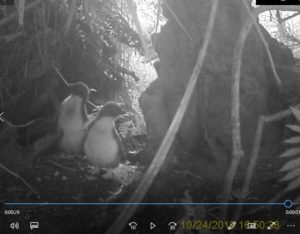
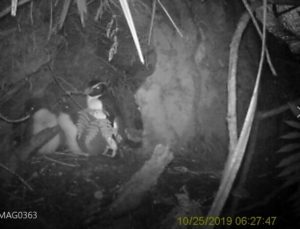
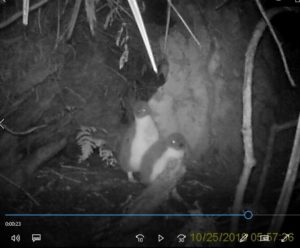
Our experience from the West Coast tawaki nest sites in recent years is that, if tawaki chicks survive, only one chick is usually raised to fledging, but in these photos, from cameras at Gorge River, one tawaki pair has raised two chicks!
Tawaki camera monitoring records first pair of chicks
Our experience from the West Coast tawaki nest sites in recent years is that, if tawaki chicks survive, only one chick is usually raised to fledging, but in these photos, from cameras at Gorge River, one tawaki pair has raised two chicks!
Our experience from our monitoring of West Coast tawaki nest sites in recent years is that, if tawaki chicks survive, only one chick is usually raised to fledging, but in these photos, from cameras at Gorge River, one tawaki pair has raised two chicks! Fiordland crested penguins or tawaki follow the crested penguin approach to breeding, that is laying one egg first and a larger one a couple of days later - which then hatches first (B chick). The larger chick then gets fed first and the second, back up chick if you like, only gets fed if the first one is full, being pushed out of the way by the first one. This almost always means that the chick from the first egg (A chick) dies within a few days of hatching. But not for this nest and in fact not in other areas where food is more abundant. The Tawaki Project has found that some of the pairs monitored at Harrison Cove in Milford Sound were raising two chicks with plentiful food right on their doorstep and had foraging ranges of only 3km. In 2015, during the second year of camera monitoring by the West Coast Penguin Trust in South Westland, it seems that most if not all nests failed at Jackson Head due to chick starvation. The Tawaki Project were tracking some tawaki from Jackson Head and found that they were going significantly further to forage to feed chicks than in other years, for example they averaged a 12km range in 2014 but a 100km range in 2015 during very strong El Niño conditions. (Read their 2016 season report here including reports for Jackson Head 2015 and Milford Sound 2016.) The Trust is fortunate to have Catherine Stewart at Gorge River to maintain cameras in the tawaki colony and has continued this valuable work each season since it began in 2014. This year, for the first time in the six years of our camera monitoring, she has seen two chicks grow up in one nest. She reported: "Nest GR15 raised two chicks, at least to the end of October. Lots of video of B chick being preferentially fed and A chick much smaller during the guard phase, but later they were pretty equal." Catherine has now reviewed all the recordings from 10 cameras and Robin Long, Tawaki Ranger, is compiling a report for the season, collating the Gorge River Data along with breeding success monitoring at two other South Westland sites. The report will be available soon.