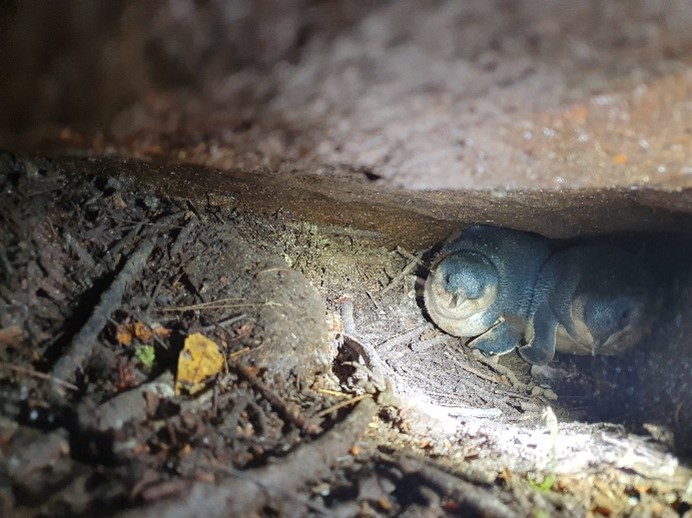
Both Greymouth guides and Greymouth cubs wanted to learn about their local little penguins this term and we were able to help.
Several weeks ago, the trust received separate requests from Greymouth guides and Greymouth cubs. Both groups were keen to learn more about the local penguins - kororā, and to get down to their local beach for a bit of detective work.
Guides and rangers point out penguin tracks
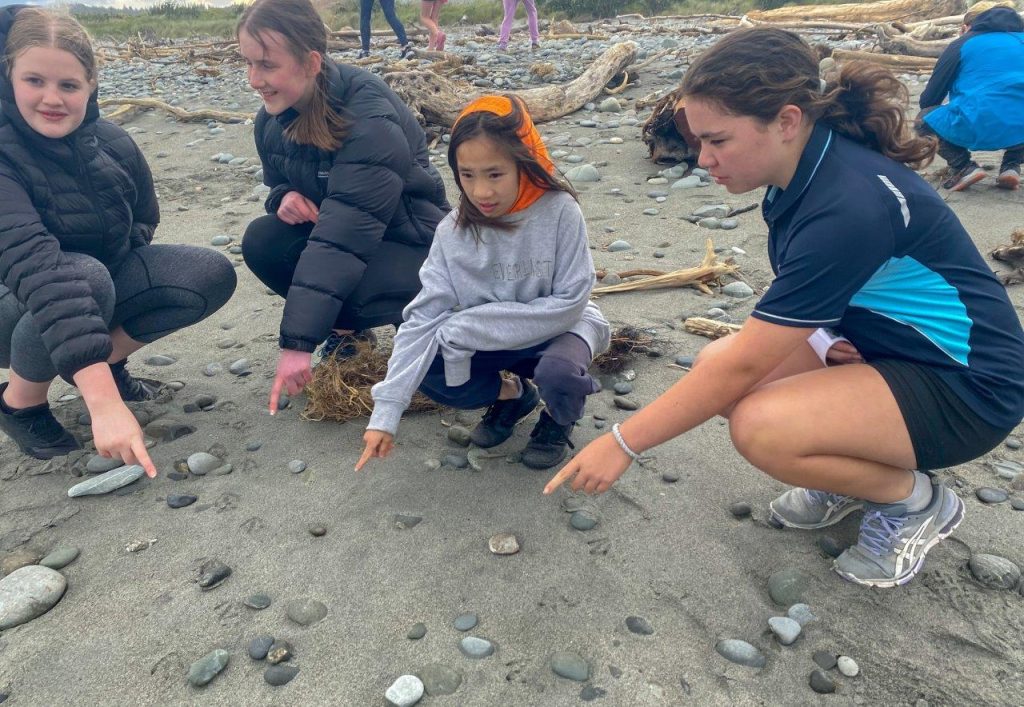
The Greymouth Guide Club Guides and Rangers had a chance to visit Cameron's Beach with Penguin Ranger Lucy Waller on a chilly, windy evening, 19th November.
The group found many penguin tracks on the beach and learned all about nesting, penguin features and behaviour. The Rangers are keen to work with the trust in future to help advocate for the penguins and do more work for their conservation.
The Guides are aged from 9.5 years to 12.5 years and the Rangers are 12.5 years old and up. Guide leader and mother of one of the guides, Joanne Naish said: "They really enjoyed the trip and we could not believe how many penguin tracks we all found. Lucy was informative, knowledgeable and engaging with the girls."
Craig Passuello, one of the leaders of Greymouth cubs, explained that the cubs were working towards their 'Oceans Better World Badge' and were planning a beach clean up.
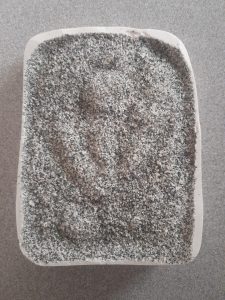
Greymouth cub scouts' plaster of Paris kororā footprint
The group was keen to make a difference, pickup up rubbish, perhaps talk to dog owners, and learn about penguins, discovering their tracks as well as interpreting what other tracks might mean - dogs, people, vehicles - from the point of view of the smallest of penguins.
The trust supplied each group with our educational resource, Blue Penguins and Other Seabirds - activities for exploration and action for schools and community groups, and Mr Passuello decided to give the 'plaster of Paris tracks' activity a go with the cubs, with great results!
Mr Passuello reported: "The weather was perfect and the beach clean up at Cameron’s with the Greymouth Cub Group was a great success. We were even fortunate enough to find some penguin footprints and we took a plaster cast of one. We are to take the cubs back at a later date and get them each to make a cast."
Both groups are keen to work with the trust next year to grow the knowledge of these enthusiastic young people and support their journey to be more nature aware, learning about penguins and the threats to them, and then taking action to help their local kororā thrive.
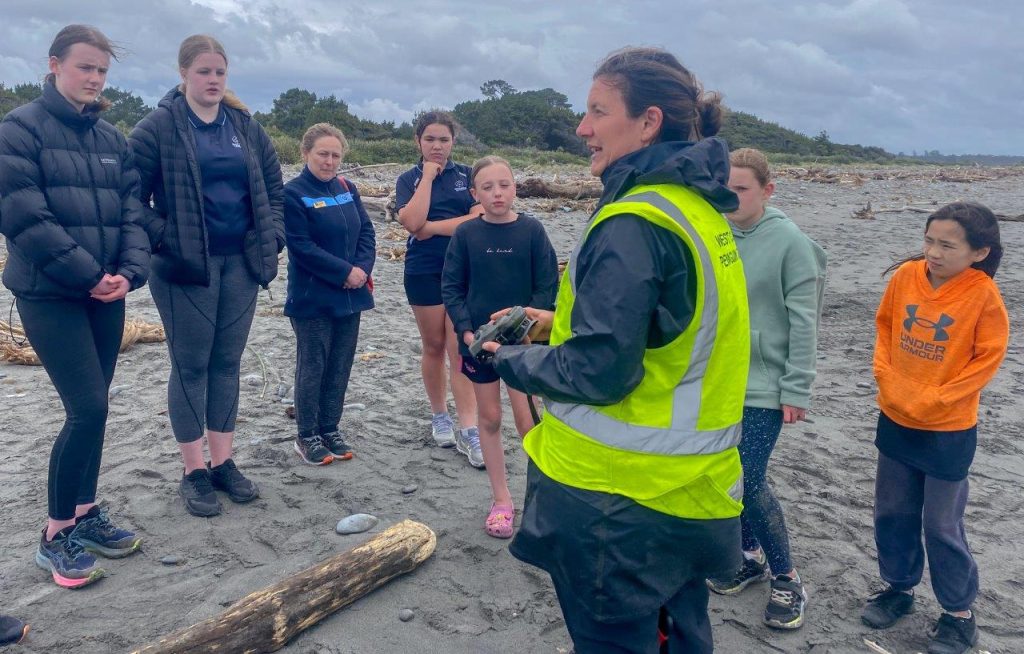
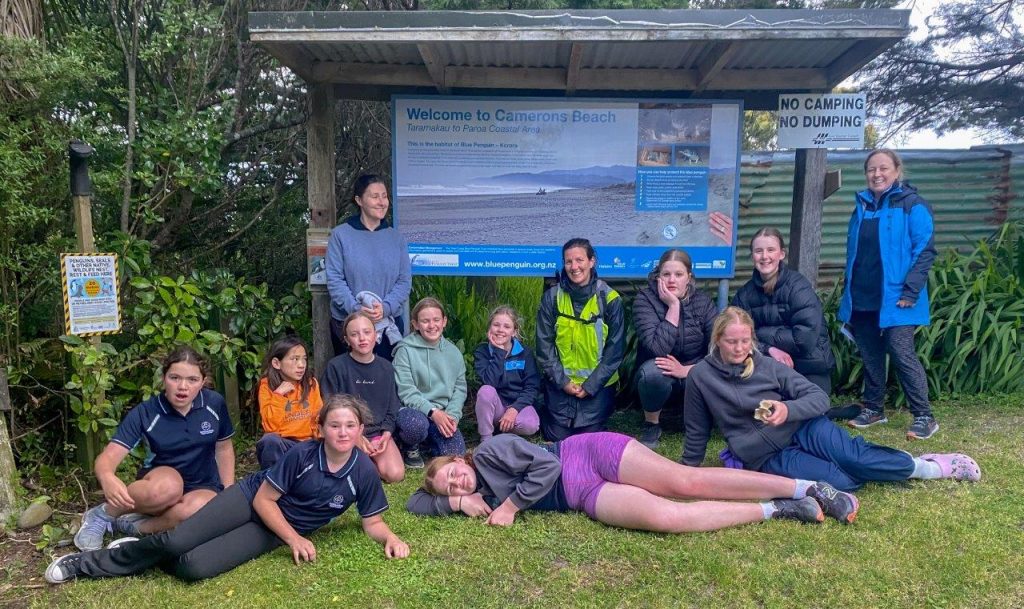
Lucy talks to Greymouth guides and rangers about penguin monitoringGuides, Rangers, their leaders and Ranger Lucy after a blustery field trip
The Trust speaks up for penguins and other threatened seabirds when the need and opportunity present themselves.
Advocacy - speaking up for penguins
An important aspect of our work is advocacy.
We know that you rely on us to speak up for penguins and other threatened seabirds through a variety of processes.
Te Tai Poutini Plan
Most recently, Trust Manager, Inger Perkins, spoke to the commissioners working on the new regional district plan, Te Tai Poutini Plan (TTPP) - so far a 5.5 year process - during the hearing on the final chapter - Ecosystems and Biodiversity. The commissioners need to apply a multitude of laws, policy statements and strategies but also bring their experience and judgement to bear in creating a plan that will meet the sustainable management requirements of the Resource Management Act and support the region for years to come. At the heart of their work is balancing economy and development with environmental protection that is in all our interests.
Our aim is to ensure penguins and other threatened seabirds and the places they breed and feed are protected.
The process to develop TTPP has gone from discussion groups and workshops to a draft plan then proposed plan. We provided feedback, comments, submissions and then further submissions, following up with presenting to commissioners where we believed the case to protect penguins needed further strengthening, often arguing for changes of just a word or a few words that will make a big difference.
Find information about Te Tai Poutini Plan here.
Find out about the purpose of a District Plan and associated processes here.
Consent applications, plans and strategies
The Trust also keeps an eye on resource consent application in coastal areas, ensuring planners and developers are in the know about penguin habitat whether relating to a proposed vast new mine or a small rock protection in front of a single bach.
There are a variety of processes where we believe we must speak up, representing these precious birds, and that extends to consultation on new legislation or new plans and strategies.
For example, last year, we contributed to the review of public conservation land yet to be classified known as stewardship land where it was relevant to penguins and other threatened seabirds.
Also, every region has a Conservation Management Strategy (CMS) that guides the Department of Conservation (DOC) staff and conservation boards. The West Coast CMS was finalised and published in 2014 and each CMS is due for review every 10 years. The West Coast CMS will be revised/rewritten in 2025 and DOC is inviting comments as they get the process underway through a short survey.
This is an opportunity for everyone who wants to see conservation to the fore to have their say. A draft will be published for more specific comment in due course, but we encourage you to have your say, as we will be doing. The last day to complete the survey is Monday 16th December - not long now - please spare a few minutes to add your views. All you need including a link to the survey is here.
The DOC website explains what they are asking: "Before we begin drafting the CMS, we want to hear from everyone who uses, values and enjoys these public conservation areas. By sharing your thoughts and ideas, you can help shape how these places are managed over the next decade."
Funding to maintain our role as advocate
Advocating for penguins, petrels and other sea and shore birds and their habitat takes time and is a cost to the West Coast Penguin Trust. It's an essential part of the trust's work but it relies on donations - grants don't cover that aspect of our work so we need your help to maintain this critical area of work.
Your donations will help ensure that we continue to speak up for penguins, little penguins or kororā and Fiordland crested penguins or tawaki, and of course other threatened seabirds including the Westland petrel or tāiko.
Thank you for your support whether through donations, submissions or your very valuable and much appreciated moral support!
Our vision continues to be that “Sea and shore birds and their habitat of the West Coast Te Tai Poutini are healthy and thriving”.
Our Mission is to achieve the vision through research, education, awareness, advocacy and practical projects, founded on strong science.
Message from the Chair
Robin Long
After three years as Chair, I will be handing the role over to a rotating roster of Trustees at the August AGM, as I have been spending too much time overseas lately to do it justice. Nevertheless, the conservation of penguins and West Coast ecosystems is still a very important part of my life, so I will remain on board as a trustee.
The 2023-24 year has seen a fresh start for the Trust as our Education Ranger, Lucy Waller, took on the additional role of general Ranger, but also a long hard look at our funding streams and the sustainability of our operations.
In my message a year ago, I acknowledged that the Trust has relied upon funding from DOC for half of our operational expenses, and that the DOC funding appears to have dried up. With an increased focus on fundraising and grant applications, we are faring better than expected a year ago and are quietly confident that we will continue to do so. We've had to make some tough decisions around our reduced budget but we believe in the value of our work and the need for it to continue.
We are immensely grateful for everyone's support and hope it will continue as we work towards our vision of a healthy and thriving Tai Poutini.
Thank you, with appreciation for all your help - ngā mihi maioha
Robin Long, Chair, West Coast Penguin Trust, August 2024
Tragically, a loose dog dug a little blue penguin / kororā out of a nest box in late July and killed it. It is almost certain that the same dog killed the partner of the dead penguin a few days later.
This horrific news and the deaths of these penguins should be absolutely avoidable.
The Trust joined DOC, Buller DC and the Carters Beach Reserves Committee at the August Carters Beach market to share information about the presence of penguins and keeping dogs safe and under close control. It was a great opportunity to share information and agree some action.
As a result and with the group's input, the trust designed a flier, improved by compliance and dog control officer Tracy Judd, DOC and Sean Judd kindly printed it and Richard Nicholl, resident and on the Reserves Committee, delivered a copy to every home in the small Carters Beach community.
As always, the key message is that dogs are the biggest threat to penguins at the beach, and it is a simple matter of ensuring they are safe and secure at home and under close control when taken out for exercise.
Sadly, just before this attack, another little penguin was killed at Serpentine beach, near Kumara Junction.
Any beach could be used by little penguins. Any dog not under control, no matter how small and cuddly, could pick up and injure or kill a penguin, or scare it from a nest causing eggs or chicks to be abandoned.
We hate to harp on about this but it seems someone must.
We will be at the Barrytown School twilight gala on Friday 25th October to share the same thoughts and reminders.
Thank you for your responsible dog owner behaviour and sharing the reminder with friends who are dog owners.
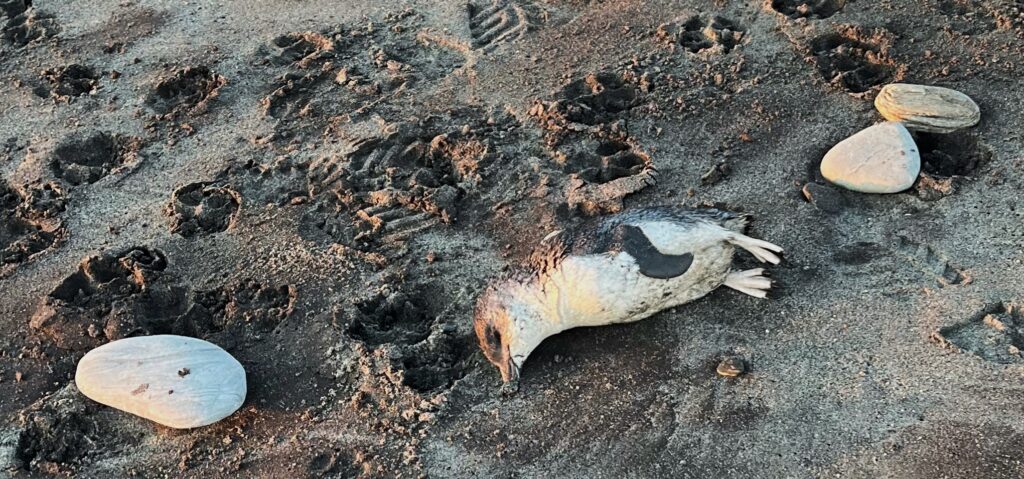
With blood in its mouth and dog tracks all around it, the Department of Conservation (DOC) assumes that this little blue penguin or kororā was killed by a dog last week at Serpentine beach.
With blood in its mouth and dog tracks all around it, the Department of Conservation (DOC) assumes that this little blue penguin or kororā was killed by a dog last week at Serpentine beach.
With blood in its mouth and dog tracks all around it, the Department of Conservation (DOC) assumes that this little blue penguin or kororā was killed by a dog last week at Serpentine beach.
This should be a season of good news as penguins are starting their breeding season.
Instead, DOC and the West Coast Penguin Trust are asking all dog owners to keep dogs under close control at the beach at all times and always out of the vegetated areas. Close control means that there is absolutely no doubt that they will return to you immediately that they are called, leaving anything of interest whether another dog, human, curious smell, food (perhaps toxic) or wildlife.
In fact, that request goes to all beach users.
West Coast Penguin Trust Manager, Inger Perkins, says everyone can help.
“It may be that dog owners are visiting the area and have no idea that there may be penguins present. It can’t hurt to say hello and just note that there may be penguins present so keeping dogs under close control and out of the dunes is important. Also, from dusk to dawn, dogs should be on a lead as penguins could be coming and going across the beach.
“Kororā are the smallest of all penguins, standing just 30cm tall. They are vulnerable to a variety of threats. Your darling dog might just want to play, with no malice at all, but unfortunately the necks of penguins cannot withstand the jaws or a playful shake of a dog of any size.”
With assistance from DOC, the West Coast Penguin Trust has been recording reports of dead penguins since 2006. The location and, where possible, the cause of death is added to a database. The results are clear: 56% of the penguin deaths were due to vehicles on our coastal roads while 19% were killed by dogs.
Penguin protection fences along the Coast Road north of Punakaiki and north of Hokitika, are keeping penguins safe on the sea side of roads and the proportion of penguins killed on the roads has reduced significantly since the fences were installed. However, there are other places where penguins will venture onto roads. If you’re travelling at night, it will be safer for you and give penguins more of a chance if you drive a little slower and allow a bigger gap when following another vehicle.
When it comes to dogs, the proportion of penguins killed by dogs has remained at around 19-20% of all reported penguin deaths. You will probably have seen signs at beach access points reminding us that penguins, as well as seals and other native wildlife, nest, rest and feed in the beach area. The shared advice from district councils, DOC and the Penguin Trust is to stay at least 20m, or four car lengths away, from any wildlife. Dog owners are encouraged to keep dogs on leads after dark and before dawn, and at all times in the dunes and coastal scrub where penguins could be nesting.
Ms Perkins, says:
“Sadly, encouragement is not always enough and if we have shared this message once, we have shared it a thousand times, and yet sadly here we are again.”
Senior Biodiversity Ranger at DOC in Greymouth, Darrell Haworth, explained:
“It is an offence if you’re the owner, or person in charge of a dog that attacks protected wildlife and that dog kills wildlife or injures them so badly they have to be destroyed to end suffering. Anyone convicted of such a charge can be sentenced to prison for up to 12 months, be fined up to $10,000, or both.
“But before looking at compliance options, why not think of the dog? A dog that is allowed to roam is not only a risk to wildlife but also to itself and road users if it wanders on to a road. Keeping your dog safe and secure at home, and under effective and close control when out walking or hunting, just makes sense.”
Ms Perkins added that penguins could be around at any time of year.
“We are approaching the breeding season for kororā as they sort out nests in anticipation of egg laying later this month. However, penguins could be using the beach you share with them at any time of year. You might see their tracks heading out to sea before the next tide washes footprints away.”
As the breeding season begins, DOC staff are likely to visit areas where penguins and other wildlife might be at risk from dogs, Darrell Haworth says.
“We’re keen to ensure the message is clear before we do so, to avoid having to potentially issue any infringement notices.
“Don’t take dogs where they are prohibited and ensure that you always have effective control of your dog - effective control means that your dog will immediately return to you when called.”
DOC has some advice to help dog owners be more responsible when exercising dogs at the beach:
Walk on the wet sand: you’ll be more likely to avoid wildlife
Feet on sand, lead in hand: always have your lead handy in case you need to keep your dog close)
Keep your dog on a lead near wildlife and stay four car lengths (20m) away, and
Help ’em out, give a shout (let other beach goers know when wildlife is present).
DOC has more information on its website.: www.doc.govt.nz/dogs-on-beachesKeeping your dog on a lead more often, especially between dusk and dawn and in vegetated coastal areas, will help keep your dog and wildlife safe
A simple plastic mesh fence is saving penguin lives on the West Coast, keeping little penguins, kororā, safely on the sea side of the Great West Coast Road near Punakaiki.
A simple plastic mesh fence is saving penguin lives on the West Coast, keeping little penguins, kororā, safely on the sea side of the Great West Coast Road near Punakaiki.
A simple plastic mesh fence is saving penguin lives on the West Coast, keeping little penguins, kororā, safely on the sea side of the Great West Coast Road near Punakaiki.
The conservation status of these smallest of penguins is At Risk – Declining. When the West Coast Penguin Trust started out life in 2006, their first goal was to find out whether, and if so why, little penguin numbers were declining in this region. Stoats were believed to pose a threat, as they do for most native birds, so the Trust’s first project was to monitor breeding success in colonies with and without stoat trapping.
At the same time, the Trust established a little penguin mortality database, and that, created and maintained in collaboration with the Department of Conservation ever since, has proved critical in understanding and then managing threats to these penguins.
From both the breeding success monitoring and the mortality database, it quickly became clear that stoats were not a major threat at all. Perhaps plague proportions were not seen in little penguin colonies or perhaps the feisty penguins were better able to protect themselves and their chicks than other birds; that part of the picture remains unclear.
The mortality database, where every reported death of a little penguin was recorded with location and likely cause of death if known, provided the answer.
Many penguins were being killed by vehicles on coast roads. In fact, in the first eight years of record keeping, up to 68% of all reported penguin deaths were on the road, the highest proportion being in the Buller District and on the Coast Road – the state highway. The second biggest killer, at around 19%, was dogs, generally loose dogs that had been allowed to roam freely in coastal areas. That’s another story and one which, after years of awareness and education effort, may be improving.
Within a couple of years of its inception, the Trust team started talking about a fence. Should it be both sides with tunnels underneath so that penguins could safely nest on the inland side of the highway, where they would have nested for thousands of years? Or could they be fenced off the road and nest sites restricted to the seaside of the fence? There was plenty of room for penguins to nest on the seaside, so the cheaper option of a single fence was chosen.
The Trust talked and talked – to DOC and to Waka Kotahi, NZ Transport Agency then – in the hope of gaining their support and funding for the project to build a fence along the highway. Support was forthcoming but not the funding, so, with more penguins being killed every year, the Trust decided it had to make a start. In March 2012, with the help of New Zealand Conservation Volunteers, the Trust erected a trial 100m fence just south of Punakaiki, where sadly the small little penguin colony has pretty much been erased due to deaths caused by vehicles and dogs.
The new fence used a sturdy plastic geomesh manufactured for use under roads and chosen for its resistance to wear, salt and ultraviolet light. It proved successful and durable and plans and fundraising got under way for the 2.6km section of the Coast Road where the highest number of penguins were dying.
Before the 2014 breeding season was underway in July, the new fence was completed and a ceremony to officially close it was held at the beach, led by the then Buller District Mayor, Garry Howard. A year later, a further 300m of penguin protection fence was installed over looking Seal Island, completing the protection of four colonies from vehicles and cutting road kills to zero.
There are two more parts to this story, a review of the mortality data before and after the fences were erected, but also, as the penguins began to thrive again, they started exploring further afield, and, tragically, a penguin was killed on the road in the fenced – or more accurately mostly fenced – area during the 2021 season.
Firstly to the data, and the graphs tell the success story.
Before the fence was installed, 56% of all reported deaths were caused by vehicles (154 of a total of 273 dead penguins for eight years). 75% of those deaths on the roads were in Buller (116), largely on the Coast Road.
When compared to the six years after the fence was installed, the proportion of penguins being killed on the roads dropped to 37% (49 of 131) and half of those were in the Buller confirming the assumption that the penguin protection fence was working.
Pre and post penguin protection fence mortality graphs 2006-2019
Looking at the numbers as opposed to percentages, it is clear that penguins are much better off. Without a fence and, based on the figures before the fence was installed, it is likely that around 87 penguins would have been killed on the roads in the Buller between 2014 and 2019 but the actual number is 25. 25 too many of course, but that’s as many as 60 penguins saved over that period.
Mortality data maps pre and post fence 2006 - 2014 - 2022, fence extent indicated
We should pause at this point to thank those who made the fence possible, providing donations, grants and in kind support, including DOC, Waka Kotahi/NZTA, Maccaferri/Geofabric, Farmlands and many wonderful individuals. The value of the fence in 2014 money was in the region of $60,000, a massive project for the small Trust.
And now to the next chapter. Sadly, the main 2.6km fence was built with three big gaps. Four bach owners occupying legal road managed by Waka Kotahi did not want the fence installed close to their baches. This was beyond the comprehension of the Trust team. If you enjoy living or holidaying in such a fabulous coastal location, surely the wildlife would be part of that experience. But at the time, the main colony areas were protected and the fence was doing its job.
Until 2021. As the penguins thrived with the penguin protection fence behind them, numbers appeared to be growing. And as populations grow, they spread out. After the report of a penguin being killed on the road beside one of the gaps, the Trust knew that the time had come to fill the gaps in the fence. Two of the baches next door to each other had changed hands in the intervening years and the new owners were only too happy to support penguin protection.
With annual support from Waka Kotahi NZTA to help maintain the fence, that funding was redirected in 2023 and WestReef were able to complete a new section of penguin fence near Limestone Creek before the 2023 little penguin season was underway. This was just as well as we subsequently heard that penguins had been rescued from the road in that area the previous year.
Read about that 2023 section of fence here.
The Trust then focussed on a gap towards the southern end of the main fence and that was completed, again with funding from Waka Kotahi NZTA and undertaken by WestReef, before the 2024 breeding seaseon.
Read about the 2024 section of fence here.
There is one more part of the picture to share. When the invaluable mortality database was established, locations of dead penguins were recorded as text and it was clear where most penguins were being killed. With assistance from a very courageous volunteer, making sense of often very confusing records – entries like ‘just past green shed’ or using local names that weren’t on topo maps was challenging! – the Trust has transposed the locations to grid references and from there to geographic information that can be displayed on digital maps.
The data layer can be brought into any map system and the Trust is sharing it with council planners to inform all aspects of the planning process, whether for new plans or consent applications.
Having a very visual data set, showing the locations of around 450 dead little penguins – and sadly growing, is also enabling the Trust to review the worst sections of roads and perhaps consider new fences.
In sharing this success story and hope for the future, the Trust also needs to share a plea. Sadly, grants from DOC seem to be a thing of the past as their funding is reduced for a variety of reasons. The Trust has relied on DOC over most of its seventeen years for around 50% of its costs to operate, with the balance coming from grants and donations. An equivalent amount to the earlier DOC grants comes from volunteers and in kind support, so that every dollar from DOC resulted in $3 of penguin conservation.
Without DOC support, new funding will need to be found to avoid reducing the Trust’s operation. We have an ongoing campaign to maintain the important work that we do, including research, practical conservation projects, education, awareness and advocacy.
Our vision is that West Coast seabirds and their habitat are healthy and thriving. We need you to help us continue to work towards that vision. If you can help, please go to our ‘donate’ page to donate by credit card or bank payment. Thank you for your support.
With penguins apparently thriving on the seaside of the penguin protection fence north of Punakaiki, they were exploring further afield and a gap in the fence urgently needed filling after a penguin was killed on the road there and others have been seen on the edge of the road.
Ten years on, a gap in the penguin protection fence has been filled
With penguins apparently thriving on the seaside of the penguin protection fence north of Punakaiki, they were exploring further afield and a gap in the fence urgently needed filling after a penguin was killed on the road there and others have been seen on the edge of the road.
With penguins apparently thriving on the seaside of the penguin protection fence north of Punakaiki, they were exploring further afield and a gap in the fence urgently needed filling after a penguin was killed on the road there and others have been seen on the edge of the road.
Funding and support from Waka Kotahi NZTA and support and action from Westreef enabled a new section of fence to be installed this week, in time to protect little penguins - kororā as we approach the new breeding season.
Westreef team installing new section of penguin protection fence
This only happened with a lot of work behind the scenes over a couple of years. The gap wasn't critical when the main fence was installed in 2014 but has become so and we are thrilled that the work started and should be completed this week.
The penguin protection fence has saved the lives of dozens of little penguins since it was installed, with several penguins a year dying on that stretch of road before the fence went up.
Left - penguin mortality records before fence installed in this area (2006-2013) and right, afterwards, with one penguin that sadly found its way onto the road through the gap (2014-2023)
This was the second big gap to have been filled in as many years and we are very grateful to the team at Westreef for getting it done both times in the window between breeding seasons.
Maintenance is always needed due to vegetation grown or slips for example. You can help by alerting us to any issues and also ensuring the self-closing sprung gates are not stuck open. Although a few escape hatches have been incorporated into the fence just in case a penguin finds itself on the wrong side, we'd rather they were kept safely on the sea side of the fence.
Funding is also needed to maintain the fence and to work on projects like this that take up a lot of time - your donations are always welcome and help us to make projects like this work. Thank you for your support!
Students take direct conservation action by building and installing nest boxes at a colony near Greymouth.
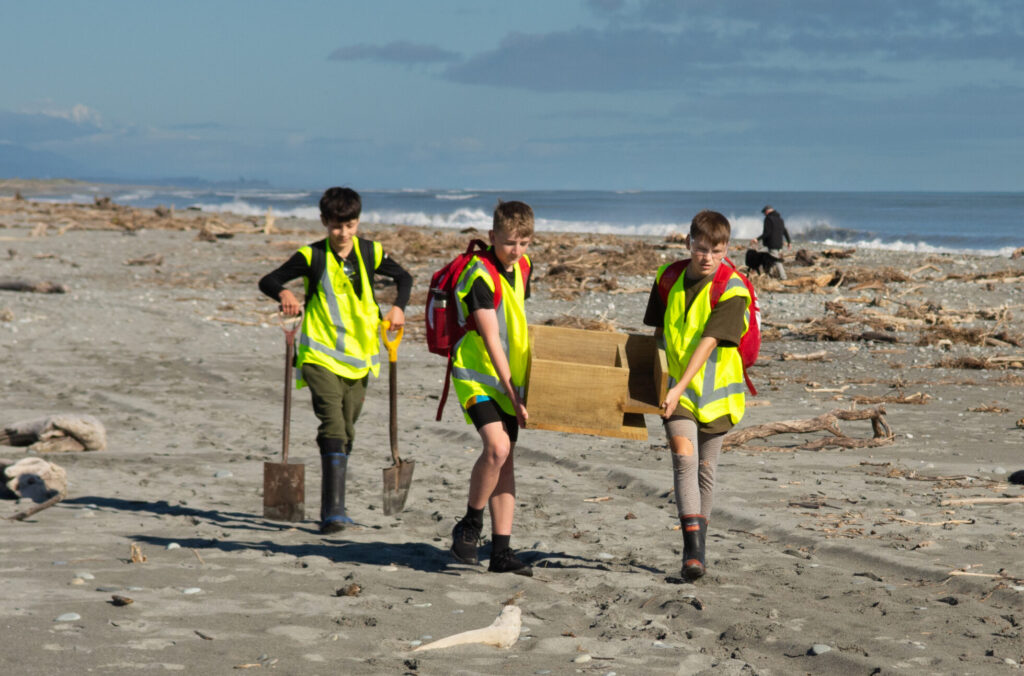
Westland High School conservation students have been taking direct conservation action by building and then installing nest boxes at a colony near Greymouth. The conservation class, led by Deputy Principal, Peter Brailsford, have been exploring the threats to and needs of penguins locally.
One project sought to help penguins up an erosion bank to their nest site near Hokitika (find that story here) and the latest project involved building new nest boxes and installing them in the Camerons coastal area near Greymouth.
Gorgeous day at the beach, getting the new nest boxes to the nest site
The West Coast Penguin Trust's education programme supports teachers to take students on a voyage of discovery, learning about the smallest penguin in the world whose ancestors have been sharing our beaches for some three million years before we arrived. (Read about fossil little penguins here.)
Having learned about the biology of little penguins or kororā, students go on to explore the situation locally and consider what threats there might be to the survival of this threatened species in their back yard. The next step will be to consider taking action!
These conservation students are helping provide shelter for kororā. In the coastal area north of the Taramakau River mouth, erosion over the years has lost nesting habitat and the Guardians of Taramakau and Paroa Coastal Area Trust have installed nest boxes as well as carry out rat and stoat trapping there. New nest boxes will mean that the penguin colony could grow, which will be both exciting and useful as we hope to expand the kororā monitoring and research programme there.
Huge thanks to the students and their wonderful teacher, Peter. Great job team, and such a perfect day for it!
WHS students dig in a nest box
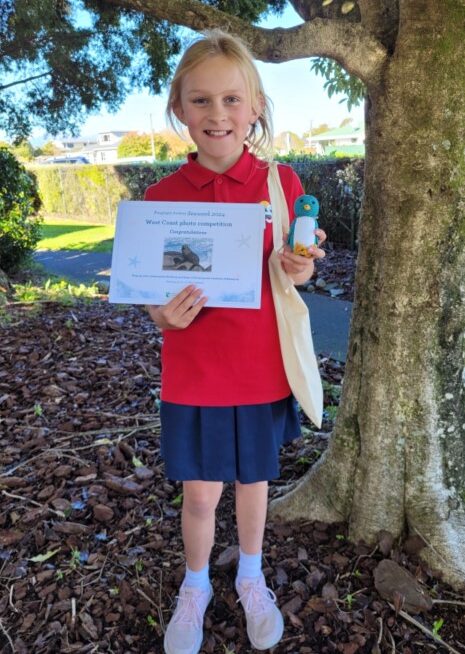
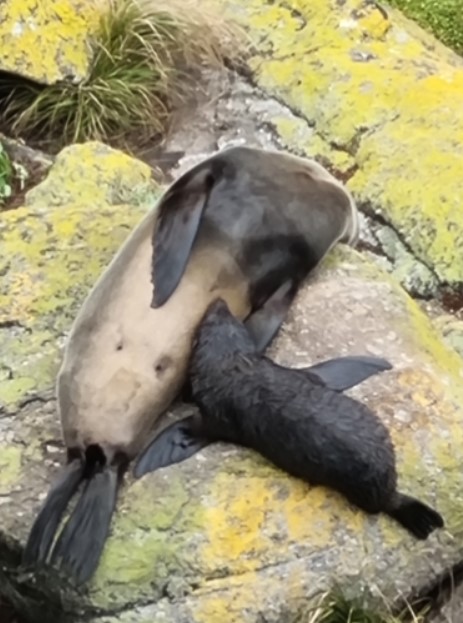
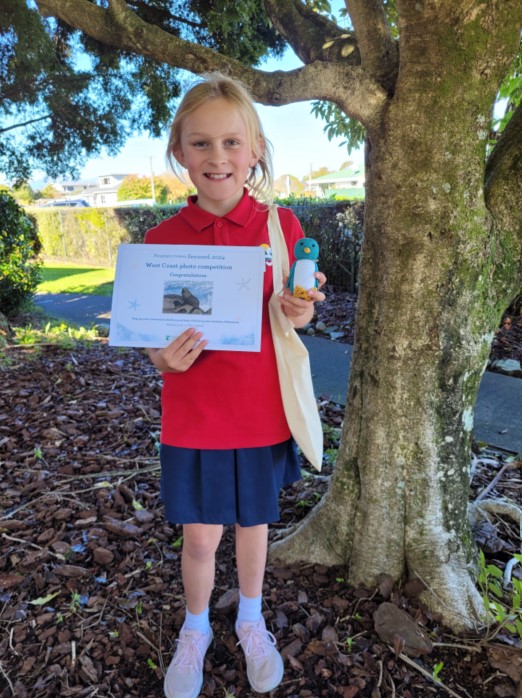
DOC West Coast ran a photo competition to celebrate Seaweek and our wonderful wildlife recently. Hokitika Primary schoolgirl, Elise Caldwell, won the penguin pack prize for her mother and baby seal photo.
DOC West Coast ran a photo competition to celebrate Seaweek and our wonderful wildlife recently. Hokitika Primary schoolgirl, Elise Caldwell, won the penguin pack prize for her mother and baby seal photo.
The national Seaweek campaign is led by the Sir Peter Blake Marine Education and Recreation Centre in March each year and is a campaign that is especially important to the Department of Conservation on the West Coast with our taonga species and Marine Reserves.
This year's theme was ‘celebrating sea creatures of Aotearoa’. DOC held a West Coast regional photo competition again, with some great prizes from very generous local organisations - including the West Coast Penguin Trust who provided a penguin themed prize pack. There was also a prize for the most proactive school (two nights at Ōkārito School House).
Along with other contributors, the Trust helped to judge the photos entered from Coasters as young as 4 or 5.
The winner of our penguin prize pack was Elise Caldwell of Hokitika, who said:
"I celebrate Seaweek by observing lots of sea creatures at Tauranga Bay seal colony. I loved watching this mummy and baby seal snoozing and snuggling together."
Nicky and Peng are on a fabulous adventure, a four year contract in the Falkland Islands where there are penguins ... lots and lots and lots of penguins!
Dream come true for penguin fan and Trust Supporter
Nicky and Peng are on a fabulous adventure, a four year contract in the Falkland Islands where there are penguins ... lots and lots and lots of penguins!
Nicky and Peng are on a fabulous adventure, a four year contract in the Falkland Islands where there are penguins ... lots and lots and lots of penguins!
Nicky Armstrong and her pal, a large cuddly penguin called Peng, have been Supporters of the work of the West Coast Penguin Trust for many years. Nicky's passion for penguins extends to several other large soft toy penguins and in fact a penguin themed home!
So, as a lawyer drafting Government Bills and other legislation in Wellington, when the opportunity arose to work in the Falkland Islands, she not only jumped at the chance, but took Peng along for the adventure too.
She told me: "there are penguins - lots and lots and lots of penguins!! The plan is to go around and meet every one of them in person. We've met quite a few."
Magellanic penguins at Rookery Point: Nicky Armstrong
And here's the latest from Nicky:
We’ve got to the end of our first penguin season. It’s been very penguinny!!
The Magellanics and Rockhoppers have moulted and gone off on their winter holidays. They should be back in about September/October. The Gentoos are here all year although without chicks to feed they can go off to feed for longer periods so they are not all on shore at the same time.
The Kings are also here all year round although the biggest colony – at Volunteer Point – is out of bounds for the winter because the farm track to get there is closed because it gets very boggy. This autumn has been unusually wet so the farmer closed the track at the end of April. Fortunately, a week after my visit.
King penguin selection with one moulting scruffy Magellanic penguin in top left : Nicky Armstrong
Having a good camera and very photogenic subjects, makes it relatively easy to take good photos – but it does result in a ridiculous number of photos. As I sort them out, I'm sharing them on my Flickr page.
Gentoo penguins: Nicky Armstrong
The bird flu reached here this summer but fortunately not widespread. There were isolated birds found in various places but mostly they were birds that don’t normally come ashore here, and it was thought they probably got blown off course because they were ill. One of the outer islands had an outbreak that affected some of the penguins, and there was an outbreak at one of the albatross colonies. But not the kind of mass deaths that have happened in some places.
A lot of the birds have now left for their winter holidays. Some of the marine mammals (who can also get bird flu) – like the elephant seals and sea lions, also go off for the winter. So, for now there is less concern about the flu. But there is considerable concern about next season – all the wildlife will be coming back, some might bring the flu back with them, and others will be coming back still with no immunity. We will just have to wait and see.
As we have mentioned occasionally, this latest strain of avian influenza is a massive concern for seabird and marine mammal conservationists around the world. In our recent news story, we note that, while unlikely to reach New Zealand, it remains a possibility and we - all of us who visit coastal areas and beaches - must be vigilant and prepared. Read more here.
Back to the fabulous photos of penguins. Nicky has kindly allowed me to share her Flickr page here. It's a public page, but you probably wouldn't have found it otherwise and it is well worth sharing with outstanding photographs of not only penguins but other wildlife, landscapes and much more - and if you look carefully, you might see Peng, especially in his yellow/orange Argyle fleecy top! Enjoy!
(Featured image at the top - King penguins at Volunteer Point by Nicky)
Sample of photo albums on Nicky and Peng's Flickr accountRockhopper selection: Nicky ArmstrongPebble Island selection with Gentoo chicks and Sea lions: Nicky Armstrong
Woodpecker Bay Baches
Woodpecker Bay is the bay encompassing Fox River, just north of Punakaiki, on the wild West Coast of New Zealand’s South Island. Our West Coast accommodation consists of 6 self-contained baches situated along the coast of Woodpecker Bay.
Woodpecker Bay offers remoteness and unmatched natural beauty and all of our baches have stunning ocean views and are right on the water’s edge. All baches have fully equipped kitchens and all linen is provided, all of our baches have free and fast WiFi. They are suitable for couples, friends and families looking to explore the beauty of the West Coast.
We are thrilled to have been supporting the West Coast Penguin Trust since 2016.
Funds are raised from visitor admissions and donations. To date, the fund has raised over $5,000,000 to support a wide variety of conservation projects aligned with the work of Auckland Zoo.
We also provide financial resources for external organisations and individuals to carry out vital field conservation work in New Zealand and overseas.
West Coast Penguin Trust's education programme was fortunate to be supported by the Auckland Zoo Conservation Fund in 2024-25. The theme for grant support changes each year and conservation education was the focus of that funding round, fitting our work with schools perfectly.
Westland Mineral Sands (WMS) is proud to announce its partnership with the West Coast Penguin Trust, strengthening its commitment to conserving the unique biodiversity of the region and supporting vital efforts to protect the kororā (Little Penguin). This partnership with the West Coast Penguin Trust reflects WMS’s commitment to balancing operational excellence with environmental stewardship. By prioritising the protection of the region’s precious wildlife, WMS aims to ensure the kororā can continue to thrive in their natural habitat for generations to come.
Partnership announcement, 10th December 2024:https://www.westcoastpenguintrust.org.nz/news/wms-partners-with-west-coast-penguin-trust-to-support-penguin-conservation/WMS Group website:https://www.wmsnz.com/
Our Vision
“Building an intergenerational business for New Zealand”
We are committed to becoming a world leader in critical minerals that advance the shift toward a sustainable future. As we work towards achieving this, we will build a resilient business that benefits our company, the West Coast, and New Zealand for generations to come.
Caring for our local habitat
We are lucky enough to live and work so close to the magnificent coastline which gives our region its name. But we’re well aware it’s not just our home and we consider it our duty to protect the wildlife around us through thoughtful planning of our sites and monitoring in our day-to-day operations.
The West Coast is home to kororā or little blue penguins. We consulted with experts and brought in a penguin-tracking dog to help us identify where penguins are nesting and to help us understand their movements. As a result, we altered our traffic management plan to ensure our trucks were not travelling either side of dusk or dawn to avoid disrupting kororā and their migration patterns.
The purpose of PIC is to pay the pensions of current and future policyholders. This focus delivers value for stakeholders.
Why the PIC penguins?
Emperor penguins have been central to PIC’s brand from the start. That’s because they’re memorable and intrinsically appealing, as well as striking to look at. Emperor penguins embody qualities that the PIC team works hard to emulate every day. They are:
Loyalty
They form lifelong partnerships, working together to protect and nurture their young and cooperating for the wellbeing of the group. Like them, our team invests time in building long-term relationships, showing ourselves to be dependable and dedicated.
Adaptability
Penguins have evolved to live successfully in water and on land, in many different climates. We too are adaptable, staying agile in a changing environment and evolving our business with innovative solutions to meet client needs.
Resilience
There are few animals on earth as tough as Emperor penguins, who withstand long Antarctic winters and endure months without food. PIC stays strong even in the harshest economic conditions and in the face of the most volatile markets.
The West Coast Penguin Trust is thrilled to share a love of penguins with PIC and to have received generous donations from them.
Since 1985 we have returned over $1 billion back to the community, supporting thousands of good causes all around New Zealand.
Our Values
INTEGRITY – Do the Right ThingCOMMUNITY – Stronger Together INNOVATION – Change for the BetterACHIEVEMENT – Strive for Success
A grant was made by the Lion Foundation in 2023 for the Trust's education ranger to deliver our education programme to West Coast schools.
The Brian Mason Scientific & Technical Trust was established in July 1991 to receive and allocate grants for the advancement of scientific and technical objectives in Canterbury and Westland
We are fortunate to have had a grant from this Trust to research and publish information about threats to Westland petrels - tāiko, the information proving invaluable in our advocacy work.
A second grant was awarded in 2022 for little penguin - kororā - foraging study taking place over 2023 and 2024 breeding seasons.
The Sargood Bequest is a charitable trust founded in 1939 by Sir Percy Sargood of the firm Sargood Son & Ewen. Sargood Bequest actively supports community groups and individuals within New Zealand.
The purpose of the fund is to make grants to projects and activities in the Children & Youth, Cultural, Sports & Outdoors, Educational and Environmental categories with a focus on Access, Participation and Inspiration. The majority of grants made by Sargood Bequest are under $5000. The Trustees favour projects to which funds are specifically targeted. From time to time the trust also makes larger grants or pledges over a number of years at the discretion of the trustees.
The Trust has been fortunate to have been awarded grants principally for our Education work, but also for the Community Conservation Symposium.
Westland Dairy Company - formerly Westland Milk Products, based in Hokitika.
Westland. A place, a people, a brand and a spirit.
It is this naturally determined, adaptive spirit that enables our customers to find their edge, to nourish life through our products we have made beautifully for generations.
Westland Dairy Company have supported the Trust to print wildlife awareness signs for beach access points across the region and have been at pains to ensure penguins are protected at and around the pipeline drilling project site on the north edge of Hokitika. Following that project, they remained committed to protecting penguins and have installed a penguin protection fence in the area to prevent penguins being killed on the state highway. They have also generously assisted with the cutting of access ramps for penguins when erosion results in barriers between nest and sea.
The Trust's relationship with Westland continues to grow and their support is hugely valued and valuable.
https://www.westland.co.nz/en/company/purpose-and-values/
Wellington Zoo is New Zealand’s first Zoo and Wellington’s oldest conservation organisation, caring for animals since 1906. The Zoo is a not for profit charitable trust, and has been that way since 2003. The Trust runs the Zoo on behalf of Wellington City Council.
They are proud to be the world’s first carboNZero certified zoo and they became the first zoo to win the Environmental Sustainability Award at the World Association of Zoos and Aquariums (WAZA).
The zoo follows the WAZA commitments to excellence in animal welfare and conservation.
They are also part of the Zoo and Aquarium Association - a regional organisation for zoos in the Australasian region. ZAA manages the coordination of breeding programmes and sets the level of professional standards and practice for members. They are proud to have been accredited under their Animal Welfare standards.
The West Coast Penguin Trust is hugely proud to be a Conservation Partner, sharing an interest in improving the conservation management of Fiordland crested penguins and sharing information and resources that contribute to penguin conservation generally.
Lottery Environment and Heritage provides grants for plans, reports and one-off projects that will protect, conserve and promote New Zealand’s natural, cultural and physical heritage.
The Trust has received grants for three major projects, namely developing an education resource (2015), presenting the Community Conservation Symposium (2018) and the little penguin - kororā - foraging study 2023-2024.
"A great journey is easy, safe and connected. Waka Kotahi NZ Transport Agency is focused on providing one integrated land transport system that helps people get the most out of life and supports business.
"We look after the national transport system with our partners, today and for the future. We’re innovating to make sure the system is efficient and sustainable, unlocking opportunity and keeping New Zealand moving.
"We’re working to deliver our customer promise – great journeys to keep New Zealand moving."
Waka Kotahi NZTA recognised the risk posed to drivers on the Coast Road (state highway 6) at night, where penguins on the road could cause drivers to swerve off the road. Their focus on safety fitted with the Trust's aim to protect penguins and keep them off the road and the Trust was hugely grateful for the agency's support managing the safety of the fence construction project. Waka kotahi NZTA continue to support the penguin protection fence through an annual amount allocated to fence maintenance and extension, and used for this purpose by Westport based road contractor, WestReef, also very supportive of this project.
The Department of Conservation has been the main sponsor of the Trust since its inception and continues to support our work with advice, collaboration and encouragement.
We're very fortunate to work with such a passionate group of people throughout the West Coast region.
The West Coast Community Trust manages its investments and apply income by way of grants for charitable, cultural, philanthropic, recreational and other purposes in Buller, Grey and Westland.
The Trust has been fortunate to receive grants for its education and its awareness programmes.
We know next to nothing about tawaki’s marine ecology, their foraging ranges, which prey species they consume and at which water depths they forage. Critical information is missing to assess how human activities might impact on tawaki, be it ongoing climate change, fisheries activities or pollution of the marine habitat with mining effluents or oil-leaks.
This project will address the key aspects of tawaki’s marine ecology throughout the range from South Westland to Stewart Island.
We will:
examine their foraging strategies across the different marine environments they inhabit
study the spatial distribution of their diving activities to determine whether there are specific hot spots at sea
investigate which marine and terrestrial aspects affect the species’ population dynamics
We also collaborate with the West Coast Penguin Trust to further knowledge and conservation management for tawaki through our collaboration as The Tawaki Coalition.
Enviroschools is a nationwide programme supported by Toimata Foundation, founding partner Te Mauri Tau, and a large network of regional partners. Early childhood centres and schools commit to a long-term sustainability journey, where tamariki/students connect with and explore the environment, then plan, design and take action in their local places in collaboration with their communities.
We are fortunate to be able to use key structures from the Enviroschools programme in our education programme and we join forces with Enviroschools - coordinators and schools - where we can for even greater environmental education outcomes.
The Trust has also worked with Enviroschools for the West Coast to establish a network of environmental educators in the region.