Trust’s 2022-23 Annual Report
October 17, 2023
Our annual report always includes a message from the Trust Chair, the highlights and challenges of the previous year and our enormous thanks to all those organisations and individuals who have supported our work.
Trust’s 2022-23 Annual Report
Our annual report always includes a message from the Trust Chair, the highlights and challenges of the previous year and our enormous thanks to all those organisations and individuals who have supported our work.
Our annual report always includes a message from the Trust Chair, the highlights and challenges of the previous year and our enormous thanks to all those organisations and individuals who have supported our work. This year, our Chair, Robin Long, reinforces our vision - sea and shore birds and their habitat across the West Coast Te Tai Poutini are healthy and thriving - highlights the funding challenges, and embraces the changes over the year. We report on our various projects and, for little penguins or kororā, this meant a poor season apparently linked to a severe cycle of La Niña conditions and the marine heatwaves that it brought last spring and summer. The little penguin mortality database we share with the Department of Conservation has been invaluable in focussing attention on the key threats to these birds. We have now worked on the data so that it can be viewed on maps providing even more value to our advocacy role and for council planners. It also helps focus our attention on areas where extra action may be needed, perhaps new penguin protection fences. Speaking of fences, we were very pleased to add fencing in the Limestone Creek area north of Punakaiki and will need to add more fencing between breeding seasons in the next couple of years to completely protect kororā in this section of the coast road. The report is available as a PDF via the link below, with updates on our Fiordland crested penguin / tawaki work, Cape Foulwind and Seal Island trapping projects, a note about our favourite petrel, the Westland petrel or tāiko, our education programme - much treasured by all the teachers and staff that get to work with Ranger Lucy Waller, and our awareness and advocacy work. We are so grateful to our donors and sponsors all year round but this is our annual opportunity to put it in writing where everyone can see it. Our heartfelt and huge thanks go to these wonderful individuals and organisations that enable us to help understand and better protect penguins and seabirds.WCPT 2022-23 Annual Report (PDF)

St Canice’s School get support from whānau and local businesses to build nest boxes
October 16, 2023
Generous support from whānau and local community helps St Canice's students build twelve nest boxes.
St Canice’s School get support from whānau and local businesses to build nest boxes

Generous support from whānau and local community helps St Canice's students build twelve nest boxes.
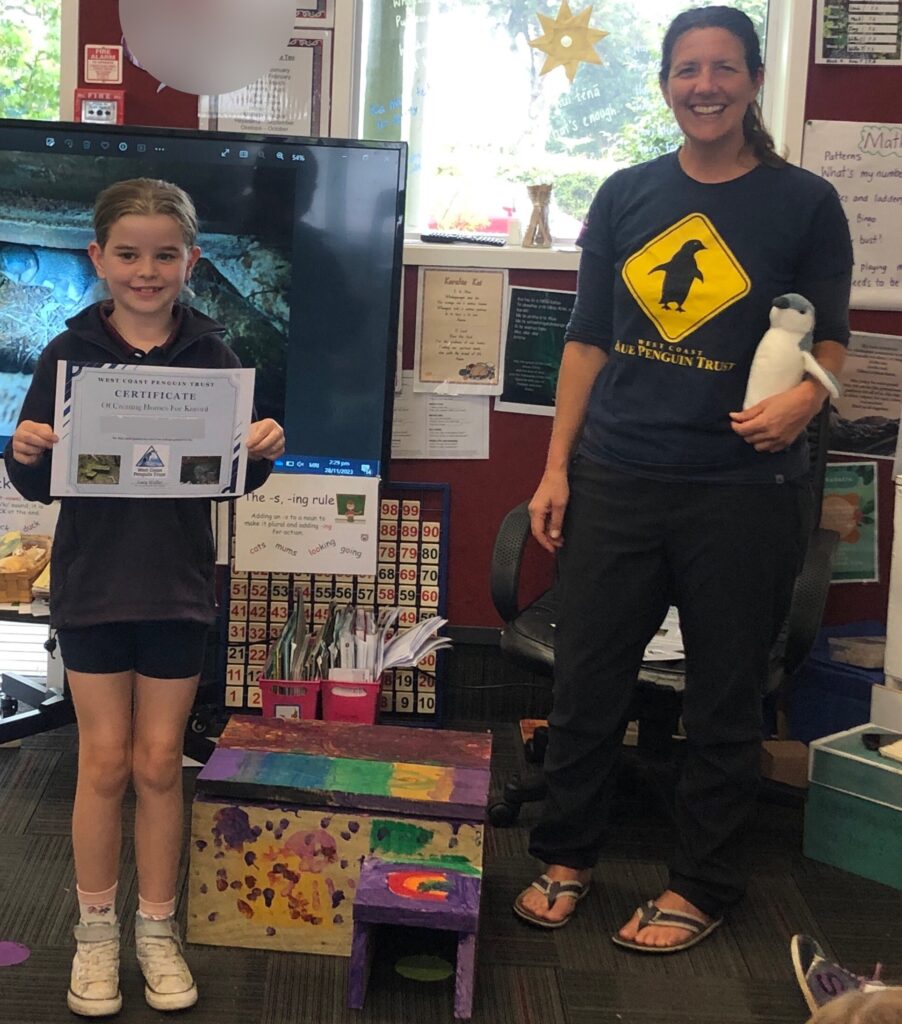
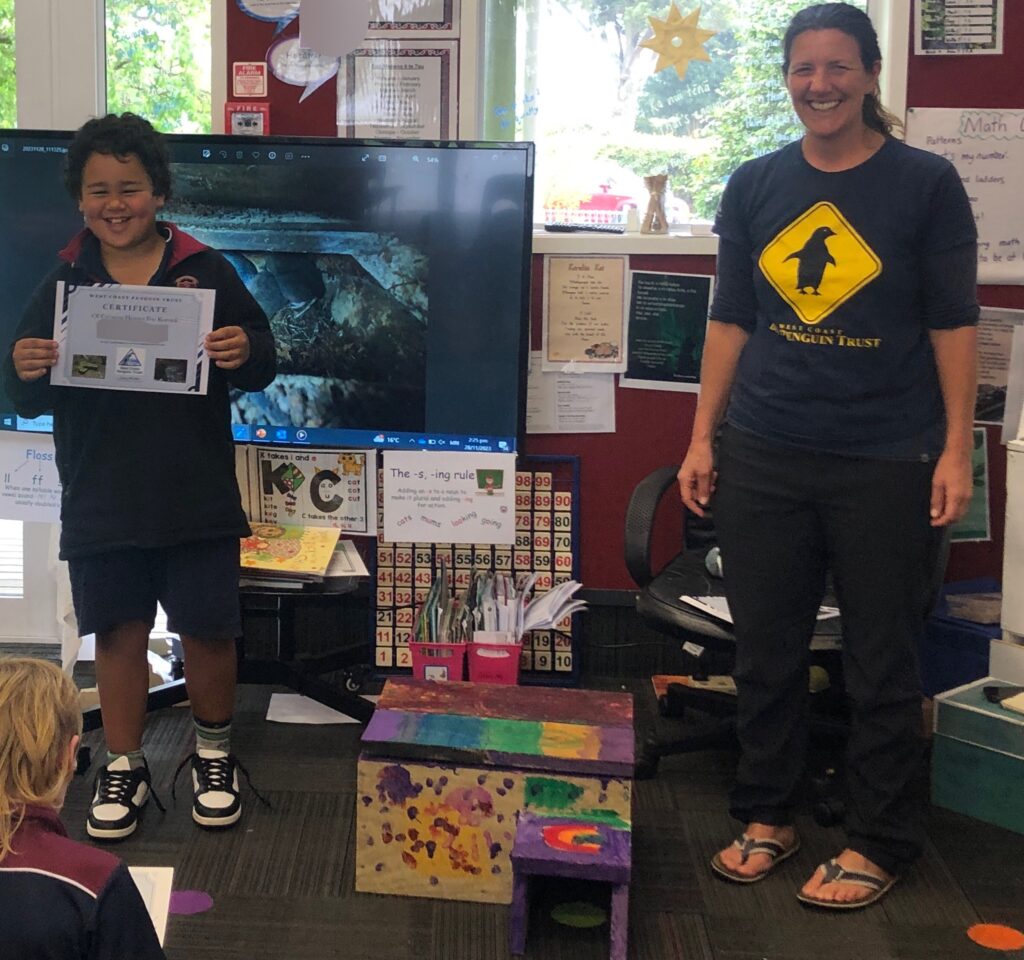
George Atfield's year 3/4 wonder class at St Canice's School in Westport take action for penguins! We had a fun day at the school building nest boxes for little penguins and we were ever so grateful for the generous support we received from whānau and local community. The students did so well with drills, hammers, nails and lots of paint, successfully building twelve nest boxes for the trust to put out where needed in the local colonies for next season. There were no blue thumbs in the process either! We would like to say a big thank you in particular to Laurie Cockfield, Milah's Grandad, who built seven penguin boxes at his house, two of which he funded himself. We would also like to say a big thank you to Jake Orchard (Louie’s Dad), Chris Kennard (Hudson’s Dad) and John Noble (Hadley’s Dad), who all took a group and helped out on the day.Our very grateful thanks go to Steve Atfield at Vetpak, who sponsored the materials for ten boxes.
Vetpak is a New Zealand owned company that manufactures a varied range of Veterinary products for the production animal sector. Products include Rotagen Combo, a non-antibiotic treatment for calf scours effective against Rotavirus and Cryptosporidium, feed additives, sanitation solutions, mineral supplements for sheep, dairy and beef cattle. They also produce a range of specialist nutritional supplements designed for penguin and kiwi chicks.
Vetpak is proud to support the West Coast Penguin Trust and the great work they do. You can visit their website here www.vetpak.co.nz



Celebrating Tāiko Event – Saturday 4th November
October 16, 2023
Come join the Westland Petrel Conservation Trust, DOC, Forest & Bird's Kiwi Conservation Club and the West Coast Penguin Trust for a celebration of tāiko on Saturday afternoon, 4th November.
Celebrating Tāiko Event – Saturday 4th November

Come join the Westland Petrel Conservation Trust, DOC, Forest & Bird's Kiwi Conservation Club and the West Coast Penguin Trust for a celebration of tāiko on Saturday afternoon, 4th November.
Come join the Westland Petrel Conservation Trust, DOC, Forest & Bird's Kiwi Conservation Club and the West Coast Penguin Trust for a celebration of Tāiko (Westland petrel) on Saturday 4th November, between 2pm and 5pm at the Barrytown Hall. The afternoon will be jammed packed with information from local experts on these magnificent birds, including lifecycle, breeding and migration patterns and much more. You will hear about the threats and issues faced by these adventurous and unique local birds and any action you can take to help protect them. Their will be games for children and talks for adults, along with a Q&A session. We hope to see you all there.Promising signs for the 2023 season from the Tawaki at Jackson Head and Knight’s Point
October 16, 2023
Considering the strong El Niño weather pattern this year, officially declared by NIWA recently having forecast it for some time, we have been relieved to see a very different story play out at South Westland tawaki colonies this season compared to 2015 , when El Niño had disastrous effects and all chicks starved. We hope the season continues in this positive way for 2023.
Promising signs for the 2023 season from the Tawaki at Jackson Head and Knight’s Point

Considering the strong El Niño weather pattern this year, officially declared by NIWA recently having forecast it for some time, we have been relieved to see a very different story play out at South Westland tawaki colonies this season compared to 2015 , when El Niño had disastrous effects and all chicks starved. We hope the season continues in this positive way for 2023.
Considering the strong El Niño weather pattern this year, officially declared by NIWA recently having forecast it for some time, we have been relieved to see a very different story play out at South Westland tawaki colonies this season compared to 2015 , when El Niño had disastrous effects and all chicks starved. We hope the season continues in this positive way for 2023. Sarah Kivi and Lucy Waller, our two rangers, took a monitoring excursion down to Haast to do a second check on the colonies at the beginning of this month. The terrain at the two sites are quite different, with Jackson Head being a very exposed coastal, rocky area and Knight's Point being sheltered and very much in the dense rain forest. Burrowscoping is not needed for tawaki in these areas as it is for little penguins in Charleston, as they tend to nest in rocky outcrops and under bushes and trees.


News from the kororā colonies
October 16, 2023
An update from the kororā colonies on the West Coast.
News from the kororā colonies

An update from the kororā colonies on the West Coast.
Our fortnightly monitoring has continued this year at our little / blue penguin Charleston colony and a couple of checks a season for our other sites, Whitehorse Bay, Bullock Creek, Punakaiki River and Joyce Bay. It has been a late start for the Nile River colony, with some eggs laid in August, as reported to you all in the last newsletter, but then sadly abandoned by the next check. Now we have a mixture of incubating birds, new chicks and even post-guard chicks (when both adults leave the chicks to forage for food). Last year's breeding success was low, probably due to the extreme marine heatwaves brought about by La Niña conditions, and now, with a new El Niño fully established, we are watching carefully to see what effects it may have on this year's season. Further south, at Camerons Beach south of Greymouth, we have a similar story, but with more chicks just entering the post-guard stage. We will continue our monitoring efforts for the rest of the season and by the Christmas newsletter we should have some more news, hopefully of most chicks having fledged by then.


To South America and back – the Westland petrel annual migration
August 18, 2023
To South America and back - the Westland petrel annual migration
To South America and back – the Westland petrel annual migration
To South America and back - the Westland petrel annual migration
A Department of Conservation team, with field work led by Westport based biodiversity ranger, Kate Simister, has been funded to conduct three years of research into Westland petrels / tāiko. The funding comes from the Conservation Services Programme, which monitors the impact of commercial fishing on protected species, studies species populations and looks at ways to mitigate bycatch. The new funding has allowed the work programme to expand to cover a range of new projects not previously attempted with this species. These include:- Understanding burrow occupancy rates in this species to determine how burrow mapping and nest counts can be related to numbers of breeding pairs. In particular how the status of apparent non-breeding birds occupying nest sites changes over time (e.g. are these pairs skipping breeding attempts, failed breeders or do these birds lack a partner?)
- Investigating the diving behaviour of Westland petrels using time-depth records to determine their risk profile from fisheries methods such as surface and bottom long-lines.
- Carry out multi-year tracking of adult birds using Global Location Sensing tags to determine extent of time spent within the New Zealand EEZ and elsewhere in the Southern Hemisphere.
- Track juvenile birds to determine if they migrate to seas beyond New Zealand.
- Testing of different tag attachment methods for GPS or Argos passive integrated transponder tags.

Wilderness Lodge Lake Moeraki welcomes back the tawaki for the 2023 season
August 10, 2023
The first sign of the arrival of tawaki on our beaches each year is a set of footprints by the 4 to 4.5kg male penguins leading from the Tasman Sea across the beach and heading to the coastal forests to start their breeding season.
Wilderness Lodge Lake Moeraki welcomes back the tawaki for the 2023 season

The first sign of the arrival of tawaki on our beaches each year is a set of footprints by the 4 to 4.5kg male penguins leading from the Tasman Sea across the beach and heading to the coastal forests to start their breeding season.
Since 1989 when we opened Wilderness Lodge Lake Moeraki each year at the beginning of July we have welcomed Tawaki/Fiordland Crested Penguins returning to the Lake Moeraki coastal forests to start their 5 month breeding season. They have swum about 2,000 kilometres from their Sub-Antarctic Convergence summer feeding grounds halfway between New Zealand and Antarctica. This is a remarkable journey. Satellite transponder studies by the Tawaki Project (see photo from winter 2020) show they may have swum a total of nearly 10,000km over that 6 month period.
The first sign of Tawaki's arrival on our coast are a set of footprints by the 4 to 4.5kg male penguins leading from the Tasman Sea across the beach heading to the coastal forests. Males are joined about two weeks later by the slightly smaller 3.5 to 4kg female. The pair are both exceptionally chubby in preparation for the demands of the breeding season.
It is so exciting for us to see them meet their mate after an absence in the wildest oceans on earth where they are apart for 6 months or more. They don't show much excitement and just stand facing each other, occasionally mutually grooming and beak touching. Over the next five months, we will closely monitor Tawaki at the South Westland breeding colonies that we have studied and helped to protect for the last 33 years. Penguin numbers counted at our study colonies have nearly tripled over our 33 year study period (see graph below), helped by effective pest control by DOC and ourselves, prohibition of dogs on this coastline and public education and careful management of people by Wilderness Lodges of New Zealand, DOC, the West Coast Penguin Trust and the Tawaki Project.


Dr Gerry McSweeney has been monitoring tawaki or Fiordland crested penguins as they come and go near the Wilderness Lodge he opened back in 1989. Careful recording of numbers of penguins seen throughout the breeding season has developed into an invaluable source of data. In recent facebook posts, which have been picked up by the media including an interview on RNZ recently, Gerry shares the excitement of tawaki arriving, the positive trend in numbers and the joy of being near these handsome birds. We have collected together some of those stories into one place for easy access. 1: West Coast story "Rare penguins swim 2000km to return to the West Coast". https://westcoast.co.nz/news/tawaki-swim-2000km-to-return-to-the-west-coast/
 2: Facebook post: "Compare the numbers of Tawaki penguins counted on our standardised 90 minute trip counts 1996 to 1999 with Tawaki numbers counted 20 years later 2016-2019 (see graph below). Penguin numbers counted approximately doubled over this 20 year period. If the sighting results from 2021 and 2022 are compared with the 2016-2019 figures there has been a further approximately 50% increase in penguin counts compared to the 2016-2019 period. This all points to a very healthy Tawaki breeding population here. Certainly in every wild animal population there will be year on year variation but the overall trend of a growing population is very promising for penguin conservation."
 3: RNZ interview with Dr McSweeney, aired on 'Nights' on 2 August 2023: https://www.rnz.co.nz/national/programmes/nights/audio/2018901039/west-coast-penguins-return-home-after-2000km-trip
4: August 13th - video of tawaki pair having and the first of two eggs - facebook post.
5: Find the latest posts from Dr McSweeney and the wild South Westland coast here on the Wilderness Lodges facebook page.
The West Coast Penguin Trust will be monitoring breeding success in three tawaki colonies this season and will provide updates as they become available.
3: RNZ interview with Dr McSweeney, aired on 'Nights' on 2 August 2023: https://www.rnz.co.nz/national/programmes/nights/audio/2018901039/west-coast-penguins-return-home-after-2000km-trip
4: August 13th - video of tawaki pair having and the first of two eggs - facebook post.
5: Find the latest posts from Dr McSweeney and the wild South Westland coast here on the Wilderness Lodges facebook page.
The West Coast Penguin Trust will be monitoring breeding success in three tawaki colonies this season and will provide updates as they become available.

Wilson’s little penguin – Eudyptula wilsonae
June 27, 2023
A new species of fossil penguin has been named Eudyptula wilsonae after the late New Zealand ornithologist Kerry-Jayne Wilson MNZM, who was an internationally respected seabird researcher and advocate for conservation.
Wilson’s little penguin – Eudyptula wilsonae
A new species of fossil penguin has been named Eudyptula wilsonae after the late New Zealand ornithologist Kerry-Jayne Wilson MNZM, who was an internationally respected seabird researcher and advocate for conservation.
A new species of fossil penguin has been named Eudyptula wilsonae after the late New Zealand ornithologist Kerry-Jayne Wilson MNZM, an internationally respected seabird researcher and advocate for conservation, and chair and scientist for the West Coast Penguin Trust. New penguin species are being found and fitted into the jigsaw of the origins and lineage of penguins by a team from Massey University, Museum of New Zealand Te Papa Tongarewa and Bruce Museum in the USA. This one, related to the little penguin or kororā of today, was found in three-million-year-old sediments in the Taranaki region.

13th Oamaru Penguin Symposium – appreciation for past and emerging scientists
June 7, 2023
Kerry-Jayne Wilson MNZM and emerging penguin scientists were recognised at the recent Oamaru Penguin Symposium.
13th Oamaru Penguin Symposium – appreciation for past and emerging scientists

Kerry-Jayne Wilson MNZM and emerging penguin scientists were recognised at the recent Oamaru Penguin Symposium.
Our late great Chair, Scientist and guide, Kerry-Jayne Wilson MNZM, loved the biennial Oamaru Penguin Symposium and encouraged any of our Trust team to attend if they could. Over the years, the symposium has moved from a little or blue penguin, kororā focus, to other Aotearoa New Zealand penguins, other penguins in far off lands and other threatened seabirds. In May, the 13th symposium was again arranged and presented by Dr Philippa Agnew, Research and Environmental Scientist at the Oamaru Penguin Colony. It was the first symposium since Kerry-Jayne died in March last year and, with the support of Philippa and Dr Thomas Mattern, we were able to acknowledge the tremendous contribution that Kerry-Jayne made to penguin and seabird science and scientists in New Zealand and Australia. To open the symposium, Dr Mattern gave a tribute to Kerry-Jayne and shared a wonderful story of chasing tawaki in Harrison Cove, Doubtful Sound a few years before she died. It's a lovely story and you can enjoy it on this short recording from the symposium on our Vimeo page - or play from the image below. Before she died, Kerry-Jayne published a book that had been in her mind for many years, New Zealand Seabirds - A Natural History. Her Trustees found one remaining copy at Kerry-Jayne's home after she died and thought it would be fitting to present it at the symposium. We agreed that it would go to a young and emerging penguin scientist whose presentation at the symposium stood out. Blake Hornblow was chosen from some outstanding young scientists for his work and presentation entitled Foraging ecology of Tawaki (Fiordland penguin) in Doubtful Sound and a summary of his excellent paper is copied below. Congratulations to Blake and to all the young scientists and all the presenters at a superb symposium.
The Little Blue Bach and a tale of generosity
June 7, 2023
Bach owners Daniel Beetham and his Mum Anna McKay are penguin champions.
The Little Blue Bach and a tale of generosity

Bach owners Daniel Beetham and his Mum Anna McKay are penguin champions.
Bach owners Daniel Beetham and his Mum Anna McKay are penguin champions! We love to share a story of our supporters now and then and Daniel and Anna are overdue for our enormous thanks and appreciation. Based up in Auckland but falling in love with the West Coast, a few years ago Daniel bought a tiny bach, Woodpecker Bay Bach, on the edge of the ocean between Punakaiki and Charleston. His plan was to make it available for holiday bookings and his bach became a star - voted best bach in its first year!